

Many films have shared the name, but for me, The Last Man on Earth is now and always will be the 1964 classic starring Vincent Price. It was the first psychotronic film I ever saw — at the age of 5. And I had nightmares about it for years. Any film that gives children nightmares for years can’t be all bad and is probably really good. The Last Man on Earth is great.
It was the first of at least four feature-length film adaptations of Richard Matheson’s now classic 1954 novel I Am Legend. And it was the only one that Matheson was directly involved in.
Below, I dive deep into this film. Any questions you have should be answered.
The Plot of The Last Man on Earth
Some people don’t like spoilers. It’s weird because no one ever says, “Don’t tell me how Romeo and Juliet ends!” Shakespeare himself tells you in the sixth line of the play, “A pair of star-crossed lovers take their life.” But I am nothing if not accommodating. So I hide the plot from those of you who don’t want to see it although there may be some spoilers in the later analysis.
The truth is, I mostly create the synopses for people who want to write about the films but can’t remember some detail. That’s why they are often long. And also why many people won’t want to see them even if they don’t care about spoilers.
Brief Synopsis
Only one man survives a global virus that turns humans into vampires. Now he spends his days destroying the remaining vampires.
Detailed Synopsis
The film starts at dawn. There are various shots of a deserted city. But then the shots start including dead bodies lying randomly on the ground. Then it cuts to a close-up of a sign, “COMMUNITY CHURCH: THE END HAS COME.”
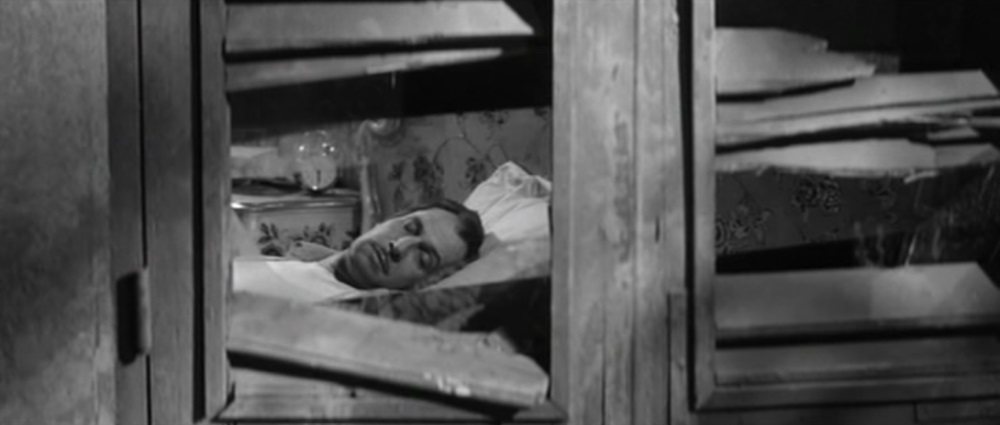
Enter: The Last Man on Earth
The film then cuts to a residential area. We see through a boarded-up window Vincent Price asleep inside a house. His alarm clock goes off: it’s 6:00 am. He stretches and we hear in voiceover, “Another day to live through; better get started.” And as he walks through the house, the credits announce that this is The Last Man on Earth.
In between the acting and technical credits, we learn that he “inherited the world” in December of 1965. It is now 5 September 1968. We know because he’s drawn calendars on the wall and he marks off another day. He goes outside and we see that he has crosses, garlic, and a broken mirror on his front door. Clearly, this is a vampire film.
Starting the Day
Then we see Price move around his house, garage, and yard. He does the following:
- Adds gas to his generator
- Looks at two dead vampires (preyed on by stronger vampires) in his yard
- Drinks coffee (and unseen orange juice)
- Uses his radio to see if anyone is around, “KOKW calling” — on two frequencies — no one is
- Finds that he needs fresh garlic
- Picks up a girl doll, smiles, gets mad, and throws a can (quickly composing himself, thinking, “Reason’s the only advantage I have over them”)
- Checks his map of the city where he hunts the vampires daily (“Eleven kills” the day before.)
- Uses a lathe to make another stake (“just wide enough so their body seal can’t function”)
- Puts the dead bodies in the back of his dark 1956 Chevy station wagon
- Gets in his car and drives off.
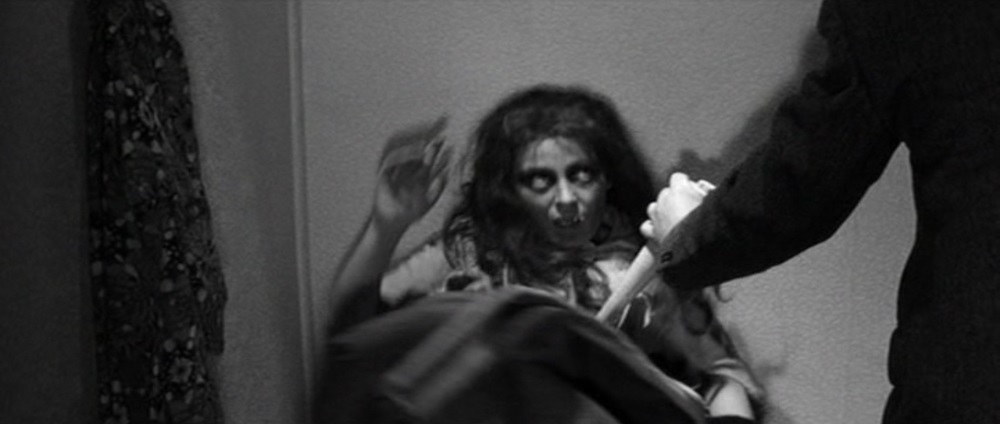
A Day in the Life of a Vampire Killer
As he drives along, he sees many dead zombies but leaves them for the moment because he needs gas. So he drives to an abandoned “CALTEX”[1] truck where he seems to get gas and then drives to a pit that is constantly smoldering.
He puts on a gas mask and then drives to the edge of the pit. He pulls one of the corpses out of the back of the car and throws the body into the pit, pours gasoline into it, and then throws a torch that explodes. And off he goes. He is a busy man.
Next, he goes to a grocery store and into its cooler. There is a generator running it, so this must have been set up by him sometime before. He gathers up a box of garlic and takes it back to his car. Then he goes to pick up mirrors at “Scopel’s for Mirrors.” He chooses 7 of them. You have to wonder: after almost three years, he’s gone through almost 2,000 mirrors (two doors). You’d think he would pick up hundreds at a time so he doesn’t have to go to the mirror store so often. (I’m assuming the vampires destroy them nightly, but maybe not.)
Finally, it is time to go to work. We get a montage of him searching and hammering stakes into vampires (just two, but it seems like more because of the editing). And he takes them to the pit. We see a bit more hunting and then he heads back home because it will be night soon.
When Night Comes
Back at home, the last man on Earth prepares garlic rings and puts them on his two doors. The mirrors have been replaced too.
It is night now. He walks around the house and then puts on a stack of records and some generic-sounding jazz of that period starts up.
Outside, the first vampire appears waving a stick. He is followed by many more. They approach the house and for the first time, we learn the last man on Earth’s name. The lead vampire yells, “Morgan, come out!”

These are not your classic vampires. In fact, they are the prototypes of the zombies that we will see a few years later in Night of the Living Dead. They walk slowly and without great coordination. They aren’t very smart, either. If they were, they certainly would have found a way into Morgan’s poorly protected house.
As the vampires pound on his walls and windows, Morgan grabs one of many bottles of what looks like brandy. He has trouble getting it open, sits down on the couch, and eventually tosses the bottle on the floor out of disgust for his situation. For the first time in the film, Morgan looks afraid.
A Lazy Day
The film cuts to a scene where the last record has ended. It is now quiet. Morgan is asleep on the couch but wakes suddenly from a nightmare. He looks out the window and it is daylight, “Another day to start all over again.” So we’ve seen what Morgan’s life is like and it isn’t pleasant.
Morgan starts preparing for his day — shutting off the lights he left on, turning off the record player. But as he starts to work on the lathe to make new stakes, he becomes overwhelmed. He turns the lathe off and leaves.
Outside, he drives to a small funeral chapel. He sets down next to where the coffin would be placed and thinks how much he misses “Virge” — presumably his wife, as we will find out later.
He falls asleep and manages to sleep away the whole day. When he wakes, the sun is down and the vampires are out!
A Dodgy Night
Morgan rushes toward his car, quickly fending off two vampires. When he gets to his car, it is surrounded by a half-dozen of them. He gets in the car and races away. Of course, this is only half of the challenge.
By the time he gets home, the vampires are already banging away on his house — assuming he’s inside. When they see the car’s headlights, they turn and attack. Morgan pushes away three vampires as he gets out of his car. Then he uses a mirror against his primary antagonist to get into his house. But two other zombies are right behind him.
Morgan manages to close the door but one of the vampires has his arm inside. So Morgan opens and closes the door on the arm until it is removed. Vampires, it appears, feel pain.

Home Movies
After the commotion, Morgan sits down on his couch with an 8 mm film projector and watches old home movies. At first, it is his wife with their newborn daughter. Then friends. A birthday party for the daughter when she’s perhaps 5-years-old. Then there are images of them at the circus and a rodeo.
Morgan begins to laugh. He laughs harder and harder. Then we hear the banging on the house and his laughter turns into crying. Morgan composes himself and thinks, “Three years…” and we dissolve into a flashback.
Flashback: Before the End
The film returns to the birthday party we just saw in the home movie. Morgan has his movie camera and is shooting away. We meet Morgan’s wife, Virginia (Emma Danieli) or “Virge” as he calls her. More important, we meet his neighbor and co-worker, Ben Cortman (Giacomo Rossi-Stuart), who we recognize as the lead vampire who yells at Morgan each night to come out.
Ben shows Morgan an article he tore out of The Telegraph with the headline, “Plague Claims Hundreds: Is Europe’s Disease Carried on the Wind?” Morgan is highly skeptical, but we already know that Ben is right.
The most unbelievable thing in the whole film happens next: the Morgans’ daughter, Kathy (Christi Courtland), wants Ben to do card tricks for her friends. Meanwhile, Morgan and Virge discuss the plague and he admits that it is possible that the disease is carried on the wind.
We also get some exposition. They can see the bacteria that is causing the plague but nothing seems to kill it. Both Morgan and Ben work at a lab that is working on the problem — I assume by this point pretty much everyone who can is working on it.
Some Time Later Things Are Worse
The scene changes to some time later. Morgan is watching Kathy who is ill. He goes to his wife’s room. She too is ill, but she won’t admit it to Morgan. The two of them watch over their very sick daughter and Virge says she is frightened.
Morgan, in the same car we’ve seen him in 3 years later, drives to work at the Mercer Institute of Chemical Research. At work, he and Dr Mercer (Umberto Raho) discuss another dead end: the “bone marrow” theory isn’t right. Morgan notes that the bacteria are living off each other. Ben finally makes it into work and shows that he doesn’t think much of Mercer.
More exposition. The city is littered with dead bodies that are being disposed of in a pit. There is no more communication with Europe. It is now accepted that the germ is airborne. And there are rumors that some of the dead have come back to life. Infected people are tired in the daytime and can’t stand the sunlight. Morgan tries to remain calm, but it’s clear that Ben’s more pessimistic outlook is getting to him.
Things Are Worse at Home
Morgan is watching television and things look bad — the only thing anyone is talking about is the plague. Virge asks if anything is new and he tells her no. So things have been like this for a while.
In the morning, Kathy is blind. Virge wants to call the doctor. Morgan forbids it. He says that if she calls the doctor, the doctor will report it. She asks how he knows it isn’t something else that is wrong with Kathy and he replies, “Blindness is one of the symptoms.” He tells her, in no uncertain terms, that no one is to come into the house. (You can see this one coming.)
As Morgan leaves his house, he sees army men in gas masks taking a wrapped corpse and putting it into a truck. A woman is following after them crying and begging not to dispose of him “in the pit.”
An Empty Lab
Then he goes to pick up Ben. But when he goes to the door, there is a mirror and a ring of garlic. Ben answers the door. He’s clearly sick, but even more, crazy. He won’t leave his house and accuses Morgan of being one of “them.”
At the lab, Morgan is the only one who shows up, other than Dr Mercer. They have an odd conversation where Dr Mercer says, “I won’t deny there’s some strange evolutionary process going on, but mankind won’t be destroyed.” What’s interesting about it is that it only vaguely applies to the movie. It is clearly a callout to the book where Morgan (Neville in the book) is the last man on Earth and there is a new species that has evolved.
Goodbye, Kathy
When Morgan gets home that night, there is one of the corpse-trucks outside. He goes inside and sees Virge sitting facing away from the door. He runs to Kathy’s bedroom and finds only a stuffed animal.
Virge explains that Kathy was reaching out to her and then collapsed. I assume she just died. But Virge called the doctor who called the army who took Kathy’s body away.
Morgan drives to the pit and tries to find the truck with his daughter. He tells one of the men that he’s looking for his daughter and the man replies, “Mister, a lot of daughters are in there — including my own.” This seems to put things in perspective for him. He just stares into the pit.
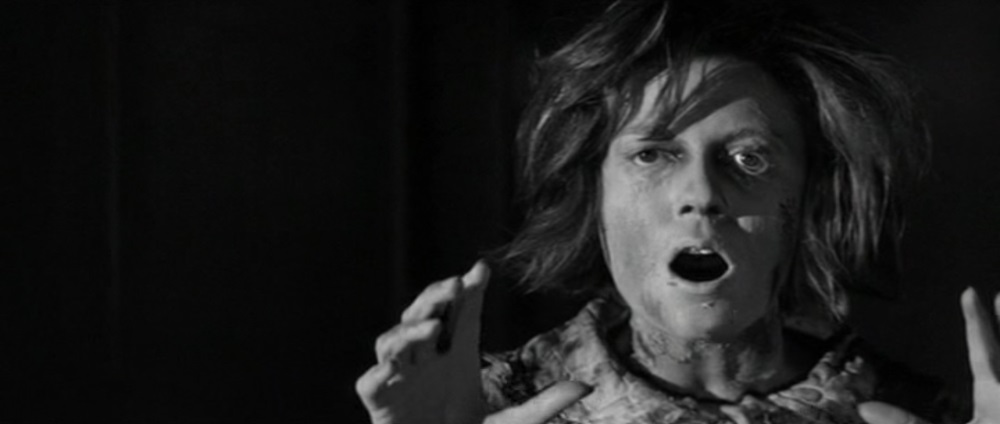
The End is Nigh
Morgan is in the kitchen getting ready to go to work when Virge screams, “Bob! Bob, I can’t see!” He runs to her. But she’s dead.
But he has, what he thinks is a good idea — one last bit of kindness for Virge. He waits until night and drives her corpse out into the countryside. He digs a hole and buries her.
Back at home, he pours himself a drink. But he hears a woman’s voice, barely a whisper, “Let me in.” He looks out the window. Nothing. He goes to the front door.
Whoever is outside is turning the doorknob. He asks who is there. There’s no answer. Finally, he opens the door.
There is a woman in the shadow outside. She walks forward into the light and we see it is Virge, dirty from digging herself out of the ground and very much undead. She says “Robert” over and over as she comes toward him, presumably to drink his blood.
Back to Reality
The film dissolves back to the present. The banging continues. Undead Ben says, “Morgan, we’re going to kill you!”
Outside, we see him and other vampires beating away on Morgan’s car that he was forced to leave outside.
A New Day Dawns
It’s before 6:00, but Morgan is already awake in bed. He goes outside to see the damage. His car is destroyed.
So Morgan goes car shopping. He plays with the idea of getting a convertible but notes that he has to be practical. What he needs is a hearse. He chooses a 1958 Ford station wagon that looks very much like his last car, except that it has four headlights.

Life!
After getting home and parking his new car in the garage, Morgan sees a little dog run down the street and in his yard. It looks like a black poodle-like mutt. Morgan is thrilled to see it, but as he approaches it, the dog runs away. Seeing the first signs of animal life in three years, Morgan chases the dog for almost two minutes of screen time.
While out, he finds three vampires in the park with iron stakes in them. He knows he doesn’t use them, so there must be others alive. He removes one of the stakes and takes it home.
With this new information, he gets on his radio again, more hopeful than ever. But there is no response. Then he hears a dog whimpering outside. He gently gets the dog, which is wounded, and brings it inside.
Night falls and the same group of vampires comes knocking. Inside, we see that Morgan has bandaged the dog. But when the vampires start pounding, the dog runs and hides.
Morgan soothes the dog and tells it what great times they will have together. It’s a sweet scene, but then some of the dog’s fur comes off in his hand and he looks concerned.
Dead Dog Walking
Next, we see the same microscope image of infected blood — this time it is the dog’s. Morgan looks up from the microscope and laughs before becoming glum. He says, “What’s the use?”
Back in the park sometime later, Morgan is digging a small grave. The dog is in a small burlap bag. There is one of Morgan’s stakes driven into it.
The Last Woman on Earth?!
After burying the dog, Morgan sees a woman in the distance, walking toward him. When the two make eye-contact, the woman flees. Morgan chases after her yelling that he isn’t going to hurt her.
He finally catches her and tells her he couldn’t be one of “them” because it’s light out. She is mute throughout. Finally, he says, “Do you want to come with me or do you want to face them?”
He walks away and turns back toward her. Then she follows him.
Coffee Break
Back at Morgan’s place, he’s brewed some coffee. In another part of the house, the woman looks at herself in a mirror suspiciously. She pulls a small box out of her waistband and then puts it back. She finds an old sweater of Virg’s and puts it on over her torn shirt.
Finally, the two of them meet and talk. Morgan offers her a cup of coffee and she accepts. But the woman is clearly nervous. She seems especially bothered by Morgan’s lathe.
We find out that her name is Ruth. She tells him that she lost her husband. (In the book, it was Morgan/Neville who killed him — thinking he was a vampire.) He tells her about his lost wife and daughter.

I’ve Got a Lovely Bunch of Garlic!
Suddenly, Morgan becomes suspicious and goes to the kitchen, grabs a bunch of garlic and shoves it in Ruth’s face. She turns away and says to stop it — finally running to the other side of the room.
(My personal opinion is that Morgan acts like a complete jerk here. If he had suspicions, there were better ways to deal with them. He looks like a horror villain as he does it, which makes sense given the ending.)
Morgan is convinced that Ruth is infected. Ruth insists that she isn’t. She tells him she’s always had a sensitive stomach and then recounts her recent life. She makes a good case for herself, but Morgan seems unconvinced. So she tries to leave, but Morgan won’t let her because it is almost dark and the vampires will be everywhere.
Dinner
After their fight, Morgan cools down and goes off to make dinner for them. Then the vampires start banging on the house.
At the dinner table, Ruth tells Morgan she can’t eat. She notes that he seems unaffected by the vampires. He says that he isn’t afraid of them, but that he takes precautions because there are so many of them.
Ben yells from outside, “Come out, Morgan!” Morgan tells Ruth that Ben was his friend — “like a kid brother” — but that if he ever finds him, he will put a stake in him. This weary callousness seems to bother Ruth.
Why Morgan Is the Last Man on Earth
Ruth asks Morgan why he is immune. His only theory is that many years earlier, he was bitten by a bat while working in Panama. He thinks it carried the disease but that since he got only a small amount of it, he was effectively vaccinated.
They discuss what Morgan will do if Ruth is infected. Morgan offers the possibility of containing the disease. But Ruth is not hopeful and goes into the bedroom and closes the door.
Drugs!
Inside the room, Ruth coughs and seems to be sick. Now when she sees her reflection in the mirror, she quickly looks away.
She takes the box out of her waistband and removes a syringe from it. Just as she is about to inject, Morgan barges in.
He grabs her and the syringe falls to the floor, “You are one of them.” She says that she was and that without the injection, she will be again.
Morgan asks what it is and she tells him it is “defibrinated blood plus vaccine.” (Fibrin is “white insoluble fibrous protein” that seems to have something to do with blood clotting. Just in case you were wondering.)
Ruth Is Not Alone
After some science-sounding mumbo-jumbo, Ruth says, “We’ve had it for some time now.” Morgan freaks out, “We?!”
Morgan demands to know why Ruth is there. She says she was sent to spy on him to find out if he knows any more than they do. The truth is, he knows far less.
Ruth explains that they are in the process of reorganizing society. But Morgan can’t be part of it because he is a “monster” to them. She continues, “You’re a legend in the city: living by day instead of night — leaving as evidence of your existence bloodless corpses. Many of the people you destroyed were still alive! Many of them were loved ones of the people in my group.”
(This speech is a callout to the novel, which ends with Morgan/Neville thinking that in the new society, he will be the boogyman. See below for more.)
Morgan suddenly looks concerned and says that he didn’t know.
She asks if there is any way he can get out of the house. He’s confused. She explains that people from his group are coming after him that night and that she was supposed to keep him there.
And she draws a gun.
Morgan mocks her and tells her to go ahead and kill him. She throws the gun down on the bed and says, “Now you know. What are you going to do?” Then she starts coughing and collapses, seemingly falling asleep.
Morgan picks up the gun and walks away, thinking. He walks to his lathe and picks up a stake.
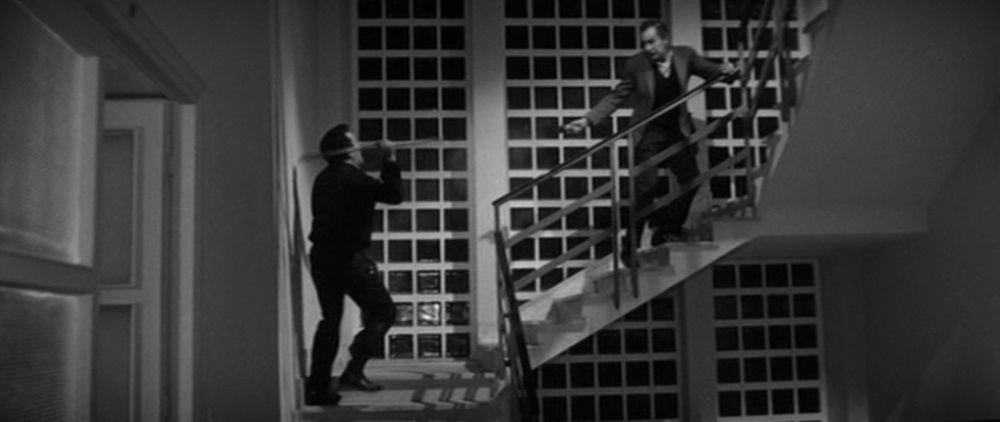
A Cure
The scene dissolves to Ruth on the couch. Morgan is sitting next to her. He is transferring blood from himself to her using a transfusion device that looks very much like something used in the Edwardian period.
Morgan uses it correctly. He pulls up to draw in blood. Then he twists the nob (thus closing the hole leading to his body and opening the hole to hers). And he pushes it back down and turns the nob back. This is repeated a number of times.
Finally, he removes both of their transfusion needles. He also (strangely) removes a rubber tie from her upper arm.
Ruth wakes up and wants to know what is going on. Morgan says that the antibodies in his body have cured her.
Morgan makes her look at a mirror, which she does without problem. Then he has her smell garlic, which she also has no problem with.
Ruth is suddenly agitated. She has to tell the others. She says, “When they come here, there won’t be time for questions and answers.”
Morgan says they can wait until the next day. He is ridiculously cavalier about it. (This relates to the book where Morgan/Neville thinks the group will only capture him.)
Who Forgot to Bar the Door?
Morgan goes into the kitchen to look at Ruth’s blood under his microscope to prove to her that she’s really cured.
Outside, Ben breaks the mirror and opens the door. This is a bit odd, given that we have seen Morgan unbar it every time he’s left the house. It seems odd that he forgot on this of all nights.
When Morgan reenters the living room, he sees that Ruth is gone. We hear her calling from outside, “Robert!”
Morgan rushes outside and finds Ben attacking her. He pulls Ben off.
Why Morgan Should Have Left
As Morgan checks Ruth, jeeps come speeding toward the house.
Ruth tells Morgan to run. But he is stunned.
He watches as the men from the jeeps act like a military unit, killing the vampires with iron stakes.
Finally, he runs — but only to hide.
Ben has made it to the roof of the house. (He’s having a very effective night!) One of the group’s members sees him. They shoot him off the roof with a machine gun. Then they turn their attention to Morgan.
They shine a spotlight on him and he runs.
Ruth tries to stop them, but as she said, there is no time for questions and answers.
The Chase Begins
The jeeps and men on foot follow. Morgan hides in some brush to avoid them.
He probably should have stayed. But he is close to the 22nd Precinct building. He runs into it just as the two jeeps show up.
Morgan uses Ruth’s gun to shoot at them.
As they follow him, he climbs the stairs — killing one of the men. At the top of the stairs, he kills another. (Note: killing more of them is not a good strategy if he would like to plead his case; he will be caught or killed.)
The Armory
Morgan finds the armory and goes in. He locks the door. Then he breaks the glass that holds the arms. But rather than grab a machine gun, he grabs what looks like grenades, but aren’t.
He climbs out the window and makes it to another room via the ledge.
The men break into the room, see he is gone, and turn around — taking a safer route.
Morgan begins throwing the things he got from the armory. They are smoke bombs. They clearly annoy the men, but don’t much slow them down.
The Church
Morgan gets out of the building and runs toward a church. By the time he gets to its door, he’s been shot in the arm and abdomen.
The men continue to chase him inside the church and he manages to avoid them.
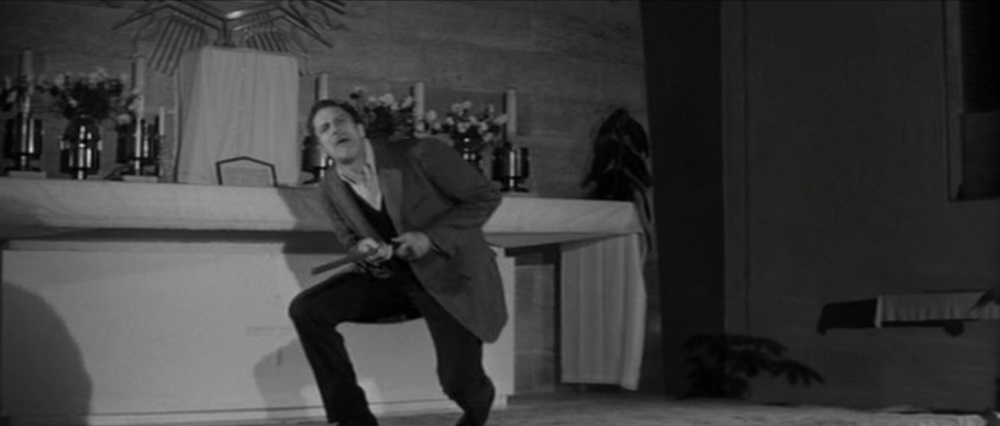
Then a group of women shows up. They walk into the church, just as Morgan runs out just before the altar.
The men slowly approach him from both sides. He backs up onto the altar.
Ruth runs into the church.
Morgan, knowing he is dying lashes out, “You’re freaks! All of you! Freaks! Mutations!” Then one of the men throws a stake at him, hitting him right in the middle of the torso.
As Morgan holds onto the stake running through him, he says, “You’re freaks! I’m a man! The last man.” And he collapses onto the ground.
Ruth Ends the Film
Ruth rushes to him. He tells her, “They were afraid of me.” She replies, “They didn’t know” — recalling Morgan’s statement about killing them.
Ruth slowly walks out of the church. We hear a baby crying. She pats it on the head and says, “Don’t cry. There’s nothing to cry about. We’re all safe now. All safe.” This is an indication that her blood can cure them all.
The film ends on a wide shot of the group in the back and Ruth walking out alone.
Analysis of The Last Man on Earth
Fundamentally, there is nothing terribly different between The Last Man on Earth and Robinson Crusoe. In both cases, the “man alone” tries to maintain the society that was lost. In the case of Morgan, it doesn’t make a lot of sense.
The vampires are killing each other. What is the point of trying to wipe them out? They don’t pose a threat to him. Indeed, if he just moved, they likely wouldn’t be able to find him.
Given that he believes he is the last person on Earth, he must think that humanity dies when he dies. Yet he still goes around disposing of these vampires.
But rather than doing something more edifying, Morgan chooses to do what is, intellectually at least, easy: dispose of the undead — something the government was doing when he was searching for a cure.
In this way, I see it as something of a critique of society. The system must be kept going, even when it makes no sense. It is work for the sake of work. It is a mouse on a spinning wheel.
Schopenhauer’s Paradox

To get a little philosophical, Morgan represents Arthur Schopenhauer’s ultimate paradox. We struggle through today so we can live another day to do it all over again. Morgan is quite explicit about this. At the start of his second day in the film, he says, “Another day. Another day to start all over again!”
But at least in the modern world, there’s a problem with Schopenhauer’s paradox: life is not a complete drag. We don’t just eat to avoid starving; most of us enjoy eating. There is entertainment. There is the interaction of other humans.
Morgan has none of that. There is no joy in his life until the dog shows up and that quickly goes away. We see none of the kind of self-enjoyment that Zac does in The Quiet Earth. And after he has his fun, he works to fix the problem. Killing vampires is not going to fix the problem. Zac is taking measurements and doing calculations. But if he acted like Morgan, he would have become a garbage collector.
Lonliness
Ultimately, I think The Last Man on Earth is about loneliness. Morgan is never so happy as he is after he cures Ruth, “We won’t be alone! We’ll never be alone again!”
I think he goes on killing the vampires because it is the closest that he can come to human contact. (This is explicit in the book where the main thing you could call entertainment for him is staying close to home and searching for Ben; he says he hopes he doesn’t find him, not because he minds killing Ben, but because this pleasant activity will be gone.) But there’s no indication that he understands this.
Even the vampires banging on his door and breaking his windows keeps him in touch with humanity.
The Making of The Last Man on Earth
There are some strange things in The Last Man on Earth.
Evolution in the Novel, Evolution in the Script
A good example of this is the issue of evolution, which is fundamental to the novel.
We always see evolution from the standpoint of the species that survive — because we are one of them. The novel turns it around and shows us what it is like for a species to die off.
We see the issue of evolution in the film, but it is dropped. Dr Mercer notes that there is some evolutionary process going on.
But this idea makes no sense once Morgan cures Ruth. The implication of the ending is that there will not be some new species (or subspecies) but rather, Ruth (via Morgan) will restore humanity.
The Screenplay
This is no doubt due to the screenplay rewrites.
At first, Richard Matheson wrote the screenplay for the legendary Hammer Film Productions. It was going to be produced by Anthony Hinds (son of Hammer’s co-founder William Hinds). But they learned that the British censors would not allow the film. So they sold it to movie theater tycoon and film producer Robert Lippert.
At that point, I suspect the script was quite true to the novel. Indeed, I wonder why it is that no one has made a close film adaptation of the novel. It would work really well. Instead, the films just get further and further away from the source material.
But after Lippert got the script, it was going to be made by Associated Producers Incorporated (API), a subsidiary of 20th Century-Fox, created to make low-budget, “B,” pictures. The budget for these films was generally about $100,000. And they were shot over the course of a week with reshoots rare. So I’m sure the script was rewritten, by William Leicester, with cost in mind. This was the only feature film that Leicester ever wrote. But he was a highly successful television writer — a perfect choice to convert a Hammer film into an API film.
I suspect the film was also changed because it would play better on the drive-in circuit to end with a big chase and Vincent Price being impaled with a pike. The end of the novel is contemplative with a tender scene with Ruth visiting him in jail and giving him some pills that will kill him painlessly before he can be executed. It could be made to work even for the action film crowd. But it is an entirely different location and it really doesn’t change how the story ends.

Rome as Los Angeles
Matheson’s novel takes place in Los Angeles. And that’s where the screenplay was based. This caused some problems as Vincent Price discussed in an interview with Tom Weaver in Attack of the Monster Movie Makers:
The problem doing The Last Man on Earth was that it was supposed to be set in Los Angeles, and if there’s a city in the world that doesn’t look like Los Angeles, it’s Rome. [laughs.] We would get up and drive out at five o’clock in the morning, to beat the police, and try to find something that didn’t look like Rome. Rome has flat trees, ancient buildings — we had a terrible time! And I never was so cold in my life as I was in that picture. I had a driver and I used to tip him a big sum to keep the car running, so I could change my clothes in the back seat.
The Director(s)
According to Matheson, Lippert was planning to get Fritz Lang to direct the film. He would have said that in the late 1950s — probably 1957. Fritz Lang’s last film as director was in 1960 — the exceptional The Thousand Eyes of Dr Mabuse. But by this point, Lang was going blind. Even if he had been willing to make The Last Man on Earth[2] he wasn’t really capable of doing it by the time it was actually shot in 1961.[3]
So, according to Matheson in Return of the B Science Fiction and Horror Heroes, they got Sidney Salkow. But here we run into a problem. On English-language prints of The Last Man on Earth, Salkow is indeed listed as the director. On Italian-language prints of L’Ultimo Uomo Della Terra, Ubaldo Ragona is listed as director. (See below for a comparison of the credits in the two versions.)
The Art of Dubbing
In order to get a handle on the situation, we need to understand how films were made in Italy. The industry there did not embrace sync sound. So films were shot silent and then dubbed in the studio. As a result, the Italians got really good at dubbing.
When dubbing is brought up, people tend to think of dashed-off English dubs of Japanese films — where the words have almost no connection to the movement of the lips. This is not necessary. For example, The Bicycle Theives is beautifully dubbed in its original language.[4] It is also beautifully dubbed in English. I doubt that most people who watch The Last Man on Earth notice that it is dubbed.
My Hypothesis
I’ve yet to find confirmation, but I suspect that Sidney Salkow did direct the film in the traditional sense of the word. My guess would be that Ragona took care of the dubbing. That’s no small feat. It isn’t just a technical matter; it requires directing the actors in their vocal performances. Actually: double the number of actors because different actors did the parts in the different languages. (This isn’t always the case.)
The only American actor in the film was Vincent Price. I assume all the Italian actors dubbed their own parts. But Ruth, played by Franca Bettoia in the film, was dubbed in English by Carolyn De Fonseca. I don’t know who dubbed Vincent Price in Italian, but it certainly isn’t Price. Dubbing is much like stunt work: something the film industry wishes to pretend doesn’t exist. We only know of Fonseca because dubbing English parts for the Italian film industry was almost her whole career and so she’s really well know. And she worked almost her entire career in Italy. (She also died there.)
Matheson wasn’t on the set. And Price didn’t talk about the film that much.
No Joint Directing — At That Time
Of course, it is possible that the two men jointly directed the film. But at that time, the Director’s Guild of America (DGA) would not allow more than one person named as “director.” (This is why the Coen brothers always showed Joel as the director and Ethan as the producer. In fact, all those films were co-directed and co-produced by the two of them — a fact that is backed up by many of the people who worked with them.) So maybe it was a joint project and they simply credited it that way for the sake of the DGA. (I don’t know of an Italian equivalent; many directors outside the US are members of the DGA, however.)
Credits
The credits listed for the US and Italian prints are quite different. So I’ve put together the following table for research purposes.
| Function | US | Italy |
|---|---|---|
| Director | Sidney Salkow | Ubaldo Ragona |
| Assistant Director | Carlo Grandone | Carlo Grandone |
| Screenwriters | Logan Swanson[5] and William Leicester | Furio Monetti and Ubaldo Ragona |
| Script Supervisor | Rita Agostini | |
| Director of Photography | Franco Delli Colli | Franco Delli Colli |
| Cameraman | Alvaro Lanzoni | |
| Assistant Cameraman | Angelo Lannutti[6] | |
| Sound Engineer | Enzo Silvestri | |
| Sound Recordist | Armando Timpani | |
| Boom operator | Bruno Zanoli | |
| Key Grip | Federico Tocci | |
| Chief Electrician | Renato Pietrini | |
| Syncronozation | Fonolux | |
| Editor | Gene Ruggiero | Franca Silvi |
| Music | Paul Sawtell and Bert Shefter | Paul Sawtell and Bert Shefter |
| Orchestration | Alfonso D’Artega | |
| Music Editor | Norman Schwartz | |
| Music Publishing | Nazionalmusic | |
| Art Director | Giorgio Giovannini | Giorgio Giovannini |
| Set Decoration | Brunello Serena | |
| Costume Designer | Lilli Menichelli | |
| Wardrobe | Carmen Frosali | |
| Make-Up | Piero Mecacci | Piero Mecacci |
| Producer | Robert Lippert | |
| Associate Producer | Harold Knox | |
| Production Manager | Vico Vaccaro | Vico Vaccaro |
| Assistant Production Manager | Lionello Meucci | Lionello Meucci |
| Production Supervisor | Luciano Volpato | |
| Production Secretary | Ermete Santini | |
| Soundstage | Titanus | |
| Development and Printing | Istituto Luce | |
| Photographer | Alfonso Avincola | |
| Starring | Vincent Price | Vincent Price |
| Co-starring | Franca Bettoia (Ruth), Emma Danieli (Virgina), Giacomo Rossi-Stuwart (Ben) | Franca Bettoia (Ruth), Emma Danieli (Virgina), Giacomo Rossi-Stuwart (Ben) |
| With | Umberto Raho (Dr Mercer), Christi Courtland (Kathy Morgan), Antonio Corevi (governor), Hector Ribotta (TV reporter) | Umberto Raho (Dr Mercer), Antonio Corevi (governor), Ettore Ribotta (TV reporter), Enrico Salvatore (?), Giuseppe Mattei (leader of the infected), Rolando De Rossi (?) |
Credit Comparison
There are a couple of interesting things here. The first is that, as usual for European films, there is more credit provided. What’s especially interesting, in a general sense, is that the camera operator is a greatly respected position in Hollywood. Yet they are relegated to the five or ten minutes of scrolling credits at the end of the film. So it’s nice to see that these and other artists are more publicly recognized outside the US.
The more interesting thing is that two different people are given credit for the same job depending upon what version we look at: director, screenwriters, and editor. I figure the Italian “screenwriters” just wrote the Italian dialog. (Note: one of them is the Italian director.)
Editing Differences
The differences between the English and Italian edits are small. There are three major differences and one minor. There were two scenes cut from the American version and one scene cut from the Italian version.
The minor difference is at the beginning of the chase at the end of the film. The Italian version has a bit more coverage of the pursuers. It’s just a few seconds and it isn’t clear why they were taken out of the American version.
Major Differences
Here are the major differences.
1. Morgan and Virge
After Morgan goes to the pit to try to get his daughter, he comes home and has a conversation with Virge. This goes on for about a minute and a half.
Morgan is angry that Virge called the doctor. He says he can’t sleep because when he tries, he sees the hellish pitch. He adds that they at least could have given her a proper burial. (This would have been bad as we later find out after Virge dies.)
Virge says they shouldn’t shut each other out, which causes Morgan to soften. The scene ends with Virge saying they could have another child when the pandemic is over.
Here is the transcript (in Italian) of the entire scene:
Morgan: Cerca di dormire. Un po’ non posso appena chiudo gli occhi vedo quella specie di inferno — quel maledetto cratere. Non dovevi chiamare quel medico per nessuna ragione, stavamo morendo. Volevo saltare nelle fiamme. Avremmo potuto almeno darle una dignitosa sepoltura un posto.
Virge: No, ti prego, non torturarti. Ormai è tutto finito.
Morgan: È tutto finito.
Virge: Ma non finito per noi, Bob. Ci siamo noi due. Le volevo bene almeno quanto. Te non costruire un muro fra noi.
Morgan: Sì, hai ragione. Scusa, Virginia.
Virge: Boh.
Morgan: Dimmi.
Virge: Quando tutto questo sarà passato potremmo averne un’altra.
2. Morgan and Ruth
After Morgan tells Ruth about his theory of why he is immune, there is a conversation between the couple. Morgan reiterates what happened with Virge and how he continues to live despite the fact that his life has no meaning.
Note that Ruth moves during the scene. The scene’s absence in the English version is covered by an exterior shot of Ben banging on the door.
Here is the Italian transcript of the scene:
Morgan: Tutti questi anni ho sognato una compagna e ora scopro che in fondo non l’ho mai non ho mai desiderato perché adesso so che il mondo è finito non si può arredare un cimitero e poi chiamarlo casa.
Ruth: Tua moglie…
Morgan: Virginia.
Ruth: Spero non sia morta con…
Morgan: Proprio così esattamente come gli altri è una notte è tornata. L’avevo seppellita, ma è tornato che tuttavia è tornata.
Ruth: Mi dispiace. E ora cosa farai.
Morgan: Sono sopravvissuto, ma non ho più nessuno scopo davanti a me.
Ruth: E perché te la prendi.
Morgan: Perché perché l’uomo ha la possibilità di vivere anche senza una ragione. Ti sorprende. Eppure molta gente viveva in questo modo prima vegetando. Credi che abbia torto lo credi.
Ruth: Non sta a dire. Questo sono molto stanca. Vorrei dormire un po’ adesso. Se non ti dispiace.
Morgan: Puoi usare la mia stanza?
Ruth: Grazie.
3. Morgan and a Gun
In the American version, Morgan kills two of his pursuers as he runs up the steps of the 22nd Precinct building. This is cut from the Italian version. It goes from Morgan entering the building to his entering the armory.
I have a feeling this might have been censored: it does show a guy with a gun killing two people. I rather like this cut because as I discussed in the synopsis: Morgan is acting stupidly by killing them. He is cutting off any hope that they would show him mercy.
It’s clear from the two versions that there was a final edit done by one or more people. It is definitely not true that the two versions had different editors. Small changes were made to some existing final cut of the film.
Continuity and Other “Errors”
Some people get very picky about what they see as errors in films — especially continuity errors. I’m not one of them.
Often Supposed Errors Aren’t
One of the reasons is that “continuity errors” often aren’t. For example, a famous one from The Last Man on Earth is when Morgan first goes to the pit. When he put the two corpses in the back of his car, they were facing inside. When he gets to the pit, the female is facing outward.
Is this a continuity error? You can call it one. But there is much missing action between Morgan leaving his house and arriving at the pit. Perhaps while fueling his car, he noticed that the female corpse had moved and was in danger of falling out. So he rearranged her position. Or maybe she fell out while he was driving and he had to put her back in.
Yes, it’s certainly the case that it was simply better for blocking to remove the corpse with its head facing out. But I have a hard time calling this an error.
Having Fun With “Errors”
I do like that people watch films often and closely enough to notice really minor things.
Unfortunately, they are pretty much always presented as reasons to hate the film. As you will see in the following list of well-known “errors,” most were just decisions that had to be made to make the film better. The Last Man on Earth was a low-budget film. They certainly didn’t have the money to go back and reshoot scenes or shoot necessary transitions that weren’t clear until the film was cut.
So when I see these “errors,” I am mostly impressed. For example, using the same long shot for different purposes is wonderfully creative. It isn’t something to complain about — at least if it isn’t something so obvious it ruined the film for you the first time you watched it.
Corpse Direction
When Morgan is carrying the female corpse from the car in long-shot, her head is on the right side of the screen. But when we see him in medium shot, her head is on the left side. It is also on the left side as it tumbles into the pit.
Again: I can justify it because there is missing time in between. He could have dropped her, picked her up in a more comfortable position, and continued on. But that seems a stretch. It’s odd though. The medium shot seems to have been done at a different time — likely in-studio. So it’s easy to imagine this being a mistake.
But when he throws the dummy double of the woman into the pit, her head is on the same side as in the medium shot. My best guess is that they messed up with the dummy and later added the medium shot to make the actual toss less jarring from the previous long-shot.
The Magic Car
After Morgan throws the torch into the pit and there is an explosion, the car that is behind him is not the car he has at that time: the 1956 Chevy. Instead, it is the 1958 Ford that he got after Ben and his fellow vampires destroyed the Chevy. You can tell because the car suddenly has four headlights.
Clearly, they had meant to have a body dumping scene later in the film.
Left-Hand Side of the Road
After Morgan gets the garlic, we see him driving towards us. He is setting on the right (passenger) side of the car. He’s also driving on the left-hand side of the road.
Clearly, they had the print flipped horizontally. I think they did this so that the dissolve from the previous shot of Morgan driving away from the supermarket to this shot worked better. Regardless, this is an incredibly hard thing to notice. And it isn’t a continuity error. The editor changed the continuity so that the film looked better.
The same thing happens elsewhere, such as at the fairgrounds and when over-sleeping at the church and rushing home at night.
Duplicate Shots
After his vampire hunt, he goes to the pit to throw in his victims. But the long-shot of carrying the new male corpse is actually the original shot of him carrying the female. This is hard to complain about given that it is on the screen for only 2 seconds. It’s actually a clever trick to keep the budget down. It does, however, repeat the “head changes sides” problem.
Something similar is seen when Morgan is driving home after sleeping all day at the funeral chapel. There is a shot of him driving past a bunch of oil spots on the road. It cuts to Morgan in the car. Then we see the car drive by the same oil spots.
But those are not the same shots. They were simply shots taken on the same stretch of road.
These are the same “left-hand side of the road” shots discussed above.
Bus in the Distance
After Morgan has caught Ruth and said she can come with him, for about a second, we can barely see what looks like a bus at least a mile away moving down the road. It takes up 0.03 percent of the screen and there is little contrast between it and the road and land around it. I include this “error” only to show just how pedantic people can be about this kind of stuff.
What’s more, one could justify it since there are beings alive who drive motor vehicles.
Day-for-Night
A number of night scenes — especially of the car driving and the scene where Morgan buries Virge — are shot as day-for-night. And I think at this point, everyone agrees that while day-for-night is at times acceptable, it is never good. Not much care was taken in the day-for-night shots in The Last Man on Earth. And to me, it is the one weak aspect of the film — the one thing that draws me out of it.
Just the same, this was a low-budget film. I certainly understand why they were necessary. And the most critical night scenes were shot at night and generally look good. Still, its an unfortunate stain on a classic film.

Reviews
Today, The Last Man on Earth has a pretty good reputation. The critic and audience scores on Rotten Tomatoes are roughly 70 percent.
That’s not to say that everyone likes it. But these reviews feature the most typical critical sin of not meeting the film on its own terms.
Reputation at the Time
My experience over the years of sharing the films has not been that great either. (And people ask me why I’m cynical!)
At the time of its release, The Last Man on Earth was not well reviewed — when it was reviewed at all. That was also true of moviegoers. It probably is easier to see the film now with a positive attitude because it is clear that it had an impact on later films.
But I discovered the film via Creature Features in the Bay Area in the late 1960s. I saw it two or three times during that period — they played it a lot. And it gave me nightmares for years. So clearly, as a little boy, I thought the film was highly successful.
Thoughts of the Principals
What I’m more interested in now is what the principals thought of it. I’ve only found any mention of its quality by Vincent Price and Richard Matheson.
Vincent Price
Price was fond of the film. He told Lewrence French:
Funnily enough, the picture came off fairly well. I think it was better than The Omega Man, that Charlton Heston did later on from the same story. It had a kind of amateur quality about it… It was an interesting film, a very difficult story to make, to really make. It should be done as a great spectacular, just buy a city and empty it out.
Richard Matheson
Matheson, unlike Price, never missed an opportunity to bash The Last Man on Earth. But mostly he just offered insults and not actual reasons why he didn’t like it. For example, he told John Brosnan in The Horror People, “I thought it was terrible. That’s about the only way you can describe it. I had written a good screenplay but they had someone rewrite it and made it abysmal. [The film] was very poorly done.”
But one thing he said is telling, “Price, who I like as an actor, was completely wrong for the part.” And it’s true: Price is not the character in the novel. But that strikes me as silly. Certainly, Matheson had been around the film business long enough to know how it worked. But even when talking about his first screenplay, The Incredible Shrinking Man (based on his novel The Shrinking Man), he was not happy that his screenplay was rewritten.
So in this regard, I think that Matheson was unhappy that his novel wasn’t realized on the screen as he had hoped. I appreciate that, but I don’t think it says much about The Last Man on Earth.
Another thing about Matheson that is worth noting is that he was extremely conservative about cinematic art. That’s not surprising: most writers are. But in Matheson, it took the form of judging films based on little more than their professionalism. In this way, he was probably best served by television. But I’ve long wondered what he thought of the production for The Twilight Zone episode “The Invaders.” It’s a classic episode but it succeeded despite the very silly spacemen.
Seeing The Last Man on Earth
Some prints of The Last Man on Earth are in the public domain. There is a high-quality print on Archive.org.
But if you love the film, you really should buy the colorized version. I say that because it comes with an excellent black and white print of the film.
I have vague philosophical concerns about film colorization. However, if it means that people will take the time to release really good black and white films that normally would be neglected, I’m all for it.

As a color film, The Last Man on Earth is okay. It suffers the way most colorized films do: it’s filled with pastels. Interestingly, however, The House on Haunted Hill is surprisingly rich. And you can see for yourself if you do buy the colorized version of The Last Man on Earth because it is far cheaper to buy it with The House on Haunted Hill. As I write this, the two DVDs cost $7.36 on Amazon. But The Last Man on Earth alone — the exact same DVD you get if you buy it as part of the double feature — is $20.44!
In addition to everything else, having these two films is a great excuse for having your friends over for a double feature. Of course, you don’t need to buy anything for that. Archive.org also has an excellent copy of The House on Haunted Hill.
FAQs
How many times has I Am Legend been filmed?
It is hard to say for certain how many times I Am Legend has been filmed. For one thing, there are countless films (eg, Cyborg (1989)) that riff on the concept. But as far as I know, there have been 4 features based on it:
- The Last Man on Earth (1964)
- The Omega Man (1971)
- I Am Omega (2007)
- I Am Legend (2007)
The interesting thing about this list is that only The Last Man on Earth is at all close to the novel — but not slavishly so. In particular, the film ends with an action scene and the book ends reflectively. Just the same, you can see in it why the novel was titled as it was with Vincent Price’s last line, “They were afraid of me.”
The other three films stray far from the novel. The Omega Man seems to be more the basis of the two 2007 films than anything that Matheson had in mind. Yet the Will Smith monstrosity has the gall to call itself by the original novel’s title, even though it makes absolutely no sense given the narrative — even if it had ended with the much better director’s version.
The Omega Man (1971)
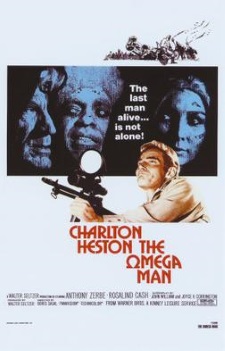
This is a fun movie. What’s not to like about Charlton Heston firing a machine gun in a deserted city, watching Woodstock, and making it with Rosalind Cash? And Anthony Zerbe as the bad guy leading “The Family” (I didn’t say it was a subtle film!) is great.
I could do without the “Christ died so we could live” symbolism at the end. (There is a hint of that in The Last Man on Earth too.) But at least there’s lots of blood and action! It’s well worth watching, even if it is cinematic candy that doesn’t reward repeated consumption.
Matheson told William P Simmons, “The Omega Man was so removed from my book that it didn’t even bother me!” Elsewhere he seemed to think of the film as free money since it wasn’t his work.
I Am Omega (2007)

This is pretty much a remake of The Omega Man starring Mark Dacascos. And it is rather good. But the southern hick survivalist is enough to offend even this left coaster’s sense of fair play. I suppose you can see it as a double-fake: obviously, he’s the bad guy so he can’t be the bad guy. But he is!
Still, a pretty entertaining outing from The Asylum. And sure The Asylum knew that the big-budget Will Smith picture was coming out, so they made this one. First, this is hardly a new thing. Second, they made a surprisingly professional film in a few months for about 1/200th as much as the Will Smith film.
I Am Legend (2007)
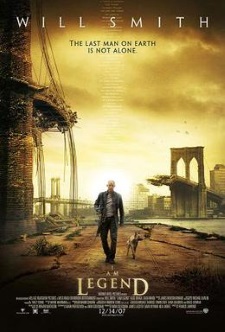
This film is not horrible. I thought the scene when he was looking for his dog (a minor shout out to the novel) was quite suspenseful. But how could it not be? I mean, JR Bookwalter could have done that in an afternoon with pocket change.
It’s a perfectly acceptable Hollywood action/suspense film. There was nothing special about it, except that it had a star. And Will Smith was fine. He’s pleasant to look at. But so is Mark Dacascos.
But it didn’t have a redneck who keeps his dead friend around for company. Which would you rather watch?
Soy Leyenda (1967)
In 1967, Mario Gómez Martín directed a short (35-minute) version of the novel. It shares much with The Last Man on Earth. In fact, other than the ending, which stays close to the novel, it seems more like a reworking of the earlier film.
It’s quite good and worth a watch!
What is the painting hanging in Morgan’s house?

At about 18:50 into the film, Morgan walks through his house and you can see a print on the wall. (It is seen elsewhere later — in particular in the flashback sequence.) It’s at least partly on the screen for 8 seconds, but it began to bug me that I didn’t know what it was. So through the use of a screenshot, some anti-skewing via gimp, reverse image searching on Google, and help from an artist friend of mine, I figured it out.
It is the painting Vandalismo by the Italian artist Giacomo Favretto (1849 – 1887). And that makes sense given that the film was shot in Rome. The painting won the Principe Umberto prize in 1880.
Where else but Psychotronic Review do people spend hours tracking down this kind of obscure information about obscure films? Nowhere!
Why is the book called I Am Legend
In the novel, Neville (Morgan in the film) is not chased and killed. He is captured and jailed, awaiting execution. Ruth, as in the movie, cares for him. She visits him and gives him pills that will kill him painlessly.
The novel ends:
Robert Neville looked out over the new people of the Earth. He knew he did not belong to them; he knew that, like the vampires, he was anathema and black terror to be destroyed. And, abruptly, the concept came, amusing to him even in his pain.
A coughing chuckle filled his throat. He turned and leaned against the wall while he swallowed the pills. Full circle, he thought while the final lethargy crept into his limbs. Full circle. A new terror born in death, a new superstition entering the unassailable fortress of forever.
I am legend.
It speaks extremely well of the movie that this idea comes across clearly, even though the phrase is never uttered. Instead, Morgan’s last words are, “They were afraid of me.” That is a less artful but clearer way of saying the same thing.
He didn’t intend to harm them. As he said, “I didn’t know.” That makes it all the more tragic.
Notes
[1] CALTEX is short for California Texas Oil Company — a joint venture of Texaco and Chevron. It was created to distribute oil outside of the US. This is one of many little hints that this film was made in Rome, not Los Angeles.
[2] I wonder if Fritz Lang would have taken the job. He spent almost two months shooting his last film. I question if he would have felt up to make this quicky — especially at the age of 70+.
[3] This is according to John Brosnan in The Horror People. He says that Vincent Price made three films in Italy that year. The first was Rage of the Buccaneers where he played opposite Ricardo Montalbán. Next was Nefertiti, Queen of the Nile, which he played opposite Jeanne Crain (Pinky — 1949) and Edmund Purdom (The Egyptian — 1954). The last one was The Last Man on Earth. Rage of the Buccaneers was released in the US in 1963; the other two were released in 1964. The copyright on The Last Man on Earth is 1963, however.
[4] Interestingly, the star of the film, Lamberto Maggiorani, was not (at that time) a professional actor. So Vittorio De Sica brought in a professional actor to dub his lines.
[5] Logan Swanson was Richard Matheson’s pen name. He didn’t want his actual name on the script, but in order to receive royalties for co-writing the script, a name that pointed to him had to be on it. Of course, his name was on it anyway: “based on the novel I Am Legend by Richard Matheson.”
According to Matheson, “Login was the maiden name of my wife’s mother and Swanson was the maiden name of my mother. So that’s where he came from. I indeed am Login Swanson.”
[6] Angelo Lannutti is erroneously listed on the Italian print as “Angelo Cannutti.”
All images are in the public domain or licensed under Fair Use and taken from either single frames from the film or from Amazon.
I liked your review. I too saw this when I was seven or eight, but it was on TV so maybe 1971, probably to get some air play on the heels of Omega Man. And I too had nightmares for years after – between it and The Creature From the Black Lagoon my parents forbade any more horror or sci-fi movies.
I hate continuity errors, especially when they could be avoided. I never noticed the ones you spoke of but I was eight so I wouldn’t have been as observant. But The Omega Man had three or four in the opening minutes of the movie. You can see a person walking outside on the street for a second or two, and then a minute later cars driving in the distance on a wide angle shot. The person would be impossible to edit as it was right over Heston’s shoulder in a close up. But the cars, that was just poor editing. They could have cut just before the cars showing and just maintained the image for a second or two. That’s laziness and should be pointed out. There’s much more of the same in the rest of the film.
I need to go back and watch again with this in mind. I think I wrote in this article that I rarely notice these things. But they are kind of a compliment to the filmmakers in that anyone watched closely enough to see them!
We must be the same age because Last Man on Earth and Creature from the Black Lagoon were both on TV all the time when I was a kid! I was confused when I was younger. I didn’t understand why they showed Creature all the time. But I watched it recently and I understand: it’s a great film!
OMG this was a wonderful read! I’ve seen the Will Smith movie and the Vincent Price one. You always help me understand movies better – and even make me less terrified of them! Thank you!
High praise; thank you! There are few films that mean as much to me. I’m not lying about the nightmares!
I met the man who drove Vincent Price around Rome for several weeks when Vincent Price was filming The Last Man on Earth. He currently owns a horror theme movie store in Rome.
Fantastic! If you know the name, please let me know. There is so little information on record about the film’s production!
Thank you. I will be in touch. I am traveling long distance by car at the moment. The man is a pleasure to speak with. He was in at least one movie himself. His store is in the Prati section of Rome. He has a book out. The name of the store may be Profondo Rosso. It’s a remarkable place.
Vincent Price stayed in place just down the main boulevard from St. Peters Basilica.
I will be in touch.
Jeff
I may be a little confused. Vincent Price was asked by the Rome movie industry, for the lack of a better word to call it, to attend its first celebration, or the lack of a better word to call that. Not only did Vincent attend but he did that at his own expense. I believe this was some time after the filming of The Last Man on Earth which would have been when the man I met drove Vincent around for several weeks.
I will be in touch.
Jeff
The man’s name who drove Vincent around is Luigi Cozzi. He is the store owner. It’s actually a book store and also has numerous other horror related things for sale. He is a real gentleman.
Thanks for this. I think I found his book, Italian Horror Movies. It’s in Italian, but there seems to be a translation by someone named Roberto Curti. Or maybe it is the other way around. I’ll research it more. I don’t think I’m up for the Italian since I am neck deep reading the two editions of Frankenstein.
Oh! This was easy. There is an English Kindle version. I’ll grab that!