

With good cause, Brian Albright chose to open his essential Regional Horror Films, 1958–1990 thus, “It’s the summer of 1964, and you and your family have rolled into the Telegraph Drive-In just outside of Toledo to munch popcorn and watch a seemingly innocuous double feature of Spencer’s Mountain (1963) and The Wheeler Dealers (1963).
“Suddenly, up on the screen, a sweaty man in a suit [William Kerwin] appears against a red backdrop and ominously intones: ‘Ladies and gentlemen, you are about to witness some scenes from the next attraction to play this theater. This picture, truly one of the most unusual ever filmed, contains scenes, which under no circumstances, should be viewed by anyone with a heart condition or anyone who is easily upset. We urgently recommend that if you are such a person, or the parent of a young or impressionable child now in attendance, that you and the child leave the auditorium for the next 90 seconds.’
“Before you even have time to cover your impressionable child’s eyes, let alone consider the logistics of leaving a drive-in for 90 seconds, you are greeted in rapid succession by images of a woman in her bra having her tongue gorily ripped out of her head, two lovers scalped [sic] on a beach, a heart plucked from another woman’s chest, and a risque bathtub leg amputation, all in dripping color and all featured prominently in the Herschell Gordon Lewis film Blood Feast (1963).”
Things Were Different in 1963
Yes, in its day, it must have been quite a thing to see. Actually, even now it’s quite a thing to see. If you have a strong gag reflex, you might want to skip it. But despite all the gore, it’s a surprisingly charming and nonthreatening film.
And if I were to pick one film that best sums up psychotronics, it would not be Plan 9 From Outer Space. It would be Blood Feast.
The Invention of the Splatter Film
It is eternally now. As a result, most people aren’t that interested in history — especially the history of things we don’t much think about like socks or pens or book-binding techniques. That’s perhaps less true of film, but still quite true. Film might as well have always been the way it was now. But there’s a (very uninteresting) history of why we see a dozen dull-as-dirty-dishwater superhero movies come out every year. Similarly, there is a history of the modern spatter film. I won’t go into much, but it all started back in 1963 with a remarkable little film called Blood Feast.
Back in 1997, one of the two main people who made the film, Herschell Gordon Lewis (the other was David F Friedman) told the UK rock magazine Kerrang! “I’ve often referred to Blood Feast as a Walt Whitman poem. It’s no good, but it was the first of its type.” I disagree with this. And having read and heard many interviews with the man, I think he did too. It’s just that he thought that was a clever line (And it is!) in addition to being true in the sense that in many ways, his follow-up, Two Thousand Maniacs! was better. But it’s a very effective and enjoyable film even today.
The Strangely Critical Michael Weldon Review
Michael Weldon is the founder of the dearly departed Psychotronic Video and author of every psychotronic film fan’s bible, The Psychotronic Encyclopedia of Film. And unlike the Medved brothers, generally showed a great deal of respect for these unusual films and their makers — or at least objective detachment. This is not the case with his review of Blood Feast.
But it is hard, looking at all of Weldon’s writing about Herschell Gordon Lewis’ films, not to think that Weldon had a problem with Lewis. It may simply be that Weldon knew what great work Lewis was capable of so he was uncharacteristically critical of the other films. Certainly, Two Thousand Maniacs! is objectively a more engaging film than Blood Feast.
But it also had three times the budget and much learned experience from making the first gore picture. Just the same, the gore is not nearly as gory — it’s obvious they wanted it to be more widely distributed. Personally, I don’t find it nearly as enjoyable.
Weldon’s Critical Review
Regardless of any of this, the following overview of Blood Feast from The Psychotronic Encyclopedia of Film is simply wrong. And it shows he misunderstood the basic nature of the film:
This is it! The infamous first gore film. If you can stand the sight of guts, it’s hilarious.
In Miami, Fuad Ramses, an Egyptian caterer, worships a goddess (a mannequin) and murders women for their body parts. A tongue, brains, and a leg are removed in disgusting and convincing full-color detail.
As the limping caterer, Mal Arnold is a determined bug-eyed psycho. Connie Mason, Playboy’s blond June 1963 playmate, is given an “Egyptian feast” by her mother. Guess who the caterer is.
A weird-looking cop (Thomas Wood) saves Connie just in time and Fuad ends up crushed in a garbage truck compacter.
The acting is terrible. If the actors were as good as the effects it would be nearly impossible to watch.
The girl whose head is ripped open on the beach is Ashlyn Martin, another Playboy Playmate of the Month (April 1964).
Lewis was the first, and for years the only, person making offensive films like this. He had previously made nudie films, but after this rural drive-in hit he did Two Thousand Maniacs, also with the untalented Miss Mason. Lewis is also credited with the music, the photography, and the special effects. In “Blood Color.”
Some of that is brilliant, especially, “Guess who the caterer is.” And it does give you a some idea of what the film is about in a very short space. But I take issue with much of it.
Offensive Films?
For now, I will hold off on discussing the two other Lewis-Friedman gore classics, Two Thousand Maniacs! and Color Me Blood Red. But I think that Weldon is totally out of line in calling this an offensive film. What he misses is just what a campy film Blood Feast is — and was intended to be! Much of the gore is indeed as good as anything you will see being produced today. But offensive?
It’s easy to forget while watching the film the first time that the only on-screen violence is the torture scene. And it is laughably mild. It is only on seeing the young woman after she is dead that it is at all shocking. But it makes the viewer wonder just how all that happened given the relatively gentle treatment she received at the hands of the notably unmenacing villain. (See below.)
We must remember, and Weldon certainly knew, that this is an exploitation film. And gore was what was being exploited. People at the time were shocked, there’s no question of that — so shocked people streamed to the theaters to see it, making Blood Feast return over 150 times its cost on its first run.
But Lewis and Friedman knew that the film would shock. (What they didn’t know is if it would shock in a good or bad way). This is doubtless why the film is far more silly than scary.
And really: did anyone ever think a human tongue was that big?
What Bad Acting?
The acting is most certainly not “terrible.”
William Kerwin
“Thomas Wood” is actually veteran actor William Kerwin who plays Detective Pete Thornton. He had been in a number of Lewis-Friedman films, most notably as the star of Scum of the Earth! — a film that is shockingly missing from Weldon’s book.
Kerwin is actually the biggest problem in the film because he is notably better than the rest of the cast that is basically made up of serious, but amateur, community theater people — not terrible. Not even bad. Just okay. Kerwin was a professional.
Before getting into film, Kerwin had a lot of theater experience, including appearing in several Broadway plays. He had appeared in 46 films and TV shows before Blood Feast. After dying at the age of only 62 of a heart attack (Given the time, he probably was a heavy smoker; he certainly was a heavy drinker, which he mixed with amphetamines), he had performed in 149 films and TV shows. To reduce him to “weird-looking cop” is insulting, especially when you consider that he clearly shines in the film.
(He and Connie Mason fell in love, married the next year, produced two kids, and stayed married until his death in 1989. Mason is still alive and never remarried, even though she had only just turned 52. I’m a sentimental old fool, so I choose to believe that they had a wonderful, if relatively brief, life together.)
Mal Arnold and What Blood Feast Is All About

And then there’s Mal Arnold who plays the villain Fuad Ramses. He’s in a league of his own. He has been much maligned over the years for his campy performance. I beg to differ. For one thing, you don’t know him as an actor until you see him play a teen in Scum of the Earth! where he’s really quite good.
Then, as Rotten Tomatoes puts it, “For all the carnage Fuad Ramses is responsible for in the film, he’s hardly a menacing figure, but Arnold has contended that he played the character exactly as Lewis directed it, completely over the top and with a ridiculous accent.” Arnold played it that way because that was the way to play it.
As I’ve mentioned, Lewis and Friedman knew Blood Feast was going to make people freak out. So they intentionally made the whole film campy to take the edge off. And Mal Arnold is the most important part of that.
He isn’t bad; he’s just weird. Fuad might not be menacing, but he seems a lot like a guy who knocks on your suburban door and asks if he can use your bathroom. Note, in a single year, Mal Arnold at age 30 played a substantial part as a teen and a lead as a 60-year-old man. And he pulls both off, despite the fact that he was limited to three takes.
Other Minor Actors
The film has a lot of actors who clearly have some stage experience but have never been on film. The best example of this is Lyn Bolton, who plays Suzette’s mother, Dorothy Fremont. She gives a perfectly fine performance for the stage. On film, it seems too much like she’s starring in a semi-professional production of The Country Wife. But there are moments, like when she is hypnotized that make me wonder how good she might have been had Lewis not had a 3-shot limit. With more takes and a director who wanted a realistic performance, she might have been quite good.
One thing we know about Bolton was that she took the role seriously and showed up knowing all her lines. So it’s quite likely most if not all of her performance was based on the first take. “Moving on!”
Then there is poor Scott H Hall who plays Frank the police captain. He was no actor and didn’t want to be one. Hall was just of friend of Lewis and Friedman who liked to help out. When the actor hired for the part of Frank didn’t show up, Hall was convinced to take on the role. He was given just one bit of direction, “Shout all your lines!” And still, he’s not bad at all. He’s got a natural authenticity on the screen. Clearly, he’s a more natural film actor than Lyn Bolton (although I have no doubt she would have improved enormously had she been given more experience in front of the camera).
An Exception: Connie Mason
Okay, some of the acting is weak. Some of the people in minor roles either take it too serious or not nearly seriously enough. It’s all fine, because it adds to the campy feel of the film. But unlike Mal Arnold, I doubt they were doing exactly what Lewis wanted.
Connie Mason, who gets third billing and an “and introducing” credit, is in a class of her own. And sadly, it is not a good class.
Mason plays Suzette Fremont, the young woman whose mother is giving her an Egyptian feast as a party. She is pretty bad.
But even though the film ultimately revolves around her, she isn’t in it that much. As a physical actor, she’s fine. She runs into trouble when she speaks.
Of course, she was a model and, according to Lewis in the commentary for the film, didn’t try to do anything except sit and look pretty, walk and look pretty, and swim and look pretty. Just the same, she’s not bad at all in Two Thousand Maniacs! — doubtless having been given some tutoring by her future husband William Kerwin, and much more filming time by Lewis.
The Three Take Maximum
All of the acting has to be seen in the context of Lewis’ three take maximum. Let me put that in perspective.
When Ed Wood was filming Jail Bait (quite a good movie — especially coming from the supposed worst director of all time), he shot 17 takes of a simple seen featuring Steve Reeves. And Steve Reeves was hardly a bad actor.
So all the actors in the film should be given a break. But it’s clear Lewis knew what he was doing, because it all works perfectly in support for the movie he wanted to make.
What’s With All the Playboy Talk?
You’ll note that Weldon points out that two Playboy playmates appear in Blood Feast. In a sense, there’s nothing particularly unusual about this; the tradition is to throw in little bits of interesting information in capsule reviews like this. But while this might have been interesting in 1963, by the late 1980s (when Weldon’s book was published), Playboy sales were way down and the magazine had become something of an embarrassment to most men.
I’ll admit, the review probably first appeared in Psychotronic TV in the very early 1980s, when Playboy was at its peak. But it was an embarrassment to most men then too. And when putting together the book, Weldon could have edited the entry — especially given the importance of the film.
In addition, in Weldon’s review of Two Thousand Maniacs! he again refers to “Playboy playmate Connie Mason.”
What I suppose is most odd about the whole thing is that there is no nudity in any of the Blood Trilogy films. So who cares? Lewis’ wife was certainly as attractive as either of these playmates and is quite nude quite a lot of the time in Scum of the Earth! — a film Weldon somehow missed.
In a modern context, with Playboy not knowing whether it is a girlie magazine or not (it stopped having nude photos but brought them back), it all seems kind of creepy.
What’s Interesting in Blood Feast
I suppose “the tongue scene” is the high point of Blood Feast for most people (see below). But there is so much more to love. And it is true that much of the gore really hasn’t been improved on. If you are into gore, you’ll love it. I doubt many directors today would use an actual sheep’s tongue for that infamous scene. But there’s more to it than that. Great care is taken with the gore. As the now dead, tongueless woman’s head falls to the side, blood (red Jell-O) leaks out of her mouth.
And it’s a fun film to watch. It’s very light-footed. Instead of, “My pa has a barn, let’s put on a show!” we get, “I’ve got some frozen animal parts, let’s put on a show and have a good laugh!” Not that I’m suggesting that’s the only kind of gore — not at all. But while the gore is taken very seriously, the rest is relaxed. It’s really a comedy with gore slathered all over it. Horror, gore, and comedy have long been linked. And it starts here in a very charming way.
Historical Significance and Partnership
But ultimately, you have to watch this film because of its historic significance. It is important because going from nothing to something is far rarer than improving on that something, regardless of how much you do. This is why I think of Blood Feast as a Lewis-Friedman film and not a Herschell Gordon Lewis film. I’ll admit that Lewis had more to do with the making of the film: he directed and shot it. But it was their idea together to make it. And Friedman was very involved in the making of the film too.
What’s more, Friedman’s marketing acumen insured that the film became a hit rather than a sleeper that only a few people would see and thus cause the evolution of the splatter film to be much slowed. As it was, the pair gave up the genre after only three films over the course of two years because the genre had become too crowded. That’s a shocking fact, given the amount of time and money required to produce a film in those days.
Essential Viewing
Blood Feast is a psychotronic essential. If you are interested in psychotronic films, you absolutely must see the film at least once. Most connoisseurs will want to own it. And I am grateful that it is packaged with Scum of the Earth! (another groundbreaking film), which you will doubtless be reading about here soon enough. But most fans will want to have it as part of the Blood Trilogy — along with Two Thousand Maniacs! and Color Me Blood Red — which I will also eventually get around to writing about.
History
Herschell Gordon Lewis (director) and David F Friedman (producer) first got together in 1961 during the making of Lewis’ first film, Living Venus where Friedman seems to have worked to some extent as a producer (he received no screen credit, so maybe more like a production manager). I haven’t been able to get my hands on it, but I know enough that it is a nudie-cutie. It sounds like a mixture of comedy and young bare breasted women. Regardless, the two became a team at that point.
Lewis and Friedman
Their first official film together was The Adventures of Lucky Pierre. Yet another nudity cutie — although without even much of a plot — or much of four plots. (It’s shocking to imagine that today they would get a soft R, in some cases a PG-13.) This started their collaboration as camera (Lewis) and sound (Friedman), which would last until the last of the Blood Trilogy.

Both men were, above all else, businessmen. They couldn’t make films if they didn’t make money. So they were always looking for ways to stay ahead of the competition. This led to them making what I still think is the first “roughie.” Roughies were distinctly different and darker. Their first, and only, roughie was Scum of the Earth![1] about a group of people who ensnare young women into posing for pornographic photographs by reeling them in with more and more provocative photos and then threatening to expose them if they don’t continue. It’s an excellent film.
What makes it different from something like Living Venus is that it shows simulated sex (no genitals are shown, of course). But what is most upsetting, even today, is the implied rape. But the film turns out very well and has a very satisfying and sweet ending.
A Different Direction
Still, Lewis and Friedman didn’t want to continue in that direction. I think they had concerns about what they would have to do next. And you only have to pop on a video porn site for a minute to see that the degradation of women is generally as or more important than the sex act itself. But it was more than that.
Lewis put it this way on the Blood Feast commentary:
They got to work fast. It’s remarkable that they released (arguably) the first roughie[2] and (inarguably) the first gore (or splatter) film in 1963.[3]
Blood Feast Begins
They managed to secure $24,500 to make Blood Feast — that’s $200,000 today. And the film went on to make $4 million ($33 million today). That’s over 150 times its investment.
That made it slightly less successful then Lilies of the Field, which had ten times the budget. But more successful than Promises! Promises! with close to 20 times the budget.
And both those films probably spent as much on marketing as they did on production. As far as I know, Blood Feast spread mostly through word of mouth, with some posters and small newspaper ads, and a lawsuit against themselves that backfired. (They got their own film banned in Sarasota, FL — pretty much their base of operations.)
The Story
I don’t believe in spoilers; I don’t watch a film to find out how it ends. What’s more, I find I have to watch a film at least three times before I really appreciate it. If I loved it the first time, it was probably just facile professionalism that I will never want to revisit. So I don’t worry too much about “spoiling” films for other people, as you will see in my analysis.
But since some people are concerned about this, I’ve hidden the plot summary. If you want to see it, just click the link below and it will appear right below this paragraph.
Blood Feast opens with an attractive blond-haired woman coming into her apartment, apparently after a day of work. She goes to her bedroom and turns on the radio where she hears about some “tragic local news.” There has been another murder that night. A young woman has been found dead with her body badly mutilated. The woman is disturbed and turns off her radio. She does not, however go back to her front door and lock it as the radio announcer suggested. And we saw her come in; she clearly did not lock her apartment. She goes to the bathroom and undresses before getting into a bubble bath with a book she is apparently reading, Ancient Weird Religious Rites. Quite suddenly, an odd-looking man (Mal Arnold) with slightly grey curly hair appears over her with a knife. She screams and he stabs her in the eye with a knife — killing her. He looks at the knife smiling proudly to himself. This is the first indication that despite the gore, this film just might not take itself that seriously. The man then hacks off her leg and puts it in a bag. Then we see the dead woman’s bloody hand slide down the outer side of the bathtub, blood smeared in its wake. That happens within the first three minutes. But it’s important to note that unlike later slasher films, there was no on-screen violence. And there is almost none throughout the film. But the gore, even today, looks very good. But the cut-off leg looks real. Disturbingly real. I’d provide a picture of it but I want you to watch the film. Normally, I wouldn’t mention the credit because they aren’t worth mentioning.[4] But in this case they are. It starts with a shot of the Sphinx head.[5] Then “BLOOD FEAST” is displayed in red. But then more and more paint (Blood?!) is added to it until it is dripping down the screen. The rest of the credits are standard, but brief, lasting almost exactly one minute. Blood Feast fades back in to reveal a door, “Homicide Bureau: Chief of Detectives.” Inside, we find Police Captain Frank (Scott H Hall) and Detective Pete Thornton (William Kerwin — under the name Thomas Wood[6]). Hall has the unenviable task of spitting out a bunch of exposition. We learn that there have been seven killings of “young girls” in two weeks, “And each killing more brutal than the other.” I think he means “gruesome” rather than “brutal” because for all of the murderer’s nuttiness, he doesn’t seem particularly cruel. True, dying from having one’s tongue ripped out would be very painful. And so would be being whipped to death. But he seems to take no joy in these actions. His normal MO is like that of the first murder in the film: he kills the woman and then takes the necessary body parts. He could have done it the other way around. He clearly has a higher purpose. Anyway, we learn that even after seven murders the cops have nothing to go on. As we’ll see, these must have been some really bad cops. The murderer never uses gloves, never covers his hair, and is generally pretty cavalier about his whole adventure. Then it’s time for Kerwin to do some exposition. We learn from him that the DA’s office is pressuring them. (Ya think?) Also, the newspapers are making a big deal out of it. (Shocking!) Hall then takes things back up and explains that there seems to be a pattern: each “girl” had different parts of her body removed. Yeah, that murderer is definitely planning something all right. Could it be a, oh, I don’t know: a blood feast! Before Kerwin leaves, he delivers a curious line, “Well Frank, this looks like one of those long, hard ones.” He extends the word “long,” and it is the second clue that this is a comedy. The whole sentence is so stupid. Seven young women have been brutally murdered in the past two weeks and the police have no clues. This is already one of those looonnng, hard ones! The film cuts to the sign, “Fuad Ramses: Exotic Catering.”[7] Inside the store, Mrs Dorothy Fremont (Lyn Bolton) approaches the proprietor, Fuad Ramses, who we recognize as the murderer. She tells him that she wants to throw a party for her daughter Suzette (Connie Mason). But she wants something unusual — something that will be the “talk of the town.” The implication is that Bolton is a socialite, but we see later that she lives in a decidedly middle class house. But that’s okay. This is a low budget film, and that is part of the fun. Ramses suggests an Egyptian feast with great drama, followed by an organ chord as used to indicate something shocking in old radio shows. If you haven’t figured out this is not a serious film but a comedy, it’s only because you are still thinking about Ramses shoving that leg into his bag. But this turns out to be particularly good luck, because Suzette is a “student of Egyptian culture.” Even better, this feast has not been prepared in 5,000 years! The keen viewer might wonder why that is. Perhaps because it requires body parts from many young virginal women? Only time will tell! Somewhere in the middle of all this, Ramses seems to hypnotize the poor woman. As if in a trance, she says, “Yes… Yes… We must do it.” She is only awakened when Ramses claps his hands. So Fuad Ramses agrees to cater the event that will occur in two weeks from Saturday. Mrs Fremont wants to know if he can prepare it in that time, and Ramses says, “Things have been ready for a long time, Mrs Fremont — a long time.” And that’s clearly not true. He hasn’t even gotten all the meat! Mrs Fremont leaves and Ramses, who drags his right leg along as he walks anywhere, makes his way into the back of his now vacant store. There we find an alter to the Goddess Ishtar. He lights a tiki torch beside a statue of the goddess, which looks good but on close inspection appears to be a department store mannequin painted gold with make-up on its face wearing a gold tiara. Ramses prays to her, believing that the blood feast will bring back Ishtar and her lover, Shamash. He also says that he is her slave. In other words, this guy is nuts — or at least born 5,000 years too late. The next scene demonstrates some nice direction/editing. We see who we will soon find out is Suzette Fremont buying a newspaper. The camera zooms in so we can see the headline, “LEGS CUT OFF.” (Typical journalists: it was just one leg. Fake news!) Then it cuts to a man in close up reading the front page and instantly cuts to Frank in his office slamming the paper onto his desk. He yells (his only direction), “A pathological killer on the loose and we can’t find one clue!” After a pause, we get another strangely funny line, “This man’s uncanny!” Hey, when Ishtar’s got your back, there’s only one thing that can stop you. And we’ll get to that. That brings the total of young virginal women murdered up to eight. We’ve got to keep track of this. It will become almost trivial later. We do find out something interesting about the murdered woman though: she was in a book club. Sadly, there was no organ chord to go along with that. It would have been brilliant. No mention was made of the book that was lying right beside her body. God forbid what would happen to this film if the police ever tried to combine any information they had. The scene ends with Captain Frank providing another strangely funny line. He mentions that the police are now patrolling every street. He adds, “We sure should get him if he tries it again.’ So this is the eighth young woman to be brutally murdered in roughly two weeks and that was the one that really got the police going. Seven wasn’t enough, but eight! That’s when a man needs to take action. Like so much of this film, it’s so charmingly ridiculous. The next scene is perhaps the most bizarre of the whole movie. A young couple is making out on the beach: Tony (Gene Courtier — Blood Feast is the only film or professional play I can find that he was in) and Marcy (Ashlyn Martin). Marcy wants to go home because it is getting late. But other than the spot on which they are lie, there is darkness — as if it were night and there were a spotlight on them (which was doubtless the case). It took me forever to justify the scene. They must be at the mouth of a cave. That’s the only possible explanation. But we see no cave, so it seems weird. Anyway, after Tony convinces Marcy to stay until it’s dark, who should walk toward them, his right leg dragging behind him? None other than Ishtar’s slave Fuad Ramses. Tony rises up, but Ramses hits him on the head with the side of his machete, knocking out the young man. Marcy screams, “Tony” before Ramses slices her head. As she lays dead, he works on her head. He’s come for a brain and he gets it. We next see him fondle it in his hands as he looks down pleased upon it. Then we see Marcy, her head bloody. Then we see a snake slithering on the sand for no apparent reason other than that producer David Friedman was into snakes and that was his pet. Finally, the film cuts back to Marcy’s bloody head and it dissolves into a police car’s flashing red light. We’re still counting because it’s trivial: Marcy was victim number nine. Frank is talking to Tony, whose head is now bandaged. He is sobbing. He (rightly) blames himself for Marcy’s murder. But he’s so overwrought that he can’t remember anything. Frank has some uniformed officers take him to the hospital for a bad case of over-acting to get him calmed down so that he can possibly remember something. Detective Thornton mentions that all the killings are the same: in each case the killer takes just one body part. When he asks Frank what kind of creature would do something like that, Thornton gets more amusingly obvious and unhelpful dialog, “Pathological killer… Sick, sick mind.” Back at the police station, Marcy’s parents, Mr and Mrs Franklin, try to provide the police with some help, which they clearly need. Mrs Franklin (Toni Newsholme) sobs the entire time, acting much like Tony had the night before. Mr Franklin (I can’t find his name, but he’s rather good) spends the whole time comforting her while trying to help the police. Marcy was, like all the young women in this film, fine and good and well-liked by everyone. (An unintentional bit of amusement is that Mr Franklin is played by a fairly young actor. Like Mal Arnold, they just sprayed grey on his hair. So he looks more like Mrs Franklin’s son. He refers to her as “Molly,” but it sounds very much like “mama.” I know that sometimes very old couples will call each other “mother” and “father.” But “mama” is too childlike and thus creepy. But it was only after putting on the subtitles that I could see he thankfully wasn’t calling her “mama.”) There is one thing that Detective Thornton finds interesting: Marcy was on a book club list. But he’s interrupted by Marcy’s mother’s outburst about having made her daughter a dress, “And now she’ll never wear it; she’ll never wear it!” And that was the end of that line of questions. There was an observation that might blow the case wide open, but you know, an old woman was crying. This is a short scene with Fuad Ramses in the back room. He is apparently cooking, but mostly just putting body parts in what could be water or could be blood. Blood would be a lot more cool, of course.. While cooking, he chatters away to his Ishtar statue, “Oh, it’s nearly ready! Nearly ready!” This is not true. As we find out later, he only gets about half the virgins he needs. More on that later. He continues and we learn the purpose of all his killing, “The ancient formula needed for your rebirth.” He pours in a glass of what I assume is blood and says, “Now we shall have the flavor… The special flavor… Seasoned just right for you, oh mother of the veiled darkness.” And finally, we make it to the tongue scene — the scene the film is most remembered for. And we are only 21 minutes into the film! A couple drive up to a motel. We assume they are drunk because a drunken solo violin version of “How Dry I Am” is played, with Lewis’ kettle drums beating ominously below. The man (Friedman, in a sea captain’s cap) and woman (Astrid Olson, who was hired because of her large mouth) get out and stumble upstairs toward their room. But they are not alone. Fuad Ramses is watching from an alcove. As they reach the upstairs, the violin is taken over by a cello. The man lets her into the room and then goes off — perhaps to buy more liquor? At this point, the music changes to just the kettle drums beating two notes as Fuad makes his way out of the darkness. When he is sure the man is gone, he limps to the door and knocks. Apparently, thinking it is just her male friend (Husband?) the woman opens the door in her underwear, having already gotten out of her dress. Fuad, in as much as he can, rushes at her. She screams. He tackles her onto the bed, his fingers in her mouth, grabbing her tongue. I guess she doesn’t just bite him because she’s so drunk. We can only hope so, because what he is about to do is the cruelest thing in the entire film — and quite out of character for him. Elsewhere in the film, he would simply kill her and then remove the tongue. For one thing, wouldn’t that be more efficient? And how strong do you have to be to rip someone’s tongue out? She does grab at Fuad and tries to push him away, but it is all to no avail. Eventually, we can only see the woman’s arms and they go limp. Then we see Fuad holding the largest tongue you ever saw. (It was an actual sheep’s tongue.) Clearly, he has murdered her by ripping her tongue out — truly an act of murder by torture. As he pulls the tongue away, we see the now dead woman’s head in close-up. It is bloody, and it falls toward the camera where we see blood (red Jello-O) leaking out of it. This is quite an unusual scene in many ways. Of particular interest is that we do not see Fuad admiring his prize. It is likely that Lewis and Friedman knew this was going to be the scene that most upset people. And as I’ve mentioned, despite everything, we don’t really dislike Fuad. Yes, he’s cuckoo for Cocoa Puffs. He really does think this is all really important to bring back Ishtar. But had we seen him smiling insanely at that tongue, he would have been far less likable. And the movie would have lost much of its campy style. So instead, we fade to quite a silly scene after the demise of this tenth victim. Dorothy Fremont, is sitting in the living room of her mansion early 1960s upper-middle class home. Suzette comes and sits with her mother. Mrs Fremont tells Suzette that the plans for her party are all under way, “The caterer has a marvelous idea!” But the young lady is not so excited. She tells her mother she is; but then she confesses, “Only I was reading about all those murders and it sort of takes all the joy out of everything.” She finishes off with a short repetition of exposition that the police captain had already given in more depth. Mrs Fremont agrees that it is horrible, but she is sure that the utterly incompetent police will find him soon. What’s more, the party will take all their minds off “all this horrible killing.” (Unfortunately, it will likely not take their minds off all the non-horrible killing — a party can do only so much!) Suzette has to be going to the lecture series she’s been attending. That night will be about cults of the Egyptian gods. Mrs Fremont almost blows the whole surprise by saying, “Did you say Egyptian gods? That’s a coincidence… Oh well, there’s that nicest little man, he…” But she stops herself and tells Suzette to call her when she needs to be picked up. This, of course, is a reference to the radio broadcast at the beginning of the film saying the women should not be alone at night (despite the fact that we haven’t seen Fuad kill anyone at night; he normally goes for dusk). But I’ve always wondered: how does Suzette get to the lecture? After Mrs Fremont makes a quick call to make sure a friend will be coming to the party, the film cuts to the lecture hall where Dr Flanders (Al Golden) is giving a speech about the cults of ancient Egypt, while taking the parting of the Red Sea as historical fact. He quickly gets to the cult of Ishtar. We find out that the cult was “one of the most bloodthirsty religions ever known.” He says that although she was a love goddess “her’s was an evil love.”
Most important, Dr Flanders explains what Fuad Ramses is up to. He says: It makes me wonder how Ishtar could rise year after year in a new body. Did they kill her last incarnation off before year’s end? If I were a goddess, I would not stand for that! Regardless, the good doctor babbles on a bit more before noting that some believe that Ishtar is still worshiped by some today, but that it isn’t know. (Well, we know of at least one worshiper, don’t we?) While much of the lecture is going on, we witness the sacrifice of a young virgin by a priest who first wanders around her with a snake (Again: David F Friedman’s pet). And then he stabs her in the chest and pulls out her heart. Suzette was not alone at the lecture. Detective Pete Thornton was there with her. He has been attending this lecture series with her and there is a budding romance between them. They discuss the case a bit. Thornton admits that they have nothing except that Tony Parker (the boy on the beach) got a brief look at him and that he had “grey hair and strange glowing eyes.” He also mentions that he has some idea that it is all related to a book, but he can’t figure out how it fits together. As we shall see, this makes him a pretty bad cop. Thornton offers to drive Suzette home, but on the way, they park by the side of the ocean and chat — mostly just babble to establish that they have a relationship. Finally, they begin to kiss. And this seems to be the first time they have done so. But it only lasts for a couple of seconds when Fuad jumps in the car and cuts Suzette’s arm off there is a report on the radio of another attack. The difference is, this victim is still alive. So there is no more time for romance. Thornton must take Suzette back home and get back to work. Thornton is back at HQ with the captain. We find that Fuad attacked a young woman on the outskirts of town. “The whole side of her face was hacked away.” But they got her to the hospital, and now that this exposition is finished, they go to talk to her because she could die at any time. I guess it isn’t so much that the police are bad as that they are incredibly lazy. The entire force is working double time. Yet Detective Thornton had time to hear about the attack on the radio, go to the station, have everything explained to him, and only then did anyone think to question the woman. “Let’s get over there pronto” indeed! At the hospital, the doctor says the victim has no chance of survival at all. But she’s conscious and is able to speak to the police. In a modern slasher film, I’m sure her face would have been something to see. Unfortunately, this victim’s head is entirely covered with gauze. Actually, this is more realistic. But they could have at least covered half the gauze with blood. Instead, there is just a small patch of blood, and this is kind of a stale scene for a movie that is racing toward its finish. We find out that the victim’s name is Janet Blake, which is very important because it means I can tell you that she’s played by actor Louise Kamp. It’s her only movie acting credit, but she did write one of the episodes of Lincoln (1974), a television mini-series. She reports that it was the same guy Tony reported on: wild eyed old man. But then she says, “He said it was for Eetar! Eetar!” And then she dies. The medical staff come in and heroically confirm that she is dead. Victim number eleven! When the captain asks the detective what he thinks, Thornton notes that “Eetar” sounds kind of familiar. Maybe because you just came from a lecture about a goddess named “Ishtar”? Really, this police force is very frustrating. I find myself almost rooting for Fuad Ramses. At least he’s good at his job! That entire scene is scored with organ music, so it sounds like it takes place in a funeral home. It works rather well. After the captain and detective are escorted away in a police car (presumably to sit around and wait for a break in the case), the film cuts to a medium shot of Fuad Ramses in his shop opening a letter. Inside is a letter that requests a copy of his book Ancient Weird Religious Rites from Trudy Sanders (Christy Foushee, under the name Toni Calvert). Fuad smiles after reading the letter. Then he grabs the phone book. He finds her number and calls only to find that she isn’t there at that time, but rather at the Fremont residence which he has the address of thanks to Mrs Fremont’s card. He hangs up and starts talking to Ishtar, telling her he needs just one more ingredient and he will be set to bring her back.[8] And it seems he has found it. Next we see Trudy swimming. She is in the Fremonts’ pool. With her are Suzette and another friend. Suzette is out of the water, reading a book that is decidedly not Ancient Weird Religious Rites. Then we hear the kettle drums indicating something bad is about to happen. A shadow of a man about to strike her appears over her, but suddenly vanishes. Suzette looks around but can see nothing. Still, she seems concerned. Nearby, Fuad Ramses climbs up a small wall. Suzette goes back to reading. And Fuad limps into what looks like an orchard. Some time must have passed, because now all three women are getting out of the pool. They discuss their excitement about Suzette’s party the following night and then Trudy leaves so she can get some shopping done before it gets dark. She’s afraid of the killer, which is rational; but she thinks she’s safe in the day, and given that Fuad has never actually killed at night, that isn’t rational. The two remaining women discuss the party, and we learn that Suzette is not as dumb as she may appear. She has figured out that her mother is giving her an Egyptian feast. But this is just to give Trudy time to dress and walk away from the Fremont residence. It is clearly dusk now, and we know when Fuad likes to attack. So it is no surprise when he runs up behind her and knocks her out. Then he carries her away, leaving her purse and one shoe behind on the lawn. This is emphasized with an extra shot. Not surprisingly, people are worried about Trudy’s disappearance. Captain Frank just hopes it isn’t “the killer.” And this is not the killer’s MO. Just the same, she’s clearly been kidnapped by someone, so it’s bad news either way. The captain leaves and Thornton calls Suzette to tell her he’s been so busy on the case that he had forgotten about her party and that he’s going to be late. He’s happy to hear that it will be an Egyptian feast, but then makes a joke that he hopes it isn’t like the blood feast they learned about at the last lecture. We find ourselves back to Fuad’s back room when him talking to Ishtar about the “flavors” he is adding for her. But we can hear a woman in the background crying in pain. Fuad picks up a cat o’ nine tails and goes to Trudy who is tied with her face to the wall. He’s unhappy that she isn’t getting with the program. (Living women are so much more fussy than the dead ones!) He tells her, “Give yourself up to the goddess!” Then he starts whipping her back, making it bleed. It is, however, the most unrealistic gore in the film. Then he gets a silver bowl (just like Dr Flanders had described at the lecture) to catch her dripping blood in. This is, interestingly, the only scene where Fuad really does seem frightening. Thornton mashes out a cigarette. He’s been sitting in his boss’ office thinking. And suddenly it comes to him, “Ishtar. Eetar?!” He immediately calls Dr Flanders because of course everyone has his number memorized. He asks for a little more information on the blood feast. And that’s what he gets: a little more — six seconds worth. That’s because he has a more important question, “Have you ever heard of a man called Fuad Ramses?” Dr Flanders tells him that Ramses wrote a book called Ancient Weird Religious Rites. Thornton remembers that this very book was found with victim number 8. (Given how Fuad worked, I would think the book would have shown up more than once.) And so Thornton gathers the troops to meet him at Fuad’s shop. He doesn’t, however, think to send any cops to the Fremont residence where Fuad might also be. But it’s forgivable, because if he had, he would have deprived us of the wackiest scene in the whole movie. Either Ramses’ shop is hours away, or he’s a really fast cook. But we cut to possibly the most disgusting scene in the film, even though it isn’t really gory. Fuad opens an industrial oven door (generally made for large-scale baking), and he puts victim 8’s leg in it. There is a bizarre quasi-dissolve, and Fuad comes back and takes the now cooked leg (I’m no chef, but I think it’s over-done) out of the oven. Maybe I just haven’t watched enough cannibal films, but this is the one scene that I don’t find amusing and instead really do find kind of disgusting. It puts into perspective just what’s going to happen at the Fremont party. Remember: Ishtar will only be reborn after the last of the food is eaten and I don’t think anyone’s going to tear into that foot! It’s curious that there is much more cooking to do. This scene really should have been placed earlier in the film. Detective Thornton is the first to arrive at Ramses’ shop. But soon the rest of the police arrive. They can’t get in the back, so they go in the front. (I guess Fuad doesn’t lock his front door. Thornton and Frank make their way into the back room with just a flashlight. What they see is not pretty. Frank turns on the lights and they see blood and body parts everywhere. Worst of all, they find Trudy, dead on the main table. Trudy: victim number twelve. It is only now that Thornton remembers that Ramses is catering the Fremont part. Before they leave, Frank gives orders to call the Fremonts and tell them not to eat the food and to act as if nothing is wrong. At the Fremont house, the party is underway. Suzette becomes annoyed that her sister is hogging the telephone. But her sister says that she was talking to her boyfriend long-distance and was suddenly cut off. She now has to hang on the line. The implication is that Ramses has cut the phone line, thus depriving them of the information about not eating anything with a foot on it. There is much excitement when Fuad Ramses enters the party. He announces that the feast is about to start. But before it can, “In order to make the feast of Ishtar more authentic, I must ask the co-operation of the young lady in whose honor the feast is being given.” Suzette’s mother is very excited about this. Suzette is not, but she follows Fuad into the kitchen. Nonetheless, Suzette follows along and we start the most wondrous of silly scenes in the history of cinema. Suzette is surprised to find that no food has been brought into the kitchen. Fuad explains that it is in the garage. It would be a desecration to bring it into the house before she had blessed the house. Why it wasn’t a desecration to bring it into the unblessed garage, I cannot say. It’s one of the wonders of Ishtar. Fuad is so touching in this scene. He tries really hard to seduce Suzette into being his last victim by telling her that she is helping him fulfill the whim of an old man. “As you can see, my dear, I am an old man.”[9] He tells Suzette that he must have a young maiden like herself to bless the feast. She is suddenly more game and giggles. So Fuad has her lay down on the kitchen tabletop (the alter). And then he gets her to raise her arms to the heavens and say, “Oh, Ishtar! Take me unto yourself!” He adds that her eyes must be tightly closed, but it’s pretty clear that has nothing to do with Ishtar. Fuad tells her that if she does this, she will make “the heart of an old man glad.” Things seem to be going great, but Suzette isn’t taking it very seriously. She sets up and then remembers the last lecture she attended. She says, at first playfully but then seriously, “Hey! You wouldn’t sacrifice me on this alter, would you?” Curses! Foiled again by that lecturing Professor Flanders! But Fuad assures her that he would do no such thing. He gets her to lie back down and raise her arms, but she’s forgotten the “sacred words.”[10] Fuad is getting impatient, but he’s trying really hard not to show it. As he tells her the words again, he walks to his bag and gets his machete. He’s about to cut her head off when she pops back up. Fuad quickly hides the machete and Suzette says, “This is silly.” Fuad continues his seduction. He says, “My dear, please do not break the heart of an old man.” He also points out that her guests are waiting, so she consents to take it seriously. She lays back down, raises her arms, and says the sacred words. He raises his machete and is about to strike and wouldn’t you know it: Mrs Fremont comes in the kitchen and screams. Fuad runs out of the house. That would have been Fuad’s thirteenth and final victim. I’ve only been counting because there were supposed to be twenty virgins (or up to a week ago virgins). This really makes me question just how good a worshipper of Ishtar Fuad really is. And it kind of explains what will soon happen to him. Outside, Fuad can hear police sirens. Why he didn’t take his car is a question for the ages. So we see a strange old man doing a limping run holding a machete. The police arrive at the Fremont house. The uniformed officers go chasing after Ramses, although I’m not clear how they know which way he went. Inside, Thornton comforts Suzette. Rather than finding Fuad Ramses, the big thing on his mind seems to be telling her that her friend Trudy is dead. And then there is a very bad attempt at humor. Frank tells Mrs Fremont that the feast Ramses cooked is evidence of murder. She’s not at all phased — the consummate party planner. She says, “Oh, dear. The guest will have to eat hamburgers for dinner tonight.” Suzette is very upset about learning that Trudy was Ramses’ 12th victim. And then she provides us with a much funnier line, “I pray that they catch him before it’s too late.” Too late for what?! It’s more of that oddball dialog that makes no sense. He’s killed 12 young women. It is clearly too late for them! Thornton and Frank leave to find Ramses. But before they go, Thornton hints that later, after the shock has died down and everything, he will ask her to marry him. It’s sweet and sick at the same time. And where will they find a caterer for the wedding now? Fuad has made it to a local dump. Strangely, even though he is old and handicapped, he can outrun the police. (This is classic Lewis-Friedman.) Thornton and Frank drive to dump, thus reaching the uniform officers. Fuad continues to run. Eventually, Fuad throws his machete toward the police, but it’s an impotent gesture. Then he continues to run to a garbage truck just leaving. This is the old (1963) kind of garbage trucks where the garbage goes into the back where it is compressed and then moved into the main compartment of the truck. I’m sure I don’t have to tell you what happens next, but I will. The compactor comes down on Fuad and we see his bloody hand just outside of it as we hear a strangely constrained scream from him. Frank stops the truck. When the garbage man sees what’s happened he’s confused, maybe a little afraid. Frank says, “You don’t know it, buddy, but you just did this town the biggest service it’s ever had.” And then he gives what should have been the last line in the film, “He died a fitting death like the garbage he was.” (Not that I believe that. He was just insane.) Unfortunately, Frank then asks Pete Thornton how he figured it all out. But we’ve been through it all with him. We don’t need him to explain what we just saw. It’s not like it makes much sense anyway. It’s a movie. There is a certain point when the good guy figures it out. But he does get a good final bit: Then the back of the garbage truck closes, implying that the remains of Fuad Ramses will just be piled on a garbage heap and eaten by seagulls. (Interestingly, that is more or less how I would like my remains dealt with — I could go without the garbage heap, though.) Finally, we see an image of the Ishtar statue that appears to be crying blood. “The End” title — presented just as the “Blood Feast” title was at the beginning.Detailed Synopsis
This Isn’t Serious, Folks: Clue One
Credits

A Crime Drama!
The Cops Know Nothing! Nothing!
This Isn’t Serious, Folks: Clue Two
Dorothy Fremont Wants a Special Party
An Egyptian Feast!
Meet the Goddess Ishtar

And the Police Still Don’t Know Anything
Never Join a Book Club!

In a Cave by the Sea
Tony Makes a Big Mistake
The Police Can Learn Nothing From Ramses’ Tracks in the Sand
Marcy’s Parents at the Police Station
Egyptian Blood Cooking With Fuad and Ishtar!
The Tongue Scene
Fuad Ramses Goes for the Kill
Bite Him! Bite Him!
She Really Should Have Bit Him

Meanwhile, at the Fremont Estate
Down at the Lecture Hall
Dr Flanders Gets All the Exposition
Unanswered Questions
Love in the Lecture Hall

The Police Get an Unhelpful Clue!
Inside the Hospital
Meanwhile Back at Fuad Ramses: Exotic Catering

The Worst Pool Party Ever
Saturday With the Police
Fuad Ramses Has a Guest
Meanwhile Detective Thornton Is Still Sitting in His Boss’ Office
How to Cook a Human Leg With Fuad Ramses
Police Arrive at Ramses’ Shop

Let the Feast Begin!
Inside the Kitchen
Fuad Begins His Seduction
Suzette Gets a Clue!
Mothers Show Up at the Worst Times

The Police Show Up Not in the Nick of Time
Meanwhile, at the Dump
Fuad Gets Compacted

Explaining the Already Explained
And Ishtar Wept
Who Wrote Blood Feast?
You would think it would be clear who wrote Blood Feast. Or if there were some controversy, it would be because no one wanted to admit to being the author. As much as I love this film, the screenplay isn’t great — and it certainly isn’t up to the level of other Lewis films.
Just the same, there is something sharp about its pacing. And the dialog is rather better than in most low-budget features. It could just use a few rewrites.
The Men Disagree!
It says there in the credits, on a screen all by itself, “Screenplay by A Louise Downe.” But in the commentary track for the film, Herschell Gordon Lewis said, “We gave the screen credit to somebody on the crew because we thought we should. Actually, everybody pitched in for the script on this one.”
In Godfather of Gore: The Herschell Gordon Lewis Documentary, David F Friedman claimed that Lewis and he wrote it and that Downe just typed it. According to him, it was a publicity stunt.
At a later time, Lewis claimed that he wrote the whole thing himself. I know how the brain changes as one gets older. You forget things. I’m only in my fifties and Friedman lived to be in his late 80s and Lewis into his early 90s. It’s not hard to look back 50 years and remember what you wanted to believe happen (especially when so many people have been puffing up your ego over those decades) rather than what really happened.
My Suspicions
I am deeply suspicious for a number of reasons. First, this “somebody on the crew” was Allison Louise Downe. She was the star of the film they had just made, the excellent and financially successful Scum of the Earth! (under the name Vickie Miles).
Yes, she was on the crew of Blood Feast, although she isn’t credited with anything else. She did some make-up, but I suspect everyone within grabbing distance was doing that. And she played an extra in the lecture scene. And she did more, as I’ll discuss in a moment. Lewis and Friedman worked that way: getting everyone excited about “putting on a show.” Of course, they were the only ones who saw any real money from it.
But what Friedman says bothers me even more, because clearly the press release they put out about Downe writing the film was done six months after the film was released. So why can’t it be true and a publicity stunt?
Changing Stories
It’s also telling that the two men’s stories have changed over the years. That doesn’t speak well of their incompatible stories. (According to Simon Abrams at RogerEbert.com, “This is, after all, a movie whose script is a skimpy 14-page outline that Lewis dictated, and co-transcribed with his secretary Louise Downe” — clearly something Lewis said at some point.) And I’m sure as time has gone on and Blood Feast has become a bigger and bigger deal, they have wanted to take more and more of the credit for themselves.
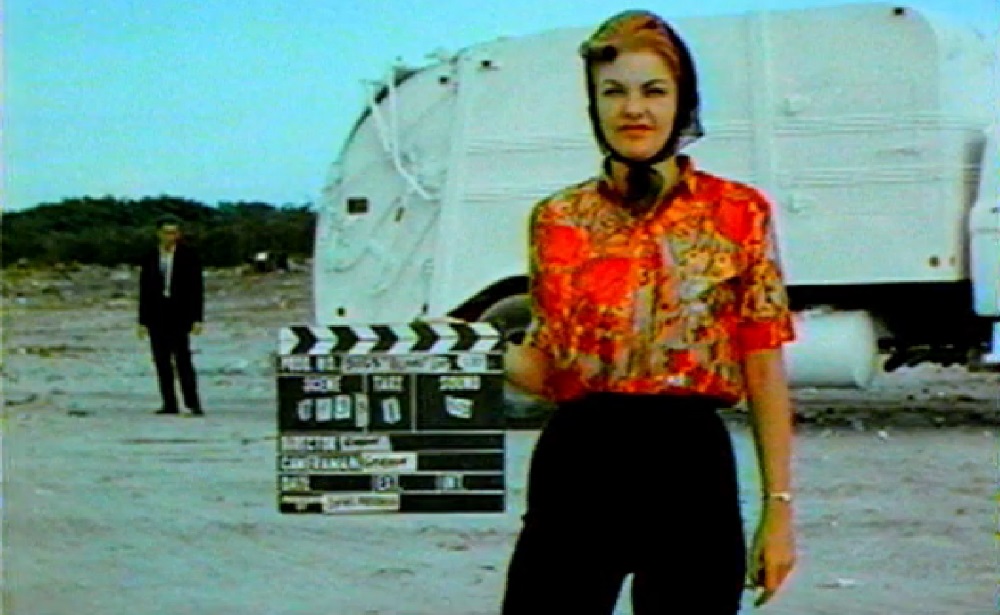
It’s also possible that these two incredibly sexist men thought that what Downe was doing was just typing. Nowhere in the credits does it say that Downe was the assistant director and production manager of the film. Need proof? There’s lots of it in Godfather of Gore, like this still cut from the film:
A Story Is Not a Screenplay
But listening to Friedman and Lewis talk about the evolution of the film, it seems pretty clear that they did, in a sense (one that the WGA would never accept) write the story. But they didn’t literally write anything at all. They sat in cafes and drove in cars and talked about the film to the point where they came up with a basic plotline. Then they told Downe what they had come up with and she had to render it on paper.
If these men had written the screenplay, they would have taken credit for it. That was their style — especially for Lewis who gives himself credit for direction, cinematography (twice), and music. If he had edited it, he would have taken credit. So why wouldn’t he take credit for writing it? But we don’t know what to think. According to Lewis, everyone chipped in and they just gave it to a random crew member. According to Friedman, the two of them wrote it and just used this silly young woman to get publicity.
Most bizarre of all is that Downe also wrote the screenplays for five later Lewis films: The Gruesome Twosome (1967), The Girl, the Body, and the Pill (1967), She-Devils on Wheels (1968), Just for the Hell of It (1968), and Linda and Abilene (1969). What’s more, she was assistant director on six of Lewis’ films — only one of which she wrote: The Gruesome Twosome.
Allison Louise Downe in the 1960s
I don’t believe for a second that “everybody pitched in.” I believe that Lewis and Friedman came up with the story idea — not the story as it is defined in the industry. And that Downe wrote the script and gets her rightful credit. I won’t give Lewis and Friedman “story idea” credit, because that is not writing.
(I don’t think I’ve ever met a person who found out I was a professional writer who didn’t tell me about at least one idea they have for a book or film. I always tell them the same thing, “You should write that!” The reason is that any professional writer has far more ideas than they can ever write. It’s not hard to come up with an idea for a story. It’s hard — often impossible — to render it in a way that anyone will be interested in.)
The “Actual” Script
I purchased Blood Feast: The Complete and Uncensored Script to America’s First Splatter Movie. It’s published as a comic book — or rather to be displayed in comic book stands. It claims to be written by Herschell Gordon Lewis with film historian John Wooley providing an introduction. And check out what he says about the authorship of the film:
…
Undoubtedly, though, Lewis is the person who brought this script to life.
There are a number of interesting things here. First is that even Wooley in 1991 didn’t know Downe’s relationship to Gordon.
Also, yet another change in Gordon’s explanation. Years later he was saying that everyone pitched in and they felt they should give credit to some random crew member.
He also said that the Egyptian theme came from the hotel he and Friedman were staying at — the one used as the background for the titles. So that’s an inconsistency. And then there is the time that Lewis said that Downe had come up with the idea of a cannibal chef.
But the most telling thing in the introduction is the last line I quoted because it concedes that Gordon is way out on a limb in claiming that he wrote the script. There’s a reason films usually have different directors and writers: they do different things. By Wooley’s logic, every screenplay should be credited to their directors because they were the people “who brought [the] script to life.”
It’s Not the Script of the Film
The worst thing about this “script” is that it is most clearly not the script. It is just a shot-by-shot reconstruction of the film, based on the original script, because it gets numerous bits wrong. The dialog, however, is word-for-word with very minor exceptions. And given that Gordon had a three-take maximum, I have a hard time believing that the actors got all their lines so perfect.
But most important of all is that the script is not typewritten, but typeset. Typewritten text takes much more room than typeset text. Yet the typeset text is 31 pages whereas the supposed screenplay was just 14 pages. So this “complete and uncensored script” is a fraud. Not that it isn’t cool to have.
This also destroys the argument Wooley tries to make about the format for the script, given that this is not that script that was shot. (It appears Wooley never saw the actual script.) And even if it were, wouldn’t Gordon’s assistant type any scripts she wrote in the same format of the scripts she had seen of his earlier work?
But if it sheds any light on the authorship questions, it pushes against Gordon and Friedman’s claims. It is yet another example of Gordon trying to take all the credit for himself, even the writer of his introduction has to admit that, yeah, his claim to have written the screenplay sounds questionable at the very least.
Downe Was Extremely Important to the Production
Cameraman Andy Romanoff seems to be the only one around who will speak about Downe truthfully. He was there. He was the assistant cameraman on Blood Feast and Color Me Blood Red in addition to other Lewis films. In Godfather of Gore, he said, “Bunny Downe! She was Herschell’s right-hand — truly right-hand person. She was in his movies. She wrote some of his movies. She was his production manager. She was indispensable in every way for all those early movies.”
At last! A person speaks for Downe! Of course, it’s hard not to get the impression that Romanoff is none too fond of Lewis. And truthfully, the more I know of Lewis, the less I like him. I like his films, but he strikes me very much like Troma’s Lloyd Kaufman. (I’ve come to the conclusion that getting a film made is so hard that by-and-large, it isn’t for nice people.)
Note also that by the late 1960s, Downe was creative director of Lewis’ film company.
The Sexism of a Generation
There was another telling scene where Lewis and Friedman meet up with Jerome Eden, who played the high priest in the film and generally worked as a production assistant to them. He mentions that it is amazing that those films were all just made by the three of them. It’s offensive because there were lots of other people doing things.
But it is particularly telling that he simply doesn’t even think of Downe. She was just a girl. She wasn’t important in making the film. He might have noted that there were a bunch of actors — like the star of Lewis’ previous film. He might also have noted that woman who was always using the clapperboard — something generally done by the assistant director on low budget films (more likely second or third assistant cameraman on union shoots).
In Lewis and Friedman’s defense, Eden’s statement does seem to embarrass them. But I think that’s just because of its amazing level of arrogance. They have no problem slighting the most important crew-member other than themselves.
Downe Has Been Largely Written Out of Lewis’ Life
That’s pretty much the only time she’s mentioned in Godfather of Gore. Television producer Ray Sager said something unintentionally telling. “What Herschell was so good at was he found topics that were right out of today’s headlines. He’d see it; he’d get a scene of it; and he’d be writing a script, or Louise would be writing a script the next day.” It makes me wonder what other things Downe didn’t get credit for.
She was an extremely important part of Lewis’ professional life for the decade he made the films he’s remembered for.
So who wrote Blood Feast: the woman in the credits: Allison Louise Downe. But it isn’t a script I will remember her for. She wrote much better scripts later.
Was the Cult of Ishtar That Bad?
In Blood Feast, the Cult of Ishtar is presented as an evil Egyptian religion based on human sacrifice and cannibalism. Is it true that although she was a goddess of love, it was “an evil love”? In a word: no. But the film is actually far worse than simply wrong.
Not an Egyptian Cult
To start with, Ishtar was not an Egyptian goddess. She was a Sumerian goddess, who first appeared as early as 6,000 years ago. She went by the name Inanna (at least that’s the English equivalent). But in these early days, she had a very small cult. (See Terry Pratchett’s Small Gods for an amusing look at this kind of thing.)
It was not until the reign of Sargon of Akkad (roughly 4,300 years ago) that she became a powerhouse goddess. The Akkadians had their own goddess named Ishtar, and the two effectively became one. Thus, Inanna became known as Ishtar in Akkadian (present day Iraq and Iran), Babylonia (present day Iraq), and Assyria (present day Iraq, Syria, and Turkey).
Note that Ishtar wasn’t a goddess of Egypt. Certainly there were trading ties between all of these countries, but Sumer (southeastern Iraq) and the other civilizations that followed were far from Egypt — roughly a thousand miles. Given that state-of-the-art travel was the camel, that was a two week journey.
Thus the place Ishtar was worshipped was very far removed from Egypt. Ishtar was doubtless known about by the Egyptian intelligentsia, but she wasn’t worshipped there — ever.
What About Sacrificing Virgins and Eating Them
The cult of Ishtar did not sacrifice 20 virgins each year and eat them. It didn’t sacrifice anyone. In fact, despite Ishtar being the goddess of just about everything, but particularly love and war, the was very effeminate.
From the beginning in Sumer, the priests of the cult of Ishtar were androgynous men, often transvestites. Many (Most? All?) are believed to have engaged in homosexual acts, which is not at all surprising.
So no 20 virgins sacrificed each year. Just a bunch of transvestites who did a lot of singing.
Is There Anything True About Ishtar in the Film?
There is one thing that may have a grain of truth in Blood Feast. Around 4,000 years ago, some believe it became a custom for new kings to have ritual sex with the high priestess of Ishtar, who was seen as a symbol of the goddess herself. But the evidence for this is not that great and it may simply be folklore.
Thus: the one thing that Blood Feast kinda got right probably isn’t true.
What Was Ishtar Like
Ishtar was a very popular goddess for thousands of years. So she evolved — often through accreting other regional goddesses. Thus, it is hard to say what she is like because she isn’t any one thing.
She started as kind of an impetuous but very smart young woman who was always trying to get ahead in life — often by setting people against each other, which is how she became a goddess of war. “Discord” would probably be a better word.
Ishtar’s Most Famous Story
Indeed, the most famous story of her shows this. She tries to take over her older sister’s domain. For this act of hubris, she is sent from heaven to the underworld. She goes, but Ninshubur (her retainer) pleads with the other gods to allow her back. They do so, but she must be replaced by her husband.
Eventually, they come upon a solution where her husband is in the underworld half the year and his sister the other half. This myth is meant to explain the changing of the seasons.
But I don’t think one would think of Ishtar as evil. The gods all act this way. She was more mischievous — a more focus female version of Pan. You can see why she became such a popular goddess — at one point the most powerful in the region: she was cool. She aspired to great heights. She was smart and charmingly devious. She was also a badass when you got her angry by doing things like raping her in her sleep.
So Blood Feast was about as wrong about Ishtar as was possible. But it hardly matters. Ishtar is just a pretext for a pretty ridiculous plot. Although it did get one thing right about the cult, if not the goddess: it lasted until almost 1800. That’s a long-running cult — three times as long as Christianity. And it is possible there are indeed worshippers of her alive today.
Blood Feast Analysis
It’s hard to analyze Blood Feast because it is, at bottom, just a narrative designed to highlight a bunch of gore set pieces. And Lewis and Friedman have always been clear that their only motivation was to make money.
Of course, it really doesn’t matter what the intent of the film was. The film is what it is. And it is primarily a cinematic equivalent of teen folklore with the hidden message that young women are under constant threat — most especially if they are partaking in sex. A good example of this would be The Hook where a couple on lovers’ lane barely miss being killed by a psychopath with a hook for a hand — only because they drive away.
(The Hook is the basis of my play, “This Actually Happened to My Sister’s Best Friend’s Cousin.”)
This, of course, quickly became a trope in slasher films (and not because of the two following Lewis-Friedman gore films): if anyone has sex, they will be the next victim. It’s really a bad trope because it makes films a tad too predictable. However, if you include enough intestines, it’s all good.
Fuad represents this pure evil that kills innocent young women. The only woman he kills that isn’t virginal is married. So these are all “good girls.” So the film tells us that even good girls must be very careful.
Is Blood Feast Sexist?
When I used to teach — and even with writers today who I help to develop — I often say, “There are no stupid questions.” But if any question is stupid, this one is.
Of course the film is sexist!

A totally pointless, but certainly non-sexist scene from Blood Feast
First, you have all the “Young women, watch out!” nonsense that is based on the idea that women can’t take care of themselves. (This is a fairly recent invention; it doesn’t seem to have been true of pre-Neolithic people. And it is the Victorian period when it really got bad.)
Next you have women being non-actors — just objects upon which things are done. They are either there to ogle by the poolside, or to be killed for body parts.
And perhaps most telling, there is the whole damsel in distress ending.
But it’s not like you couldn’t say the same thing about a large fraction of Hollywood films today. And the film has a nice reversal where the man does not save the distressed damsel; she is instead saved by her impatient mother. (If the police had not shown up, the ending would have not been substantially different since Fuad runs away at the sight of Mrs Fremont.)
So the film is sexist, but I don’t see that as a major issue since gender mores have changed so little in the last 55 years. Expecting a gore picture to transcend its own time is unfair. Yet the film does manage to do so to some extent.
As Entertainment
I think what I’ve written thus far should make it clear that I consider Blood Feast a silly film. It’s about as threatening as The Cat From Outer Space (which is a great film, by the way).
What’s shocking about the film is that a non-gore cut was made that was shown at “respectable” indoor theaters. That takes most of the enjoyment out of the film. It is the oscillation from comedy to gore that makes it work so well.
For people at the time, the gore was key to the plot. They were so horrified by it that they likely didn’t notice just what a silly little police story Blood Feast was. But for those who didn’t get the gore, they got only the silly police story (I won’t say procedural, because the cops do almost nothing other than stand around complaining that they have no clues.)
Today, the whole film works as a charming romp. Sure, there’s lots of really good gore in it. But we’ve seen it so much that we are desensitized to it. And since we know it is fake combined with its contrast to the rest of the film, it only heightens the fun of what was always a comedy.
Comparison With the Rest of the Blood Trilogy
After the success of Blood Feast, Lewis claims they wanted to make another gore picture — but one that was good. They ended up making two: Two Thousand Maniacs! and Color Me Blood Red. And most people would certainly agree that they are better films.
In a standard way — where you are looking at films as to how Hollywood makes them — they are better films. But I don’t enjoy watching them the way I do Blood Feast. They take themselves far too seriously.
That’s not to say they are bad. Two Thousand Maniacs! has great crowd scenes that are simultaneously creepy and funny. Jeffrey Allen as the mayor is a hoot. And the action plot of the two survivors is well done.
And Gordon Oas-Heim is wonderfully twisted as the blood artist Adam Sorg in Color Me Blood Red.
But the gore in both those movies is sub-par — not close to Blood Feast (although the scene in Color where Sorg refills his palette with blood by squeezing it out of his victim’s intestines is one for the ages).
This relative lack of gore really hurts the films. When a man’s hands and feet are tied to four horses that all run away from him, you want to see something more than just a horse dragging a fake-looking bloody arm.
Lewis-Friedman could get away with making more standard films after Blood Feast because they are barely gore pictures at all. And that’s sad because there were far better people to make films about the south’s still smoldering resentment of the Civil War they started and lost, or films about insane artists. Samuel Fuller is the obvious choice for the first. Maybe William Castle for the second.

What “Critics” Say
I haven’t had the time to get to the library and look at old newspapers to see the reviews of the time. But I know they were universally terrible based on numerous second-hand sources.
I do know that a critic for Variety wrote, “Incredibly crude and unprofessional from start to finish. Blood Feast is an insult even to the most puerile and salacious audiences. The very fact that it is taking itself seriously makes the David F Friedman production all the more ludicrous. It was a fiasco in all departments.”
Friedman quoted that in his autobiography, A Youth in Babylon: Confessions of a Trash-Film King. He added, “Herschell and I have often wondered who told the Variety scribe we were taking ourselves seriously.” That’s a famous line and probably has a lot to do with why I’ve always seen the film as a comedy.
Note something interesting about that review: it was written almost a year after the film had been released. The film was a huge hit by then. (Variety never would have reviewed it if it hadn’t been!) How could it be an insult to the most puerile viewer (I don’t know where he gets salacious — women in the equivalent of bikinis was hardly salacious even then)? People weren’t telling their friends to see it because they felt insulted. I’d say that “critic” was pretty typical in his hubris and stupidity.
Why Contemporary Critics Hated It
And you can well see why it was not a critic’s favorite. Other than William Kerwin, all the actors seem to be amateurs at best. (I think Mal Arnold was great and certainly could have been a professional actor. Regardless, he appears to be a bad actor because that’s how Lewis wanted the part played.)
The script is just an excuse for the gore. Much of the dialog seems to be unintentionally funny, although I think that’s an incorrect reading of it. The lighting is acceptable at its best. The score is weird. And the editing is standardly professional, but that only undercuts all the other unusual elements.
But most of all: critics had never seen anything like it. I’ll bet you could find at least a dozen critics who hated Blood Feast for its gore, only to gush over Cries and Whispers nine years later.
Modern Critics
Even today, the film isn’t well liked. Typical is Simon Abrams’ article on RogerEbert.com on the film’s 50th birthday, “Blood Feast is a terrible film, and a historically important one, too.” So it’s bad, but important.
And this isn’t just true of professionals. Lots of amateur film bloggers says the same thing — although with far more words. (At least I hide the synopsis if you don’t need it!)
The other primary take on it is that it’s horrible except for the gore. Hooray! Most “critics” today see it just as they did in 1963, with the exception that gore is now okay to like and they can’t deny the historical importance of the film. In other words, “critics” are as stupid as ever. Actually, they’re worse because they have the ability to watch the film over and over and think about it. But they don’t.
Rotten Tomatoes

Shockingly, Rotten Tomatoes only gives this film a 48 percent rating. Most of the negative reviews (and even some of the positive reviews) don’t understand the film and clearly have not watched it more than once.
Otherwise, it’s the same reactions we see elsewhere: historically important, but bad. Bad with good gore. I really don’t know why all professional “critics” aren’t just given a card on it that they can repeat for every review, “I have nothing new or interesting to say about any film.”
Ken Hanke Knows Nothing of Gore
Ken Hanke seems to know nothing of splatter films; he wrote, “Once you get past the now hokey gore, there’s nothing left.” I’ll leave the last part of that statement alone, because it is just another example of a “critic” complaining that the film isn’t what he wanted it to be.
But how can Hanke say the gore is hokey? For one thing, how can gore even be hokey. I don’t think Hanke knows what the word means. Although increasingly used to mean “contrived,” the standard definition is “sentimental” as a pejorative (“mawkish”).
I think the word he’s looking for is “dated,” but that would be too clear. Since film “critics” normally know nothing of film, they often try to put on a show of erudition by using unusual words when simple ones will do. The problem is, the most amazing thing about Blood Feast is that the gore is not dated.
Films since then have gone past it by actually showing the action whereas Blood Feast shows only the results. Certainly there is nothing dated about that tongue, which was quite real. Literal gore becomes neither dated nor hokey.
The Great Exception: Anton Bitel
A great exception is Anton Bitel, but that might not be so surprising since he is Vodzilla’s “resident horror obsessive.” His capsule review states, “Yet while it might be tempting to dismiss Herschell Gordon Lewis’ low-budget, utterly tawdry smorgasbord of sensationalism as dumb-assed trash, it is too self-aware to merit such dismissal.”
Exactly!
And he goes on to note other things that show that he gets the film by referring to Fuad as “a wonderfully daft villain.” Then he notes that the true standout in the film are the two clueless cops. It’s not that I perfectly agree with him, but unlike almost every other “critic,” Bitel clearly saw the film and not just some film that wasn’t what he wanted to see.
Take Blood Feast Seriously
Very few people take the film seriously. There is a method to its madness. It wouldn’t have been hard to make the Fuad character truly menacing or the police story more of a procedural. But artists (Lewis and Friedman didn’t consider themselves artists, but they were) know their audiences. The gore freaked people out enough. If Blood Feast had been terrifyingly realistic too, it wouldn’t have been nearly as successful at the time.
And its “camp + gore = fun” equation works even better today. And that’s why gore and comedy so often go together. See Dead Snow: Red vs Dead for a great modern example.
What to Watch For

If you are going to enjoy Blood Feast, you need to get past a few things. The first is the overall look of it. Most of Lewis’ films look kind of washed out. That doubtless had something to do with the film stock he was using. That’s because even the outside shots don’t look great.
In general, the lighting is flat. It looks a lot like a black and white B picture. There isn’t much depth to it.
Also, Lewis is not much of a cameraman. Shots are framed adequately, but when there is a pan or tilt, you can really see why great camera operators are so cherished by directors while being all but nonexistent to even film buffs.
Most of all, however, you need to go into the film expecting the romp that it is. If you don’t, than some things will drive you crazy — like William Kerwin being so much better than the other actors. But if you see him for the straight man in the zany adventure that Blood Feast is, none of the inconsistencies will bother you.
Lowbrow Goodies
Blood Feast was meant to be lowbrow. It was always intended for the drive-in circuit. But time has not been great to the film on that level. It’s a masterpiece of cinema. But it still has lots of down-and-dirty to appreciate.
- Gore: it’s as good as ever and oh did they highlight the red.
- Tongue scene: this really has to get its own entry because it’s pretty amazing. There are scenes like it in other films, but they are just ripping off (or paying homage to) this scene.
- Sex: I personally think the woman at the beginning taking off her bra (without showing the naughty bits) is far more erotic than the gynecological exams that pass for pornography today. But there is plenty more nubile flesh to ogle in the film.
- Overacting: while clearly intentional Marcy’s mom and boyfriend are so over-the-top you can’t help but love them.
- Cooked body parts: the only part of the film that is still shocking.
- Fuad Ramses’ constant monologue with Ishtar: if it weren’t for that mannequin, he’d have no friends at all.
- Non-bumbling cops: but only non-bumbling because they do nothing at all.
- Connie Mason’s non-performance is pretty funny. She’s not so much bad as not even trying. “Uh, Ms Mason? You do know the film is rolling?”
- William Kerwin: just knowing that his fine performance was despite (or perhaps because of) his getting so drunk every night he had to be carried to his hotel room.
- Garbage truck ending: what a way to go! When Ishtar abandons you, she really abandons you!
Highbrow Goodies
It’s so much easier to talk about edifying things in Blood Feast because it has the charm of a grammar school play. Despite what Variety had to say about it, the film doesn’t take itself seriously at all. It’s just good clean (bloody, but clean) fun.
- Gore: for people who are not into slasher films, Blood Feast offers gore in a very comforting setting. There’s virtually no on-screen violence. It’s all implied and then you get to look at a chopped off leg or a tongue big enough for about 4 humans.
- Knowing comedy: the film really is intended to be funny. And how can you not appreciate Mrs Fremont’s reaction on the revelations about her caterer, “The guest will have to eat hamburgers for dinner tonight”?!
- A really effective and unusual score.
- Mal Arnold’s genius performance as the only villain less threatening than Snidely Whiplash.
- William Kerwin: his stand-out performance is so effortless than he comes off as Marlon Brando compared to the other, less experienced and capable actors.
- The lecture scene: this is a very effective way of providing the motivation of Fuad’s actions. And most of it is voice-over for a recreation of the ritual killing. You may recall Humphrey Bogart take on this.[11] Blood Feast certainly gives the viewer something interesting to look at.
- Surprising damsel in distress reversal: rather than go with the standard version where the detective runs in and stops Fuad from cutting off Suzette’s head, it is her impatient mother. The police do not show up in the nick of time — something uncommon even today.
- Letters to Fuad: these are used subtly to indicate that Fuad thinks he is getting divine guidance.
Summary
It’s certainly true that Blood Feast is not a good film by typical Hollywood standards. Much has been made of the supposedly bad acting, but I consider this simple ignorance on the part of viewers. It’s more telling in the unusual script, the skimpy lighting, mediocre camera work, and uninspiring locations.
Blood Feast Is Not Meant to Be a Hollywood Movie
But Blood Feast was explicitly meant to be a film that was not like what Hollywood was producing. As Herschell Gordon Lewis put it, “We as self-declared innovators decided that we wanted to make the kind of movie that the major companies either could not make or would not make.”
And how could they not do that? The year Blood Feast was released with its budget of $24,500, Hollywood released Cleopatra with a $31 million budget. That’s well over a thousand times as much money. And although Cleopatra is quite a good film, it lost money on its first run because the studio spent more money promoting it than it did producing it.
Enjoy It as It Was Meant to Be Enjoyed
My take on all films (this may explain my fondness for psychotronic films — or any other kind of “odd” art) is that it should be judged on its own terms. Lewis-Friedman were not trying to make Cleopatra. They were trying to make Blood Feast, and they succeeded at least as well as the producers of Cleopatra.
The truth is, Blood Feast is a fun movie that moves bristly to its conclusion. It’s disappointing only if you are expecting it to be Cleopatra (which, at over 4 hours, could use some major trimming — especially during the interminable and doubtless hugely expensive — parade into Rome).
Obviously, if you can’t stand the sight of blood, you might have a problem enjoying this film. But to a large extent at the time and overwhelmingly now, its so zany as to be inoffensive. And as the post for Don’t Look in the Basement repeated, “It’s only a movie.” It isn’t real blood, even on the sheep’s tongue.
Many Levels of Greatness
But Blood Feast works on so many levels that it’s a crime for any serious film lover to miss. It is a very effective gore picture. It is wrapped in a light, even charming, narrative. It’s utterly unpretentious. And its close to Citizen Kane and Birth of a Nation in its influence on future filmmaking.
For me, it’s a comfort film. If I feel bad, I can put on His Girl Friday or Blood Feast. I find them equally entertaining, largely for the same reasons.
Blood Feast is not so bad it’s good. Rather, it is so much what it intends to be that it is great.
Technical Information
Information about the movie itself:
- Release date: 6 July 1963
- Length: 67 minutes (note, there was a non-gore cut version that was roughly 10 minutes shorter, but it hardly matters given it was created just to satisfy conservative opinion at the time; without the gore, it’s just a very silly movie)
- MPAA Rating: NR (note that the IMDb’s parent’s guide indicates that the film was banned in the UK until 2001 (now you must be 18 years old) and is still banned in Germany; in The Netherlands and New Zealand you must be 16 to rent or purchase it; Singapore gives it a PG rating, but apparently just for the cut version without the gore; and it suggests that the MPAA would give it an R rating today; keep in mind that the page also says, “The mummy/goddess at the end of the film is particularly disturbing in appearance” — indicating that maybe the page is not accurate, given I have no idea what they are talking about)
- Aspect Ratio: 1.37:1 (Later release as 1.85:1)
- Film: 35 mm Spherical
Cast and Information
Film is a group process, but on a film like Blood Feast, it is less so. Just the same, we know that Friedman and Lewis had lots of friends who helped out on their shoots who we will never know about.
For example, Scott H Hall, who appeared as the police captain was only there because he was a friend of the two main filmmakers. They called him a “helper-outer.”
A special problem with just about all Friedman-Lewis films is that so many people (even technical people) used different names. In the following list, I have listed their actual names with their credit names in parentheses.
Uncredited Credits
Also, be very careful in listening to Wikipedia and IMDb on matters such as these. This is particularly true when it comes to “uncredited” information. In general, it is best to go with the credits themselves, as much as possible.
For example, Herschell Gordon Lewis and Stanford S Kohlberg are listed as uncredited producers. The claim that Lewis was a producer on the film is as absurd as the claim that Friedman was the director.
I’m sure there was some cross-over, but you will note that IMDb does not claim that Friedman was an uncredited director, because you just don’t do that. They were a partnership, and producer and director was a pretty good description of what they did.
(In general, producers don’t get nearly the credit they deserve for the essential creative contributions they make to films.)
Stanford S Kohlberg
As for Kohlberg, calling him a producer is just silly.
He was a legendary drive-in owner — very creative. He was also very helpful in distributing Blood Feast. That’s basically it.
But according to Friedman, after the film was completed, he spoke to Kohlberg who suggested they open it in Chicago (where he was based). Friedman nixed that idea. He said he wanted to open it somewhere the film press would not notice it. They opened in Peoria, Illinois instead.
His feeling was that if they opened in Chicago and it did poorly, it would get in the trade papers and they would have a tough time selling it to any other theaters. If a producer consulting with a theater owner makes the theater owner a producer, then there are a whole lot of uncredited producers in the world of film.
If you read Kohlberg’s obituary in The Chicago Tribune (which is really just what Kohlberg’s children told the paper), he produced the whole Blood Trilogy!
I know of no source that would indicate that he acted as a producer for Blood Feast — or that he was around before, during, or after production. He was just one of a number of theater chain owners who Friedman knew and worked with.
Credit Where It’s Due
I have no problem giving credit for a film to a large number of people. As I’ve said, filmmaking is a team endeavor. But it’s always positions like producer and writer[12] that get this treatment.
A production assistant who helps out by loading a film magazine once never gets an IMDb listing “Assistant Cameraman (uncredited).” And it’s doubtless that a lot of people would qualify for exactly that kind of credit on any non-union film — Blood Feast most of all.
So here is my best shot at who did what in Blood Feast:
- Production Company: Box Office Spectacular, Inc
- Director: Herschell Gordon Lewis
- Producer: David F Friedman
- Screenwriter: Allison Louise Downe
- Cinematographer/Camera Operator: Herschell Gordon Lewis[13]
- Editor: Robert Sinise and Frank Romolo
- Sound Recording: David F Friedman
- Composer: Herschell Gordon Lewis
- Actors: William Kerwin (Thomas Wood), Mal Arnold, Connie Mason, Lyn Bolton, Scott H Hall, and others
Purchasing Options
There are various ways to get Blood Feast.
The Blood Trilogy
The most obvious is to get it on Something Weird’s The Blood Trilogy blu-ray or (the much more expensive) DVD (don’t believe what Amazon says, it includes a bunch of special features):

Blood Feast Special Edition
However, I think it is better to get the Blood Feast Special Edition. For one thing, it contains both Blu-ray and DVD copies. But more important, it comes with Scum of the Earth! which you can’t get by itself.
I like the rest of the Blood Trilogy, and you really should see the other two films. However, I think you will find that they don’t keep drawing you back the way that Blood Feast does. Real fans will want to own both.

Herschell Gordon Lewis Feast
For the true fanatic, there is Herschell Gordon Lewis Feast. It includes 14 films — pretty much everything you would want to see except for Blood Feast 2: All You Can Eat. The films are:
- Scum of the Earth!
- Blood Feast
- Two Thousand Maniacs!
- Moonshine Mountain
- Color Me Blood Red
- A Taste of Blood
- The Gruesome Twosome
- Something Weird
- She-Devils on Wheels
- Just for the Hell of It
- How to Make a Doll
- The Wizard of Gore
- This Stuff’ll Kill Ya!
- The Gore Gore Girls
It also includes a bunch of extras, as these kinds of things usually do:

Take your pick, but see Blood Feast — at least once — or dozens of times like I have.
Notes
Sometimes I get a bit sidetracked, so I’ve gotten into the habit of using endnotes. In this particular case, it’s a bit out of control.
Note 1
The only current way to get Scum of the Earth! alone is via a DVD-R. Don’t do that. You can get it with Blood Feast (it contains both Blu-ray and DVD), The Defilers, Night Tide, or doubtless other films.
Note 2
The reason I question Scum of the Earth! as the first roughie is that it is very subtle. There’s only one scene of simulated sex. And the implied rape is subtle enough that Lewis and Friedman could easily make the case to authorities that there was no such implication and that the censors just had dirty minds. But it’s clear and disturbing to anyone watching.
Note 3
This was hardly the first time gore was used in film, however. Akira Kurosawa’s 1961 classic Yojimbo has two very memorable gore scenes: a dog walks by with a cut-off hand, and later, the lead character, Sanjuro (Toshiro Mifune), cuts off a man’s arm, and it is quite realistic with the dismembered arm lying on the ground with the bone and cut flesh plain to see. The follow-up, Sanjuro (1962) features an absolutely awesome arterial Spurt at the end of it. But neither of these films were primarily interested in the gore. It was just used in support of stories that would have worked fine without any gore.
Note 4
This was one of Orson Welles’ biggest complaints about the production cut of Touch of Evil. The film starts with a man putting a bomb in the trunk of a car. A couple get into the car and the camera follows the car. The studio put credits over this. Welles correctly pointed out that the scene lost all of its suspense because everyone knows that the car will not explode during the credits. Notice the difference in how these sequences affect you, even though they have exactly the same visuals. (Also, Welles’ use of the sound of the nightlife rather than a score adds to the sense of danger.)
Here’s the studio cut:
Here’s Welles’ cut:
Notice how every time the leads are near the car you become anxious. But in the studio cut you don’t even notice — many viewers completely forget about the bomb once the credits start. Credits can be very important.
Note 5
The Sphinx head and the pyramid behind it used for the titles were decorations at the hotel Lewis and Friedman were staying at when they came up with the idea of making a gore film. Hence the Egyptian theme for the film. Now that’s what I call exploitation filmmaking!
Note 6
Until Blood Feast, William Kerwin had always used the name Thomas Sweetwood. For Blood Feast he used Thomas Wood, which he used for three remaining films he made for Lewis: Two Thousand Maniacs! (1964), A Taste of Blood (1967), and Suburban Roulette (1968). He also used the name for five other films, including his brother Harry’s film, My Third Wife, George. I have no idea why he changed names, but it is clear that he didn’t want these films to harm his studio career.
Note 7
Some have claimed that “Fuad Ramses: Exotic Catering” is an error and it should be “Fuad Ramses’ Exotic Catering.” I’ve inserted the colon because that is what is implied. The sign has two lines: “Fuad Ramses” on top and then “Exotic Catering” below it. This implies a colon. The sign is simply telling you who he is, “Fuad Ramses,” and what he does, “Exotic Catering.” There is nothing wrong with “Fuad Ramses’ Exotic Catering.” But it is a mistake to claim that “Fuad Ramses: Exotic Catering” is wrong. It’s a perfectly acceptable sign. If, on the other hand, the words were printed on a single line without a colon, semicolon, or comma, then it would be wrong. Regardless, even if it were wrong, you would have to be the worst kind of pedant to care.
Note 8
This is not true. He will get the last ingredient to take to the party, but he’s planning to add yet another “ingredient” at the party. So he really needs two. Not to be pedantic.
Note 9
He was 30 years old with white sprayed in his hair. As I write this in June of 2018, he is still alive, about to turn 85. Eight years ago, when interviewed for Godfather of Gore, he looked great at 77. He had been a body builder throughout his life and still looked great — admittedly with the skin of a man who enjoyed the Florida sun. But what’s amazing about the film is that somehow, this good-looking 30-year-old man in great shape does seem like an old man. Someone in Godfather of Gore referred to him as the worst over-actor of all time. That’s not even close to true. His is a brilliant performance. And the idiot who said that shows that the only film he ever saw Mal Arnold in was Blood Feast. He clearly could have been a “legitimate” film actor had he wished.
Note 10
This is amusing because the actor, Connie Mason, showed up for the shoot not knowing her lines. Herschell Gordon Lewis took an instant dislike to her as a result of that and other things. But he still cast her in his next film, Two Thousand Maniacs!, where she’s actually pretty good. He was pressured by Friedman (because having her in the film made it easier to sell) and William Kerwin (because she was his wife and I assume he loved her).
Note 11
Bogart may have said, “Whenever I have to deliver exposition, I hope they put two camels behind me fucking so the audience’ll have something interesting to look at.” That quote is taken from Lew Hunter’s Screenwriting 434
It’s not clear if he ever said this and if he did, what exactly he said. I’ve seen various versions of it. It’s possible that Bogart used the line many times and said it different ways. It does have the sound of one of a person’s “greatest hits” — an interesting story told at parties and similar occasions.
The problem is, I have no primary source. Indeed, many writers don’t say Bogart said it but “reportedly” said it. “Reportedly” is a weasel word and generally means, “I’ve heard people say it.”
Regardless, here are a few variants:
- If I ever have exposition to say, I pray to God that in the back of the shot they’ve got two camels fucking. —Ann Hornaday
- If I ever have to give exposition, I pray that in the back of the shot they have two camels fucking. —Steven Goldman
- Producer Rob Long recalls that once, when a great deal of exposition had to be spoken in a concluding scene, Humphrey protested that the only way the monologue would work is “if two camels were in the background, fucking.” —Stefan Kanfer (Note that Rob Long is just repeating a story he’s heard because he wasn’t born for over 8 years after Bogart died.)
- If you’re going to give me something expository to say, you better have two camels f-ing in the background. —Drew Yanno
More people just quote Lee Hunter and call it a day. But there is no reason to believe his quote is any more accurate than any of the others.
Note 12
The problem with writers is particularly bad because especially in Hollywood, dozens of writers can work on the same script. The Writers Guild of America (WGA) has a whole judicial process for determining screenwriting credits. One can write quite a lot of dialog, for example, and get no credit, because the WGA doesn’t see dialog as being nearly as important as most film viewers. Structure and characters are far more important.
Probably the two most memorable scenes in Crimson Tide (discussion of submarine films when the crew is on the bus, and the discussion of Lipizzaner stallions at the end of the film) were reportedly written by Quentin Tarantino. He was hired to “punch up” the script.” Some time ago, IMDb had him listed as an uncredited writer. They no longer do, perhaps because the site is trying to clean up its act. Or perhaps because the WGA has come down on them. Regardless, it’s clear that the film would be negligibly changed if those sequences had been removed — especially considering there was already dialog for those scenes.
Note 13
Amusingly, Lewis gets credit for shooting the film twice in the credits. This may just be a mistake or an indication of his enormous ego. I tend to think the both. I think he was responsible for the last credit is “Photographed and Directed by HERSCHELL GORDON LEWIS.” (Note that it doesn’t say, “Audio Recorded and Produced by DAVID F. FREIDMAN.) But no one noticed he had already been given credit in the proper place.
“better people to make films about the south’s still smoldering resentment of the Civil War they started and lost”? Say, I’d like to see someone make a movie about the Left’s resentment of the Cold War they started and lost.
I don’t really want this site to get any more political than it needs to be. But this is such a deliciously ignorant comment, I’ll leave it up.