Billy the Kid vs Dracula and Jesse James Meets Frankenstein's Daughter

“Jesse James Meets Frankenstein’s Daughter” and “Billy the Kid vs Dracula”

Billy the Kid vs Dracula (1966) poster

Embassy Pictures released Jesse James Meets Frankenstein’s Daughter and Billy the Kid vs Dracula as a double feature on 10 April 1966. They premiered together on 30 March 1966 in New Haven, Connecticut.

I avoided seeing both these films for years because they have arguably the silliest titles in the history of film.

Okay. Maybe Octopussy is worse. Of course, I’ve never seen it. I don’t much care for Roger Moore period Bond. But that also indicates why the title doesn’t matter. It’s a bond picture. They could be numbered. Who knows what to expect from Billy the Kid vs Dracula and Jesse James Meets Frankenstein’s Daughter?

Well, it isn’t hard to guess if you think like a filmmaker. After all, Dracula lives forever. So why not turn Billy the Kid into Van Helsing? Frankenstein doesn’t live forever, so we get his granddaughter (despite the title).

Jesse James Meets Frankenstein's Daughter (1966) poster

The films were shot back-to-back. William Beaudine directed both. He had been directing since the silent era. In total, he directed hundreds of feature films and television shows including 80 episodes of Lassie.

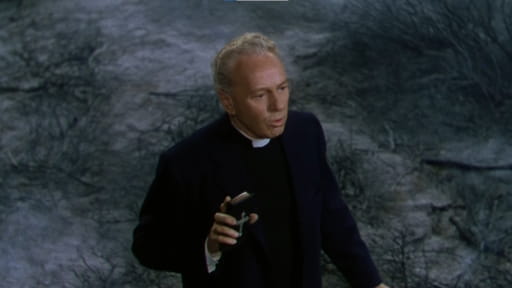
I like both films, but I prefer Billy the Kid vs Dracula — probably because of John Carradine’s over-the-top performance. I also like how the start of the film is a bit of an homage to Stagecoach. And I like the happy ending.

You can find Billy the Kid vs Dracula online but the prints range from fairly bad to unwatchable. Last year, KL Studio Classics released what is probably the best version we will get on DVD and Blu-ray. They both come with a commentary track by writers Lee Gambin and John Harrison. If you want to get Jesse James Meets Frankenstein’s Daughter, Elite Entertainment produced a good version on DVD with a Joe Bob Briggs commentary track.

But you don’t need to buy either since both these films litter the internet. Here is a decent print of Billy the Kidd vs Dracula:

And here is a so-so print of Jesse James Meets Frankenstein’s Daughter:

Other Anniversaries for April 10th

Filmmakers:

  • Harry Morgan (1915-2011)
  • Chuck Connors (1921-1992)
  • Max Von Sydow (1929-2020)
  • Omar Sharif (1932-2015)
  • Steven Seagal (1952-)
  • Orlando Jones(1968-)
  • Haley Joe Osment (1988-).

Films:

  • The Incredible Shrinking Man (1957)
  • Blood and Black Lace (1964)
  • Multiple Maniacs (1970)
  • Tombs of the Blind Dead (1972)
  • Excalibur (1981)
  • Knightriders (1981)
  • The Howling (1981)
  • Subway (1985)
  • Silent Night, Deadly Night Part 2 (1987)
  • FernGully: The Last Rainforest (1992)
  • Sleepwalkers (1992)
  • Species II (1998)
  • Dr Horror’s Erotic House of Idiots (2004)
  • Skin Crawl (2007)
  • Dragonball Evolution (2009)
  • Vampiress: Lady of the Night (2010).

Billy the Kid vs Dracula (1966) poster via Wikipedia under Fair Use. Jesse James Meets Frankenstein’s Daughter (1966) poster via Wikipedia under Fair Use.

Family Plot (1977)

Family Plot Turns 50 and Is Still Loads of Fun

Family Plot (1977) poster

Universal Pictures released Family Plot on 9 April 1976.

It was the last film that Alfred Hitchcock directed. And it was a good swan song. It is a whole lot of fun.

Of course, Hitchcock shows his usual attention to detail. The special effects are quite bad. He uses rear projection throughout and it is dreadful. And he uses an under-cranked camera in the runaway car sequence that doesn’t really work. It’s shocking that a director so known for his care and control took so little care with these things.

But the runaway car sequence, despite its obvious problems, is extremely effective. And the acting by Barbara Harris and Bruce Dern makes it hilarious.

The overall film is uneven in regard to comedy. But that’s a choice. The screenplay establishes one of the plot lines as a comedy and the other as a drama. Hitchcock has done both successfully in other films. And the contrast works well here. It does make me wonder why he didn’t direct more comedy. He clearly understood it. Just watch any episode of Alfred Hitchcock Presents.

I was slightly disappointed that the script didn’t find a way to save Karen Black. The plot set this up. But the film is already over two hours long. And screenwriter Ernest Lehman showed an admirable tendency to end films quickly. And saving black would have complicated the simple and sweet ending.

Family Plot will never displace Shadow of a Doubt or The Birds in my personal list of essential Hitchcock. But Hitchcock shot those films in my hometown. So I grew up thinking of them as iconic. And he did a better job making other films. But I don’t think you can find a film that is more entertaining from start to finish.

So let’s celebrate this golden anniversary by watching the film. If you haven’t seen it, you will enjoy it!

Other Anniversaries

Filmmakers:

  • Paul Robeson (1898-1976)
  • Marty Krofft (1937-2023)
  • Brandon deWilde (1942-1972)
  • Dennis Quaid (1954-)
  • Fred Dekker (1959-)
  • Cynthia Nixon (1966-).

Films:


Family Plot (1977) poster via Wikipedia under Fair use.

Rabid (1977)

“Rabid” and Early Cronenberg

Rabid (1977) poster

Cinépix Film Properties released Rabid in Canada and New World Pictures released it in the United States — both on 8 April 1977.

It was David Cronenberg‘s second feature film. (He made two hour-long films to start his career but most people don’t consider them features.) His first film was Shivers, which did well at the box office. Rabid did even better.

The story is bizarre. But if you know Cronenberg’s work, you will find it straightforward. After an experimental surgery, a young woman (Marilyn Chambers) becomes infected and grows a kind of sexual organ under her arm. She is compelled to use it to suck victims’ blood. She gets nutrition and the victim gets the virus that basically turns them into zombies.

The film is explicitly political. The second half of the film shows Montreal under martial law. But mostly, the film is interesting because of the body horror and the action.

This period of Cronenberg is typified by a lack of control in terms of setting. He just didn’t have the kind of budget to create the kinds of cinematic worlds that we get in later films like The Fly or Spider. But despite this limitation, he makes these films work. He just has a great eye. He holds the viewer’s attention without being flashy.

But for all its excellent rendering, I’m more interested in the writing of Rabid. Cronenberg does something very unusual. He creates a monster that is very pleasant and at first doesn’t know that she is a monster. We do get to enjoy her infecting the creep in the movie theater (Miguel Fernandes). But the “will she or won’t she” with her friend (Susan Roman) is almost unbearable (in a good way).

So on this 49th anniversary of the film’s release, let’s watch it! (If you’ve already seen it, there is a version with David Cronenberg’s commentary.

Other April 8th Anniversaries

Actors:

  • Mary Pickford (1892-1979)
  • Tim Thomerson (1946-)
  • Kane Hodder (1955-)
  • Robin Wright (1966-)
  • Patricia Arquette (1968-).

Filmmakers:

  • John Madden (1949-).

Films:

  • Colossus: The Forbin Project (1970)
  • Demon Seed (1977)
  • Bad Dreams (1988)
  • Leprechaun 2 (1994)
  • The Players Club (1998)
  • Day of the Dead (2008).

Rabid (1977) poster via Wikipedia under Fair Use.

High Plans Drifter (1973)

High Plains Drifter Is the Best Clint Eastwood Film

High Plans Drifter (1973) poster

Universal Pictures released High Plains Drifter on 7 April 1973. It had a single showing premiere the day earlier in Los Angeles. Cinema International Corporation released it outside the United States over the following months.

Clint Eastwood directed the film — it was his second feature after Play Misty For Me. I like Eastwood as a director. He focuses on telling stories. And no one has pushed him as a great director. He is what most good directors are: competent. He doesn’t get in the way of the story. And that’s more than you can say about most of the directors who people fetishize.

It is a remarkable film. I love its supernatural foundation. Eastwood did this again roughly a decade later with Pale Rider. But I find that film insipid. And it is utterly dependent on the Eastwood legend. The big problem is that the screenplay is weak — little more than a series of tropes.

Ernest Tidyman wrote the screenplay for High Plains Drifter and that is why it works so well. It is wonderfully devoid of Christian theology. And at base, it’s a revenge story. But this ghost has not just come to kill them that killed him. He’s also there to teach the weak a lesson. (And yes! I could shoehorn that into the Bible!)

The cast is great in the film. If there is one weak member, it is Eastwood himself. He’s fine. But he doesn’t take the role as seriously as he should have. John Cassavetes would have been great in the part. But it is what it is.

So let’s celebrate the 53rd anniversary of the release of High Plains Drifter by watching it!

Other April 7th Anniversaries

Actors:

  • RG Armstrong (1917-2012)
  • James Garner (1928-2014)
  • Andrew Sachs (1930-2016)
  • Wayne Rogers (1933-2015)
  • Ian Richardson (1934-2007)
  • Jackie Chan (1954-)
  • Russell Crowe (1964-).

Directors:

  • Alan J Pakula (1928-1998)
  • Francis Ford Coppola (1939-).

Misc:

  • Stan Winston (1946-2008).

Films:


High Plans Drifter (1973) poster via Wikipedia under Fair Use.

Django (1966)

Django After 60 Years

Django 1966

Euro International Films first released Django in Italy on 6 April 1966. Co-written and directed by Sergio Corbucci, it has his usual locomotive-level subtlety. At its time, it was considered extremely violent. They didn’t even let adults see it in the UK until the 1990s, which is, you know, ridiculous. Today, it seems pretty tame.

But nothing has taken away from the film’s effectiveness. Westerns are, at their core, about the conflict of Good and Evil. The only thing that determines whether I want to watch one is if the hero is suitably interesting.

The main villain, Major Jackson, is shaved and well-dressed. He looks like a hero from central casting. Django, in contrast, is scruffy and drags around a coffin through the mud.

Why Django Works

But what really makes Django work is its over-the-top action that seems more like a Hong Kong martial arts film than anything by John Ford or Akira Kurosawa. Most of the time, you don’t see Django shoot anyone. There are simply some gunshots and six men lie dead.

It’s hard not to compare Corbucci with Sergio Leone. I understand why the latter is held in such high respect. His films tend to be more artful. At the same time, they are also more self-indulgent. Leone usually believed that a scene that needed one minute should take five. Corbucci directs more like a storyteller. His pacing is perfect and nothing gets in the way of the drama.

Django plays for a very speedy hour and a half. Sadly, little effort was put into syncing the English version. The performances are fine, however; so you can try to avoid noticing. But it’s also interesting just how different the Italian and English performances are. You get a very different feel from the two versions. The Italian version is grittier and the English more comedic. So take your pick!

Here is the English version:

Here is the Italian version with subtitles:

One thing just between us, I like Franco Nero a lot more than Clint Eastwood in this kind of part. Two decades later, he played Django again in Django Strikes Again.

There is one funny thing: the title. Django ends up with his hands crippled, so they named the character after the handicapped jazz guitarist Django Reinhardt.

Also on August 6th

The following films were released on August 6th: The Thing From Another World (1951), I Vampiri (1957), In Harm’s Way (1965), Faster, Pussycat! Kill! Kill! (1965), The Ghost In the Invisible Bikini (1966), Rasputin: The Mad Monk (1966), The Reptile (1966), Audrey Rose (1977), The First Power (1990), Grindhouse (2007), Denizen (2010), Malpractice (2010), and ATM (2012).

Actors born on this day: Billy Dee Williams (89), John Ratzenberger (79), Marilu Henner (74), Michael Rooker (71), Paul Rudd (57), Diora Baird (43). And director Barry Levinson is 84.

Also born on August 6th: Screenwriter Dudley Nichols (1895-1960) and director Ivan Dixon (1931-2008).


Django Poster from Euro International Films via Fair use.

The Masque of the Red Death - Roger Corman

Roger Corman After 100 Years

Roger Corman

Roger Corman was born on 5 April 1926. He lived to be 98 — dying on 9 May 2024.

I have mixed feelings about Corman. On the one hand, as I’ve written before, “Regardless of the film, he tended to do a better job than other low-budget directors.” On the other hand, he was a low-budget producer and thus almost guaranteed to be a dick.

Let me tell you one story. When they were looking for funding for their Corman/Poe homage, Elvira’s Haunted Hills, Mark Pierson and Cassandra Peterson met with Corman. He really liked the project and offered himself a 30 percent stake in the film.

That’s right: if they paid him 30 percent of the profits, they could put his name on it. Otherwise, nothing. This goes along with all the “Roger Corman” releases that have little if anything to do with him.

Don’t get me wrong: I understand that we live under capitalism and this is the way things are. And if he hadn’t been this way, he wouldn’t have been successful. Just the same, I prefer how Russ Meyer was a money-grubbing bastard only about his own films.

But Corman is impressive. Regardless of how ridiculous his films sound, he always made them work. And his best work is great. Like most people, I love his Poe cycle.

Corman hasn’t directed that many films, though. It was his association with American International Pictures that allowed him to stretch his wings in this regard. He would always be a producer at heart. And during the last half of his life, it was all about providing money (or not) and getting his name on pictures.

But from his earliest films, like The Fast and the Furious, he helped create a lot of quality material for the low-budget market. And generally, he made the industry better.

I think Corman’s best film is The Masque of the Red Death. So let’s watch it on this day he would have turned 100!

Other Anniversaries

Films released on April 5th: One Million BC (1940), The Degenerates (1967), Theatre of Blood (1973), Foxy Brown (1974), There’s Nothing Out There (1991), Fargo (1996), Dead Air (1999), Scream Queen (2003), The Reaping (2007), The Despair (2009), Ancient Evil 2: Guardian of the Underworld (2005), Blood Rites (2012)

Actors born on this day: Walter Huston (1883-1950), Spencer Tracy (1900-1967), Melvyn Douglas (1901-1981), Bette Davis (1908-1989), Gregory Peck (1916-2003), Michael V Gazzo (1923-1995), Nigel Hawthorne (1929-2001), and Frank Gorshin (1933-2005). Michael Moriarty is 85, Max Gail is 83, and Jane Asher is 80.

Producer Albert R Broccoli (1909-1996) and director Kurt Neumann (1908-1958) were born on this day. Director Peter Greenaway is 84.


Image cropped from Roger Corman by OIFF. Licensed under CC BY-SA 3.0.

The Trial (1962) - Anthony Perkins

Anthony Perkins and The Trial

Anthony Perkins

Anthony Perkins was born on 4 April 1932.

He was only 60 years old when he died of complications related to AIDS. It’s particularly tragic given he certainly had a lot more work he likely would have done. Still, for someone so associated with one role, he left a lot of work — including other times he played Norman Bates.

Perkins had quite a colorful career and was always a remarkably compelling actor. But we will always remember him for his breakout performance in Psycho.

He was already an established actor at that time, but not well-enough known to be prevented from acceptance as a truly messed-up character. Until recently, I thought mostly about the film in terms of its effect on me rather than what was going on with poor Norman Bates.

I mean: he’s Ed Gein. Both men seemed to really miss their mamas. And both mamas seem to have been awful. We have the facts for Gein. We only have what Norman has going on in his mind. Maybe she was great when she was alive!

But I’m not a huge fan of the film. I do think it’s one of Hitchcock’s best. But it has its problems. The beginning is pretty slow. And then there is that damned ending. I’m not talking about Norman in mama’s clothes with a chef’s knife. I mean the ending with all the psychobabble from Simon Oakland (The Night Stalker).

The Trial

I prefer him in Orson Welles’ criminally neglected The Trial. Anthony Perkins has the perfect combination of intelligence and paranoia to play Josef K. And I don’t think Kafka has ever been so well translated to the screen. If you haven’t seen it, you must! And this is a good print!

Other Anniversaries

Actors:

  • Richard Coogan (1914-2014)
  • David White (1916-1990)
  • Elizabeth Wilson (1921-2015)
  • Peter Vaughan (1923-2016)
  • Kenneth Mars (1935-2011)
  • Heath Ledger (1979-2008)
  • Craig T Nelson (1944-)
  • Julie Carmen (1954-)
  • Hugo Weaving (1960-)
  • A Michael Baldwin 1963-)
  • David Cross (1964-)
  • Robert Downey Jr (1965-).

Producer:

  • Gene Reynolds (1923-2020).

Films:


Cropped from Anthony Perkins by Allan Warren under CC BY-SA 3.0.

Man With the Screaming Brain (2005)

Man With the Screaming Brain

Man With the Screaming Brain (2005) poster

Anchor Bay Entertainment premiered Man With the Screaming Brain on 3 April 2005 at the Broadway Theatre in Pitman, New Jersey. It hit the film festival circuit over the following months. And Anchor Bay released it in limited theaters on 6 June. But SyFy was a major backer of the film. And they aired it on 10 September.

Bruce Campbell went all out on this one! He wrote, produced, and directed it. And he put in one of his best (and most over-the-top) performances. He also surrounded himself with a great cast.

Man With the Screaming Brain is effortless. It doesn’t try to make a lot of sense. And it spends no time connecting sequences. The Ted Raimi character, Pavel, is there offscreen — making the plot elements fit together.

The reviews for the film were mostly bad. For a change, the critics seem to understand the film’s intent. But that doesn’t seem to have helped. It is the kind of film you have to accept and move forward with. You will be sorely disappointed if you try to put it in a box. But that’s what makes it so great! It’s almost the definition of silliness. And it’s extremely sweet. But it’s also kinda… thought-provoking!

I always have a problem writing about films like this. There really isn’t a lot to say. Everyone should just watch it! But it’s important to let the film control the experience. It is what it is. It’s a wild ride. Just hang on. But try not to worry about its many plot holes. The filmmakers didn’t!


Man With the Screaming Brain (2005) poster via Wikipedia under Fair Use.

The Last Shark (1981)

The Last Shark: The Film the Government Didn’t Want You to See

The Last Shark (1981) poster

Variety Distribution released The Last Shark in the United States on 2 April 1981.

This film is a variation (or parody) of Jaws. But that was not acceptable to Universal Pictures. So when the film came to the US, Universal sued the producers. and eventually got it banned. And it is ridiculous! There are many similarities. But the producers do not plagiarize Jaws. In fact, the plot itself is quite different. Everything else is an allusion.

The Last Shark is a response to Jaws. Almost everything in the film comments on it. Some are just tropes that don’t matter. For example, the mayor who cares more about his career than the people he represents. But in Jaws, his bad decision humiliates him. Here, the shark eats him!

Or the shark that eats through the netting. A buoy gets attached to the shark. So it is just like the barrels in Jaws. But only one scene uses it.

But what is this all about? Universal released Jaws in 1975. By 1981, it had made its money. But as I have long said: if a corporation could make a penny by shipping a million jobs overseas, they would do it. The question is whether we as a society should accept that. Currently, we do.

The Last Shark is a perfectly respectable monster movie. But as meta-cinema — as a film to watch in the context of Jaws — it is wonderful. The two films would make a great double feature. But the Rentier Class (which totally controls our courts) doesn’t want to allow this. Rather than let art run wild, they think it is more important for rich people to make every cent they can from their investments.

I will admit one problem with this film: Lucio Fulci should have directed it. It would have included the gore this film is sadly lacking. This is why, websites like OK.RU are so important. Watch!


The Last Shark (1981) poster via Wikipedia under Fair Use.

The Little Shop of Horrors (1960) - Jonathan Haze

What Ever Happened to Jonathan Haze?

Jonathan Haze

Jonathan Haze was born on 1 April 1929.

I had assumed that he died young. He was in a bunch of Roger Corman films in the late 1950s and early 1960s. And then he mostly disappeared. But he only died a year and a half ago — at the age of 95.

If you believe Wikipedia, you would think that Haze was just working at a gas station when he was discovered. But back in 1998, Psychotronic Video interviewed him. He was pushing 70. And his memory wasn’t great. For example, he claimed, “[Buddy Rich] led Woodrow Wilson’s inaugural parade…” Well, Rich was born in 1917. And Wilson’s second inaugural was over 5 months before that. Still, that’s the kind of thing people mess up. He might have meant Warren G Harding, which would make sense based on other things Haze said.

Regardless, in the interview, we learn that Haze was active in theater in his hometown of Pittsburgh. And he specifically moved to Los Angeles to act. He did indeed get a job at the Tide Oil Company gas station on Santa Monica Boulevard. And he did indeed meet “little guy” Wyott Ordung (but Haze refers to him by his middle name, Barney). Ordung wrote the screenplay for Robot Monster. But at the time, he was directing Monster from the Ocean Floor, and he cast Haze in a small role.

That film was the first one that Roger Corman produced. And it started a long working relationship between Jonathan Haze and him. They made roughly a dozen films together. He played small roles in all of them. Except for The Little Shop of Horrors. Jonathan Haze is mostly remembered for this film. And why not? It’s a lot of fun! I think A Bucket of Blood is better. But the two make a great double feature!

After this period, Haze didn’t work a lot in feature films. He met Haskell Wexler in the late-1960s. The two of them did a lot of commercial production. Haze did admit to wanting to get back into acting. But it never really worked out. Hollywood is incredibly stratified. And coming back is very hard, even when people respect the low-budget films you made.


Jonathan Haze in The Little Shop of Horrors via Archive. It is in the public domain.