Category Archives: Anniversaries

Django (1966)

Django After 60 Years

Django 1966

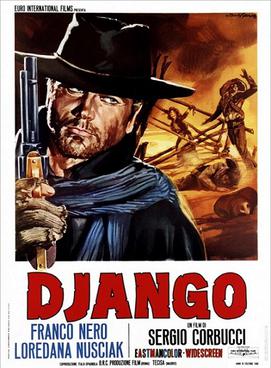
Euro International Films first released Django in Italy on 6 April 1966. Co-written and directed by Sergio Corbucci, it has his usual locomotive-level subtlety. At its time, it was considered extremely violent. They didn’t even let adults see it in the UK until the 1990s, which is, you know, ridiculous. Today, it seems pretty tame.

But nothing has taken away from the film’s effectiveness. Westerns are, at their core, about the conflict of Good and Evil. The only thing that determines whether I want to watch one is if the hero is suitably interesting.

The main villain, Major Jackson, is shaved and well-dressed. He looks like a hero from central casting. Django, in contrast, is scruffy and drags around a coffin through the mud.

Why Django Works

But what really makes Django work is its over-the-top action that seems more like a Hong Kong martial arts film than anything by John Ford or Akira Kurosawa. Most of the time, you don’t see Django shoot anyone. There are simply some gunshots and six men lie dead.

It’s hard not to compare Corbucci with Sergio Leone. I understand why the latter is held in such high respect. His films tend to be more artful. At the same time, they are also more self-indulgent. Leone usually believed that a scene that needed one minute should take five. Corbucci directs more like a storyteller. His pacing is perfect and nothing gets in the way of the drama.

Django plays for a very speedy hour and a half. Sadly, little effort was put into syncing the English version. The performances are fine, however; so you can try to avoid noticing. But it’s also interesting just how different the Italian and English performances are. You get a very different feel from the two versions. The Italian version is grittier and the English more comedic. So take your pick!

Here is the English version:

Here is the Italian version with subtitles:

One thing just between us, I like Franco Nero a lot more than Clint Eastwood in this kind of part. Two decades later, he played Django again in Django Strikes Again.

There is one funny thing: the title. Django ends up with his hands crippled, so they named the character after the handicapped jazz guitarist Django Reinhardt.

Also on August 6th

The following films were released on August 6th: The Thing From Another World (1951), I Vampiri (1957), In Harm’s Way (1965), Faster, Pussycat! Kill! Kill! (1965), The Ghost In the Invisible Bikini (1966), Rasputin: The Mad Monk (1966), The Reptile (1966), Audrey Rose (1977), The First Power (1990), Grindhouse (2007), Denizen (2010), Malpractice (2010), and ATM (2012).

Actors born on this day: Billy Dee Williams (89), John Ratzenberger (79), Marilu Henner (74), Michael Rooker (71), Paul Rudd (57), Diora Baird (43). And director Barry Levinson is 84.

Also born on August 6th: Screenwriter Dudley Nichols (1895-1960) and director Ivan Dixon (1931-2008).


Django Poster from Euro International Films via Fair use.

The Masque of the Red Death - Roger Corman

Roger Corman After 100 Years

Roger Corman

Roger Corman was born on 5 April 1926. He lived to be 98 — dying on 9 May 2024.

I have mixed feelings about Corman. On the one hand, as I’ve written before, “Regardless of the film, he tended to do a better job than other low-budget directors.” On the other hand, he was a low-budget producer and thus almost guaranteed to be a dick.

Let me tell you one story. When they were looking for funding for their Corman/Poe homage, Elvira’s Haunted Hills, Mark Pierson and Cassandra Peterson met with Corman. He really liked the project and offered himself a 30 percent stake in the film.

That’s right: if they paid him 30 percent of the profits, they could put his name on it. Otherwise, nothing. This goes along with all the “Roger Corman” releases that have little if anything to do with him.

Don’t get me wrong: I understand that we live under capitalism and this is the way things are. And if he hadn’t been this way, he wouldn’t have been successful. Just the same, I prefer how Russ Meyer was a money-grubbing bastard only about his own films.

But Corman is impressive. Regardless of how ridiculous his films sound, he always made them work. And his best work is great. Like most people, I love his Poe cycle.

Corman hasn’t directed that many films, though. It was his association with American International Pictures that allowed him to stretch his wings in this regard. He would always be a producer at heart. And during the last half of his life, it was all about providing money (or not) and getting his name on pictures.

But from his earliest films, like The Fast and the Furious, he helped create a lot of quality material for the low-budget market. And generally, he made the industry better.

I think Corman’s best film is The Masque of the Red Death. So let’s watch it on this day he would have turned 100!

Other Anniversaries

Films released on April 5th: One Million BC (1940), The Degenerates (1967), Theatre of Blood (1973), Foxy Brown (1974), There’s Nothing Out There (1991), Fargo (1996), Dead Air (1999), Scream Queen (2003), The Reaping (2007), The Despair (2009), Ancient Evil 2: Guardian of the Underworld (2005), Blood Rites (2012)

Actors born on this day: Walter Huston (1883-1950), Spencer Tracy (1900-1967), Melvyn Douglas (1901-1981), Bette Davis (1908-1989), Gregory Peck (1916-2003), Michael V Gazzo (1923-1995), Nigel Hawthorne (1929-2001), and Frank Gorshin (1933-2005). Michael Moriarty is 85, Max Gail is 83, and Jane Asher is 80.

Producer Albert R Broccoli (1909-1996) and director Kurt Neumann (1908-1958) were born on this day. Director Peter Greenaway is 84.


Image cropped from Roger Corman by OIFF. Licensed under CC BY-SA 3.0.

The Trial (1962) - Anthony Perkins

Anthony Perkins and The Trial

Anthony Perkins

Anthony Perkins was born on 4 April 1932.

He was only 60 years old when he died of complications related to AIDS. It’s particularly tragic given he certainly had a lot more work he likely would have done. Still, for someone so associated with one role, he left a lot of work — including other times he played Norman Bates.

Perkins had quite a colorful career and was always a remarkably compelling actor. But we will always remember him for his breakout performance in Psycho.

He was already an established actor at that time, but not well-enough known to be prevented from acceptance as a truly messed-up character. Until recently, I thought mostly about the film in terms of its effect on me rather than what was going on with poor Norman Bates.

I mean: he’s Ed Gein. Both men seemed to really miss their mamas. And both mamas seem to have been awful. We have the facts for Gein. We only have what Norman has going on in his mind. Maybe she was great when she was alive!

But I’m not a huge fan of the film. I do think it’s one of Hitchcock’s best. But it has its problems. The beginning is pretty slow. And then there is that damned ending. I’m not talking about Norman in mama’s clothes with a chef’s knife. I mean the ending with all the psychobabble from Simon Oakland (The Night Stalker).

The Trial

I prefer him in Orson Welles’ criminally neglected The Trial. Anthony Perkins has the perfect combination of intelligence and paranoia to play Josef K. And I don’t think Kafka has ever been so well translated to the screen. If you haven’t seen it, you must! And this is a good print!

Other Anniversaries

Actors:

  • Richard Coogan (1914-2014)
  • David White (1916-1990)
  • Elizabeth Wilson (1921-2015)
  • Peter Vaughan (1923-2016)
  • Kenneth Mars (1935-2011)
  • Heath Ledger (1979-2008)
  • Craig T Nelson (1944-)
  • Julie Carmen (1954-)
  • Hugo Weaving (1960-)
  • A Michael Baldwin 1963-)
  • David Cross (1964-)
  • Robert Downey Jr (1965-).

Producer:

  • Gene Reynolds (1923-2020).

Films:


Cropped from Anthony Perkins by Allan Warren under CC BY-SA 3.0.

Man With the Screaming Brain (2005)

Man With the Screaming Brain

Man With the Screaming Brain (2005) poster

Anchor Bay Entertainment premiered Man With the Screaming Brain on 3 April 2005 at the Broadway Theatre in Pitman, New Jersey. It hit the film festival circuit over the following months. And Anchor Bay released it in limited theaters on 6 June. But SyFy was a major backer of the film. And they aired it on 10 September.

Bruce Campbell went all out on this one! He wrote, produced, and directed it. And he put in one of his best (and most over-the-top) performances. He also surrounded himself with a great cast.

Man With the Screaming Brain is effortless. It doesn’t try to make a lot of sense. And it spends no time connecting sequences. The Ted Raimi character, Pavel, is there offscreen — making the plot elements fit together.

The reviews for the film were mostly bad. For a change, the critics seem to understand the film’s intent. But that doesn’t seem to have helped. It is the kind of film you have to accept and move forward with. You will be sorely disappointed if you try to put it in a box. But that’s what makes it so great! It’s almost the definition of silliness. And it’s extremely sweet. But it’s also kinda… thought-provoking!

I always have a problem writing about films like this. There really isn’t a lot to say. Everyone should just watch it! But it’s important to let the film control the experience. It is what it is. It’s a wild ride. Just hang on. But try not to worry about its many plot holes. The filmmakers didn’t!


Man With the Screaming Brain (2005) poster via Wikipedia under Fair Use.

The Last Shark (1981)

The Last Shark: The Film the Government Didn’t Want You to See

The Last Shark (1981) poster

Variety Distribution released The Last Shark in the United States on 2 April 1981.

This film is a variation (or parody) of Jaws. But that was not acceptable to Universal Pictures. So when the film came to the US, Universal sued the producers. and eventually got it banned. And it is ridiculous! There are many similarities. But the producers do not plagiarize Jaws. In fact, the plot itself is quite different. Everything else is an allusion.

The Last Shark is a response to Jaws. Almost everything in the film comments on it. Some are just tropes that don’t matter. For example, the mayor who cares more about his career than the people he represents. But in Jaws, his bad decision humiliates him. Here, the shark eats him!

Or the shark that eats through the netting. A buoy gets attached to the shark. So it is just like the barrels in Jaws. But only one scene uses it.

But what is this all about? Universal released Jaws in 1975. By 1981, it had made its money. But as I have long said: if a corporation could make a penny by shipping a million jobs overseas, they would do it. The question is whether we as a society should accept that. Currently, we do.

The Last Shark is a perfectly respectable monster movie. But as meta-cinema — as a film to watch in the context of Jaws — it is wonderful. The two films would make a great double feature. But the Rentier Class (which totally controls our courts) doesn’t want to allow this. Rather than let art run wild, they think it is more important for rich people to make every cent they can from their investments.

I will admit one problem with this film: Lucio Fulci should have directed it. It would have included the gore this film is sadly lacking. This is why, websites like OK.RU are so important. Watch!


The Last Shark (1981) poster via Wikipedia under Fair Use.

The Little Shop of Horrors (1960) - Jonathan Haze

What Ever Happened to Jonathan Haze?

Jonathan Haze

Jonathan Haze was born on 1 April 1929.

I had assumed that he died young. He was in a bunch of Roger Corman films in the late 1950s and early 1960s. And then he mostly disappeared. But he only died a year and a half ago — at the age of 95.

If you believe Wikipedia, you would think that Haze was just working at a gas station when he was discovered. But back in 1998, Psychotronic Video interviewed him. He was pushing 70. And his memory wasn’t great. For example, he claimed, “[Buddy Rich] led Woodrow Wilson’s inaugural parade…” Well, Rich was born in 1917. And Wilson’s second inaugural was over 5 months before that. Still, that’s the kind of thing people mess up. He might have meant Warren G Harding, which would make sense based on other things Haze said.

Regardless, in the interview, we learn that Haze was active in theater in his hometown of Pittsburgh. And he specifically moved to Los Angeles to act. He did indeed get a job at the Tide Oil Company gas station on Santa Monica Boulevard. And he did indeed meet “little guy” Wyott Ordung (but Haze refers to him by his middle name, Barney). Ordung wrote the screenplay for Robot Monster. But at the time, he was directing Monster from the Ocean Floor, and he cast Haze in a small role.

That film was the first one that Roger Corman produced. And it started a long working relationship between Jonathan Haze and him. They made roughly a dozen films together. He played small roles in all of them. Except for The Little Shop of Horrors. Jonathan Haze is mostly remembered for this film. And why not? It’s a lot of fun! I think A Bucket of Blood is better. But the two make a great double feature!

After this period, Haze didn’t work a lot in feature films. He met Haskell Wexler in the late-1960s. The two of them did a lot of commercial production. Haze did admit to wanting to get back into acting. But it never really worked out. Hollywood is incredibly stratified. And coming back is very hard, even when people respect the low-budget films you made.


Jonathan Haze in The Little Shop of Horrors via Archive. It is in the public domain.

Golden Raspberry Awards

Golden Raspberry Awards Is What’s Wrong With Awards

Golden Raspberry Awards

The Golden Raspberry Awards held their first ceremony on 31 March 1981.

It will surprise no one that I hate this. And it sums up the film critic industry. But what is the point of talking about films you hate? For every bad film that gets reviewed a thousand times, there are hundreds of good low-budget independent films that no one has heard of.

The Golden Raspberry Awards do have one good aspect. They don’t criticize low-budget independent films. But this just highlights the opportunity cost of the whole thing. It defines these largely unseen films out of existence.

But it goes after plenty of films that are later re-evaluated as good. For example, they nominated Ishtar for three awards: film, director, and screenwriter. But it won for director. The idea that Elaine May wrote a bad screenplay is laughable. And we all know why critics hated the film. It committed the greatest sin a film can commit: it was a comedy with a large budget!

Heaven’s Gate got the same treatment. Michael Cimino won the award for worst director. And like with Ishtar, the reviews were more about its budget than the film.

The Golden Raspberry Awards are really just a gossip column in awards format. And I just don’t see the point. The judges seem to do little more than listen to what industry insiders are saying and then vote. They should retire it and use an LLM to give out the awards. It would at least be quantitative.

The awards are a parody of award shows — in theory. It they actually were, I would love them! But they are just the dark side of other award shows. They are conventional wisdom, just negative. But they could still be good, though. They could use their celebrity to highlight low-budget independent films. “Hey! These mainstream films suck! But you could watch this little gem instead!”

But no. I doubt the people involved are even aware that there is anything else.


Golden Raspberry Awards via Wikipedia under Fair Use. Featured Image by karaokefanboy under CC BY-SA 2.0.

The Addams Family TV show - John Astin

John Astin, The Addams Family, and More

Carolun Jones and John Astin

John Astin turns 96 years old today. He was born on 30 March 1930.

Everyone knows him for The Addams Family TV series. And shockingly, he is the last surviving actor in the main cast — after the early death of Lisa Loring, who played Wednesday Addams. He really does define the character of Gomez Addams going forward. While in the comics, he was more of a general conniving weirdo. But the TV show turned him into more of a Latin Lover weirdo. It’s a more compelling character — and very typical of the actor.

John Astin has had a great career, even outside of The Addams Family. For one thing, in the 1970s and 1980s, he directed a lot of TV. That included some Night Gallery episodes: “The House,” “A Fear of Spiders,” and “The Dark Boy.” The first of these is probably my favorite episode of the series. It haunted me for many years after seeing it as a kid. It still gives me goosebumps to think about it even today.

Astin also starred in three episodes of the show. Interestingly, he didn’t star in any of them (as was common among actors turned directors). He starred in two where (“Pamela’s Voice” and “Hell’s Bells”) he’s in Hell. And he has a small role in the excellent “The Girl with the Hungry Eyes.”

But as an actor, he got his first big break as the lead in I’m Dickens, He’s Fenster. It was one of those shows that probably would have been a big hit had it not been cancelled just as it started to gain an audience. Two years later, he created the role of Gomez on The Addams Family.

Despite creating such an iconic character, John Astin has largely not been typecast. He has played a wide variety of roles since then. He starred in Operation Petticoat in the mid-1970s. But mostly, he played guest roles on TV shows. And, of course, he played Professor Mortimer Gangreen in all the Killer Tomatoes films except the first. Here are links to all the films (except the last):

But I’ll just embed the first episode of The Addams Family here:


Carolun Jones and John Astin via Wikimedia. It is in the public domain.

The Birds (1963)

The Birds Is Great (With Caveats)

The Birds (1963) poster

Universal Pictures released The Birds on 29 March 1963 in the United States. It premiered in a small number of theaters internationally the day before.

I love The Birds. It was shot in and around Bodega Bay, which is near where I grew up. And when I was a kid, the whole family gathered to watch it each year when it played on TV. The film terrified me. And why not? As Ethel Griffies explains in the film, “I have never known birds of different species to flock together. The very concept is unimaginable. Why, if that happened, we wouldn’t stand a chance! How could we possibly hope to fight them?”

Indeed. This film may explain my obsession with crows. But I know any self-respecting crow would never hang out with a gull!

The Birds features many great sequences. The best scene involves the jungle gym outside the schoolhouse. The structure is empty. But as Tippi Hedren waits and smokes a cigarette, she notices a couple of crows fly past. She turns and sees the jungle gym is filled with crows. It is a great jumpscare with absolutely no musical accent. All we hear is what we have heard: the kids singing “Risselty Rosselty.”

The film includes other great scenes like everything around The Tides restaurant. And the last half-hour of the film with the big bird attack.

But the film has lots of problems. The biggest is the whole romantic subplot. The principals have no chemistry on screen. And their interest in each other only makes them less likable. But most of all, it slows down the plot. The first bird attack doesn’t take place for 25 minutes. The next attack takes another 25 minutes. And the film is not well structured. Suzanne Pleshette dies off-screen! And, of course, since this is a Hitchcock film, it has to include terrible rear projection.

But okay. I know it is supposed to be suspenseful and a slow-burn. But when I watch it now, I skip the first 40 minutes. And I would skip more, but I love Pleshette!

Regardless, The Birds is a psychotronic classic. Everyone should watch it at least once.


The Birds (1963) poster via Wikimedia. It is in the public domain.

The Conqueror (1956)

The Conqueror and John Wayne

The Conqueror (1956) poster

RKO Radio Pictures released The Conqueror on 28 March 1956.

It is a CinemaScope extravaganza about the rise of Genghis Khan. Directed by Dick Powell, it does not disappoint in terms of battle scenes and spectacle. At the time of its release, John McCarten correctly noted, “You never saw so many horses fall down in your life.”

And if that were all? It is a well-made and fun old film. But it’s not. For some reason, John Wayne is Genghis Khan. Even without speaking, he looks silly with the Fu Manchu mustache. And he moves awkwardly, although I guess that’s part of his persona.

It’s when he speaks that Wayne is at his worst. Every character was apparently the same for him — be it Genghis Khan or Cole Thornton or the Ringo Kid.

It’s hard not to chuckle watching The Conqueror. Everyone else in the film can act. And then there’s John Wayne who sticks out like a Make a Wish kid whose dream was to play with the Harlem Globetrotters.

Synopsis

In it, Temujin (who will become Genghis Khan) basically goes to war because he has the hots for Bortai (Susan Hayward). He gets her quickly with a combination of bad tactics and overwhelming force.

Temujin’s mother (Agnes Moorehead) is unhappy about the “red-headed Jezebel.” (Yes, that’s actual dialog!) But then, no one is pleased. She doesn’t want to be there and is determined to cause trouble. His brother, Jamuga (Pedro Armendáriz), considers setting her free. (Jamuga is far more heroic in the film and believable as the Mongol leader.)

This is a great set-up for a tragedy, but we already know who Genghis Khan is. Add to that John Wayne and we’re talking major happy time by the end. Within 15 minutes after her capture Bortai is passionately kissing Temujin.

Cancer!

The producers shot many of the exterior scenes in The Conqueror downwind of the Nevada National Security Site, where they tested a lot of nuclear weapons. Many claim that this was the cause of such a large part of the cast and crew getting (and often dying from) cancer.

It’s not clear to me that this is actually the case. When people live long enough, they have a very high chance of getting cancer. It is true, however, that financial backer Howard Hughes thought he had effectively killed a bunch of people. He bought up all prints later and the film was not re-released until after his death.

What I think is most interesting is that so many people put themselves in danger for a film that mostly doesn’t work (at least as intended) because John Wayne never learned, or tried, to act.

Should You See The Conqueror?

The truth is that The Conqueror isn’t even good for people who like to laugh at films. There’s really only one joke. It’s a perfectly fine film. And then there’s John Wayne in the middle of it, messing everything up.

But it really should be seen!


The Conqueror (1956) poster via Wikimedia. It is in the public domain.