Category Archives: Anniversaries

Harry Houdini and His Psychotronic Films

Harry Houdini

Harry Houdini was born on 24 March 1874.

Are you surprised to see him highlighted here? Well, he made a number of films — first as an actor and later as a producer, writer, and director. Ultimately, he gave up making films. He claimed that the margins were too small. He may have thought so because his later films didn’t do that well. But he also made so much money performing live that it may have just been relatively disappointing.

Houdini started his film career with The Master Mystery. It was a 5+-hour 15-part serial. Some of the episodes are lost. But you can watch most of it online. In it, he plays a special agent on the trail of evil elites with a humanoid robot.

Following it, Houdini starred in The Grim Game. It was once thought lost. But in 2015, TCM released a restored print of the film. Paramount Pictures signed a two-film deal with him. The next year, he made Terror Island. After that, he started his own production company. It made a couple of films before he lost interest.

Historians consider The Grim Game the best Houdini film. I just watched it. And it is charming. Some of it is genuinely funny. Houdini does some of his escapes, which are interesting to watch. And the story is pretty good.

Houdini plays Harvey Hanford, a newspaper reporter. His uncle (who hates him) is about to bankrupt the paper he works at. So Hanford comes up with an idea to get his uncle to go on holiday secretly. So everyone will think he has been murdered. And there will be plenty of press because Hanford planted evidence — essentially framing himself. But wouldn’t you know it?! Someone actually murders his uncle and Hanford has to escape from jail and prove his innocence.

The climax of the film features Houdini climbing down a rope from one airplane to another. It is impressive. But more impressive is that when shooting the stunt, the two planes collided. Everyone (including stuntman David E Thompson) survived the collision.

Even though this is a silent film, I highly recommend watching it. I was charmed!


Harry Houdini via Wikimedia. It is in the public domain.
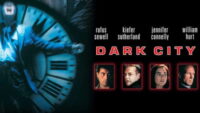
Dark City (1998) - Trevor Jones

Trevor Jones: Psychotronic Composer

Trevor Jones

Trevor Jones is 77 years old today. He was born on 23 March 1949.

I find it hard to talk about film composers. Most people don’t. I know a lot of film fans who obsess about film scores. But I feel like a composer has made a mistake if I’m noticing the score — for good or bad. What’s more, the best composers fit their styles to the film at hand.

(Note: I feel the same way about directors. People obsess about directors with distinct styles. But I think, for example, Stanley Kubrick was better early in his career. Later, he ossified. And no amount of screaming “Genius!” will change that. Story bent to his style rather than his style bending to the story.)

Of course, Jones has a style. He’s more tuneful than most film composers. But he isn’t tuneful to a fault like one composer I could name. I like the way he combines this with interesting rhythms. And I can’t think of a better composer when it comes to setting a mood. And that’s even more true when the mood is dark!

Trevor Jones was born in South Africa as a “Coloured” person under Apartheid. But he demonstrated great musical gifts early on in life. And by his late teens, he was in London. He went to work for the BBC. He worked on Ripping Yarns. But John Boorman gave him his first big break composing parts of Excalibur.

Jones composed an amazing score for one of my all-time favorite films, Angel Heart. Typically, it is a soundtrack that is good all by itself. But it sets the tone perfectly for the film. It combines crooner tunes with the dark tone of the story, I doubt the film would work without his score.

But there is another Trevor Jones score that hasn’t gotten enough love from me: Dark City. It too is a fantastic film that all psychotronic fans should see! Jones again captures the essence of the film. He combines an orchestral score with electronic music. Usually, this doesn’t work for me. But it is, as usual, fantastic. Let’s watch it!

(Note: this is the director’s cut. It really is notably better than the producer’s cut.)


Trevor Jones via Spotify under Fair Use.

Star Trek II - William Shatner

William Shatner Is a Great Actor

William Shatner

William Shatner is 95 years old today. He was born on 22 March 1931.

I have difficulty believing Shatner is still alive. Not only that. He’s still active. In fact, he recently shattered his shoulder when thrown from a horse! (People, please! Horses are evil. Stay away from horses!)

I’m not a huge fan of William Shatner. But people often claim that he’s a bad actor. Or that he over-acts. He doesn’t! People are really talking about the roles he plays. But even there, it’s wrong. He performs Captain Kirk with much subtlety when it is called for. But sure, he throws himself into big speeches when the time comes. That is how it should be!

Most people think of him as something of a one-trick pony. There’s Star Trek. And there’s TJ Hooker. But he is so much more than that! Shatner is a star in the traditional Hollywood sense of the word. Yet his credits on IMDb are more like those of a character actor. The man loves to act!

On this site, I’ve written about a number of his films. These include The Intruder, The Devil’s Rain, and The Babysitter. He also, of course, starred in one of the most famous episodes of The Twilight Zone.

But I like William Shatner best when he is histrionic. And so, we will watch Star Trek II: The Wrath of Khan. His performance compares so well with Ricardo Montalban’s performance. Montalban is another excellent actor who is often dismissed as overly theatrical. And we get to see the two men interact even though they are literally never in the same location!


Image cropped from William Shatner by Super Festivals under CC BY 4.0.

Faster, Pussycat! Kill! Kill! (1965) - Russ Meyer

Russ Meyer Beyond Sexploitation

Russ Meyer

Russ Meyer was born on 21 March 1922.

People know him primarily for his sexploitation films. But I barely think of that. He first entered my radar when I saw Eve and the Handyman. I loved that it was genuinely funny. And he continued to make films throughout his career that maintained this.

I also appreciate that his films are sex-positive. But this is largely true of the nudie cuties. Compared to films today, they have a breezy charm. But when simply showing women’s breasts was subversive, I guess this makes sense.

All of this is fun. But time has largely passed by these films. They are still good — way better than watchable. But Rush Meyer wasn’t a one-trick pony. He was a serious filmmaker. And we see this most clearly in the mid-1960s. He made three serious exploitation films:

Meyer returned to his sexy films for a while. Then Zanuck and Brown hired him to work at 20th Century Fox. He made the interesting Beyond the Valley of the Dolls. Then Fox signed a three-picture deal, which resulted in only one film, The Seven Minutes. After that, he made a handful of mostly sex comedies. And he ended his life making millions selling his catalog.

You can celebrate Russ Meyer’s birthday with any of his films. But I most wish that people watched the three mid-60s films listed above. You should really watch them all. But if you are only going to watch one, Faster, Pussycat! Kill! Kill! is the best.


Image cropped from Russ Meyer by Rebert under CC BY-SA 3.0.

Two Thousand Maniacs (1964)

“Two Thousand Maniacs!” Is Not as Good as It Should Be

Two Thousand Maniacs (1964) poster

Box Office Spectaculars released Two Thousand Maniacs! on 20 March 1964.

Herschell Gordon Lewis was no kind of artist. But he had a great idea here. As far as I know, it was the first time we get the horror film trope of Northern visitors being harassed by Southerners. And the film does it in a really great way.

Ghosts who were killed during the Civil War reincarnate every hundred years. They use the opportunity to take revenge against Northerners. And the film plays it straight. The Southerners are psychopaths. They just want to harm and kill the Northerners as collective punishment. But Lewis, originally from Pittsburgh, shows no sign of wanting to rationalize this behavior. The Southerners are just evil. Thankfully, he is not part of the vile history of the motion picture business justifying and even celebrating southern treason.

Two Thousand Maniacs! is the second of the Blood Trilogy. They bookended it between Blood Feast and Color Me Blood Red. And it is my least favorite of the three. Sure. The first is, in so many ways, just bad. But it knows what it’s doing. The gore in it is spectacular! And the last features a great central performance and an interesting plot.

But this one? The story’s pretty good. But it’s mostly just a set up for a number of gore scenes. But the gore is pretty tame! Regardless, no one watches a Friedman-Lewis film looking for deep thoughts and complex characters. Because their films appeal to our basest impulses. And this one just lies there on the screen. There is shockingly little blood!

But all psychotronic fans should see Two Thousand Maniacs! After that? I’ve seen it a few times. But I feel no interest in watching it again. I still watch Color Me Blood Red from time to time. I don’t watch Blood Feast. But that’s because I have literally watched it three dozen times! (I’m not insane; I was writing about it.)

If you’ve seen it before, you are excused from watching it again. But if not, well, you know what you need to do…


Two Thousand Maniacs (1964) poster via Wikipedia under Fair Use.

12 Monkeys - Bruce Willis

Bruce Willis and His Best Film

Bruce Willis

Bruce Willis was born on 19 March 1955.

Willis is suffering from frontotemporal dementia and probably is not long for this world. And I think this is incredibly sad. I’d rather people (including myself) just be quickly killed by a car. At the same time, he suffered from survivor bias late in his life. And his choice of films became poor even while his self-image went off the charts.

That was clear as early as 1996. He starred in the wonderful Walter Hill film Last Man Standing. Everything about that film is flawless. Except for Bruce Willis who almost destroys it. It’s still a good film. But with an actor who cared, it would have been great.

The same is true of the Die Hard franchise. The first two films were excellent. The third was watchable but bad. And the last two are crimes against humanity. Willis’ performances aren’t so much bad as nonexistent. And despite his claims to be something of a moderate Republican, we see him again and again choosing roles that glorify reactionary politics.

But there is one film that shows what Willis could do: 12 Monkeys. Terry Gilliam has discussed the problems they had getting a good performance from him. He was shooting Die Hard with a Vengeance at the same time. And they had to throw out a lot of footage because Willis just wasn’t engaging. But the end result is excellent. And combine that with the rest of the cast (which was excellent) and one of the best screenplays ever written, and you get something great.

So let us wish Bruce Willis well. And let’s enjoy what is definitely the high point of his career. When he is gone, it is how I will remember him.


Image cropped from Bruce Willis by Gage Skidmore under CC BY-SA 3.0.

Frankenstein (1910)

First Frankenstein on the Silver Screen

Frankenstein (1910) poster

The Edison Manufacturing Company released the first Frankenstein on 18 March 1910.

The motion picture industry started around 1890 and got going in the middle of the decade. By 1900, producers released upwards of 1,000 short films. So Frankenstein was late to the party. This is surprising! Producers presented Frankenstein on the stage just a few years after the novel was published. And when they did, they presented many different versions — including melodramas and burlesques.

This first filmed version of Frankenstein runs roughly 12 minutes. The story is closer to the novel than most filmed versions. Dr Frankenstein creates his creature and then returns home. Once there, the creature menaces him. Ultimately, it is trapped within a mirror due to Frankenstein’s love for Elizabeth. Or something.

The film is typical of the time. All scenes are shot with a single master. But the sets are flat, more typical of earlier periods. The creature design is horrific — especially so during its lengthy creation. You should watch the film just for this. It looks like the creature is being burned alive — but in reverse.

Two other silent film versions of Frankenstein were released. Life Without Soul (1915) was the first Frankenstein film that was feature-length. Il Mostro di Frankenstein (1921) was a 40-minute production. Sadly, both of these films are lost.

Thankfully, we do have the first filmed version of the story. And all fans should check it out. It isn’t great. But it also isn’t long. And it is very interesting to see what the producers do with so little.


Frankenstein (1910) poster via Wikimedia. It is in the public domain.

The Computer Wore Tennis Shoes (1969)

Kurt Russell Is Dexter Riley

Kurt Russell

Kurt Russell is 75 years old today. He was born on 17 March 1951.

I know what you’re thinking. “Frank’s gonna present a great film today!” You’re thinking something like The Thing or Escape from New York. Or maybe Stargate. At least he’s going to do Death Proof! Right?

Nope.

I like all those films. But I think they’d all be just as good with someone else. I think They Live was better with Roddy Piper.

Kurt Russell is a solid actor. But so are lots of people. I don’t think he really stands out. And he wouldn’t have been a star if he hadn’t had a successful actor for a father.

But I am fascinated with the live-action Disney films that Kurt Russell starred in. Again: he’s totally replaceable. But I loved these films as a kid. And I think they are still good. I really don’t know why these films have such bad reputations today.

He had roughly a dozen major roles in these films. And he was the star in four of them. He plays Dexter Riley in three of these films. And they are my favorites:

  1. The Computer Wore Tennis Shoes (1969)
  2. Now You See Him, Now You Don’t (1972)
  3. The Strongest Man in the World (1975)

Again: it could have been anyone. If it had been 20 years earlier, it would have been Roddy McDowall! (Kurt Russell’s entire career could be replaced with a handful of Roddys!)

So let’s celebrate three-quarters of a century of Kurt Russell by revisiting his first major Disney success, The Computer Wore Tennis Shoes. You can’t expect too much from these kinds of films. But if you go in expecting nothing more than an amusing romp, you will enjoy yourself.

But I’m happy just to not have to listen to people go on about Snake Plissken, who is, at base, a reactionary character who most appeals to reactionary fans.


Kurt Russell via Wikimedia. It is in the public domain.

The Stooge (1952) - Dean Martin and Jerry Lewis

Jerry Lewis and the Problem of Aging

Jerry Lewis

Jerry Lewis was born on 16 March 1926.

Most people know him today for The Jerry Lewis MDA Labor Day Telethon. The first was in 1966 and they went on for decades. I remember watching them when I was a kid. And honestly, I never quite knew what to think of the man I saw in those. Because I knew him from something else — something very different.

In 1945, Lewis partnered with the singer Dean Martin to form a comedy act. Martin was the straight man and Lewis was, well, insane. They worked the nightclub circuit. And they were very successful. They also created a popular radio show. And, starting in 1949, Paramount Pictures hired them. From there, they made 16 feature films over a 7-year period.

The first two of these films were My Friend Irma and My Friend Irma Goes West. They played supporting roles. At War with the Army was the first true Martin and Lewis film. These were basically expansions of their existing act. At least at first. Over time, they got more elaborate. And also, Dean Martin became less important. That’s because audiences were the same as I was. We were all there for Lewis and we put up with Martin and his songs.

But Jerry Lewis’ comedy is based on him being a man-child. And that worked well through these films. By the end of their partnership in 1956, Lewis was still a youthful 30. But even in their last film, Hollywood or Bust, his body didn’t really work for his style of comedy — much less a couple of years later in Visit to a Small Planet. Or it didn’t and doesn’t for me. He continued to star in a lot of films — often as writer and director. And they were generally very successful with audiences.

For the record, I think Lewis was a genius. And he did great work behind the camera. He was also great in The King of Comedy. He didn’t need to do anything different in his career, even if I would have preferred it.

These films are all pretty much the same so let’s watch The Stooge, since it is the one I best remember from childhood.


Jerry Lewis via Wikipedia. It is in the public domain.

Spider - David Cronenberg

David Cronenberg Isn’t a Horror Director

David Cronenberg

David Cronenberg was born on 15 March 1943.

Cronenberg is one of the Big Five horror directors. But he almost doesn’t belong. Sure, he makes horror films. But they are more just Cronenberg films.

What do I mean? Well, what do we make of a film like Dead Ringers? I know. People call it a thriller. But it really isn’t. Thriller is just a word people use when they can’t figure out what else to call a film.

Or Crash? That’s an “erotic thriller”! I’m on board with the erotic in that phrase. But it isn’t a thriller. Nor are most of his films. He simply has too unusual an artistic vision to be crammed into any one genre.

Consider The Fly. It is a great film and you can certainly call it horror. But it doesn’t fit either all that well. Cronenberg isn’t really trying to scare or disgust the audience. The horror that is there is about Brundle and what he is doing to himself. We generally aren’t afraid for anyone else. I would say the same for Videodrome. Other than the conspiracy subplot, it’s pretty much the same story!

Then, of course, there are David Cronenberg’s normal films. First, there is Fast Company. Admittedly, he was more or less a director for hire on that one. Then there is The Dead Zone, which is based on a Stephen King novel, but is one of Cronenberg’s most straightforward efforts.

But 2005 came. And this was the start of a disappointing decade. Cronenberg made A History of Violence, Eastern Promises, A Dangerous Method, Cosmopolis, and Maps to the Stars. Don’t get me wrong. Each of these is a good film. And I adore the last act of Cosmopolis. But, as weird as they all are, they just aren’t at the level of weird that I expect from Cronenberg.

But he came back with some classic body horror in Crimes of the Future. (Not to be confused with his early and deeply disturbing short film of the same name.) Then he made another body horror film, The Shrouds. We all return to our authentic selves — as long as something strange isn’t growing inside us.

Let’s watch one of the best David Cronenberg films that few have seen, Spider. It isn’t terribly psychotronic. But it is very disturbing!


Image cropped from David Cronenberg by Colleen Sturtevant under CC BY-SA 4.0.