When I talk about “pure horror,” I’m talking about horror that includes nothing else. It is pure terror. Think of the final sequence of The Texas Chain Saw Massacreas Sally runs from Leatherface as he waves his chainsaw. The context doesn’t matter. It just is horrific. But I don’t think a feature film could maintain this. As it is, first-time viewers of Chain Saw are generally worn out. (In fairness, you could justify moving the pure horror all the way back to the dinner sequence.)
Curve
No film to my memory is as good an example of pure horror as the short film Curve. It premiered at the 2016 Tribeca Film Festival. It is the product of three principals: writer-director Tim Egan; producer Ahren Morris; and actor Laura Jane Turner. And it runs about nine minutes.
You should watch it! But I’ll provide the overview here. Basically, nothing happens. A woman awakens on the curved edge of a concrete wall. As soon as she gets her bearings, she slides down. She stops her slide and moves back up. We see blood on her fingers. She is used to being in this position. But there is literally nothing she can do except maintain her position. Up is impossible; the further up she goes, the steeper the wall. And down is death. That goes on for eight more minutes — only interrupted by mounting evidence of unseen others who have fallen.
Avoiding Meaning
The whole thing reminds me of a Samuel Beckett play in its unrelenting bleakness. But also in how it almost dares the viewer to find some concrete meaning in it. And if you look around the internet, you will find a lot of people trying to understand it. But I think that is a mistake.
It is much like the ending of The Conversation. You know the scene where Harry Caul (Gene Hackman) goes mad looking for the bug that he thinks is in his apartment? People love discussing where the bug must be. But it just doesn’t matter. It isn’t the point of that scene.
And here, there is no point to this woman on a ledge. What is this ledge for? Who is she? How did she get there? I don’t care; I simply empathize; I share her terror!
If you want meaning, you can certainly see it as a modern version of Sisyphus. But I think that tells us a lot! After all, pretty much everyone knows who he is: the guy who pushes a rock up a hill over and over. What few know is why he was cursed to do this. Why? Because no one cares. What matters is his punishment, which we all identify with.
And so it is with pure horror and Curve. We are affected in a deep and powerful way. Go read Schopenhauer if you want to think about it. Otherwise, go watch a great horror film!
Image cropped from a frame of Curve via YouTube under Fair Use.
The War of the Worlds (1953) is a great film. The story is engaging from start to finish and it looks great — especially the special effects. Gene Barry and Ann Robinson make a nice couple and have great chemistry.
There are even politics in the film that I quite like. The politicians, military leaders, and scientists are all presented as serious people who are trying their best to solve the problem at hand. It’s the mob that gets in the way and stops any possibility of the scientists finding a solution.
This is so refreshing for a viewer in 2026 where the mob has taken over, done its own research, and decided it is best to put people in charge who are as unqualified, foolish, and uncaring as they are.
Pastor Collins
But the film’s use of religion is anywhere from problematic to repulsive. Consider Pastor Collins. To start with, he is a complete reverse of the curate in the book. The curate is hysterical and ultimately self-destructive. He is very much a “pray to God and do NOT row to shore” type.
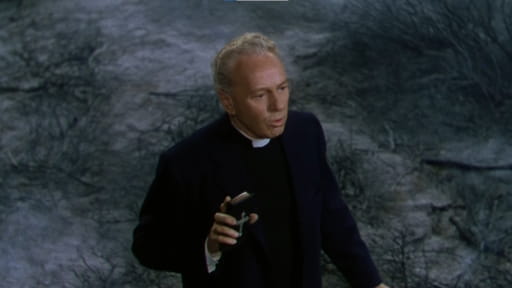
In contrast, Collins is rational and calm in his faith. He is presented as Christlike with a martyr’s death. On one hand, that’s fine. The film presents all the major characters as faultless. But there is a contrast here to other films of this time (eg, The Thing from Another World) in which the idealist is a scientist. Those characters are presented as naive if not evil. But Collins is presented heroically, shot from above as if God himself were looking down lovingly.
None of this would matter without context. I have nothing against heroic depictions of the religious. And I admire Collins. I can see myself doing the same thing for different reasons. But any science fiction film of that time would present me in a negative light. Sacrifice for traditional religious reasons is good. But sacrifice for idiosyncratic beliefs or idealism is bad.
But Pastor Collins’ death is in a very specific context — one where humans are useless and only saved by prayer. So acording to the film, he was not only heroic; he was right!
The War of the Worlds (1953) scene: Pastor Collins (Lewis Martin) heroically faces down the Martian invaders and dies. The film wants you to know he was right! Taken from the film under Fair Use.
Christian Nationalism
There is no deep theology here. This is Cold War Christianity: 99% anti-communist, 1% primitive “Jesus Loves Me” theology. It is, in fact, Christian Nationalism.
My mother’s side of the family are part of this movement. I’m no longer in contact with them, but I have no doubt that they are big MAGA supporters. Even when I was a kid, I marveled at the fact that beyond their constant claims of Jesus’ love (often used as a threat), they really only cared about the right-wing politics their pastors had fed them.
And they see the world as being divided into the good people (right-wing Christians) and the bad people (everyone else).
In the third act, we see all the bad people panicked and behaving very badly. (Interestingly, this is a reflection of the curate in the novel.) All the good people are in churches. And this includes all the scientists! Because even they know that ultimately, it’s all about God. No atheists in a Martian Invasion, am I right?!
Antisemitism
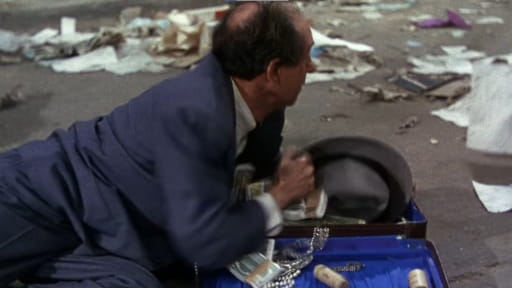
But consider all the bad people. There is only one of them whom we see for more than a second. It is the man who is trying to buy his way onto a truck out of town. He has a suitcase full of cash and valuables. He is coded Jewish and played by the great character actor Ned Glass, who just happens to be Jewish himself.
(To make matters worse, the character — not in the credits — is referred to on IMDb as Well-Dressed Looter. There is no indication he is a looter. Rather, he looks like a man fleeing the Holocaust with as many of his valuables as he could carry.)
I’m not suggesting that the filmmakers intended to be antisemitic. I just think these kinds of stereotypes are so deeply wired in the culture that they just show up. But it is telling that this scene is in a film that places all the good people in church. See?! Even the Jews are godless, which is why they are outside church with the bad people!
The War of the Worlds (1953) scene: Ned Glass as a negative Jewish stereotype weakly on the ground, surrounded by garbage, clutching his money. Taken from the film under Fair Use.
God vs Evolution
The 1953 filmed version The War of the Worlds reverses the ending. The final narration reads:
After all that men could do had failed, the Martians were destroyed, and humanity was saved by the littlest things, which God, in his wisdom, had put upon this Earth.
This is more or less what Wells wrote in the novel. But it takes an idiom and turns it into meaning. After this line in the book, Wells explains what he means:
These germs of disease have taken toll of humanity since the beginning of things — taken toll of our prehuman ancestors since life began here. But by virtue of this natural selection of our kind we have developed resisting power; to no germs do we succumb without a struggle, and to many — those that cause putrefaction in dead matter, for instance — our living frames are altogether immune. But there are no bacteria in Mars, and directly these invaders arrived, directly they drank and fed, our microscopic allies began to work their overthrow.
So it was evolution in the book. But in the movie, the final line of dialogue explains that it was a miracle from God. The great scientist says, “We were all praying for a miracle!”
The War of the Worlds in Modern America
And this, I suppose, brings us back to today. The War of the Worlds tells the viewer
Ordinary godless people are horrible.
Elites are well-meaning but impotent.
Our only hope is God.
This is not what people believe today, of course. They’ve kind of flipped the first two. Now it’s the ordinary people who are well-meaning but impotent. And the reason for that is because of the godless elites. Of course, they do believe in elites. It’s just that they are arbitrary. Since no one is trustworthy, they can elect any yahoo with a spray-on tan to lead the most powerful nation on Earth.
But the modern world has largely given up on God too. He really isn’t too evident. But the Abrahamic faiths are really authoritarian. And if they can’t get input from the strong father in the sky, they will get him with despots here on Earth. So they can throw out all the scientists, and military leaders, and politicians — at least the ones who don’t follow the Dictator.
But today, even a dictator has to watch out. Remember how Trump had one big success during his first term: Operation Warp Speed. But when Trump took credit for it, his followers hated it. So he just stopped talking about it. When your power depends upon the ignorance of your followers, your power depends on the ignorance of your followers.
I don’t think any of this is surprising. Tell people that “others” are monsters and elites are useless. And you get ignorant, hateful people who think they are knowledgeable and good. And all they think they need is an authoritarian “leader” who is as ignorant and hateful as they are.
We can see The War of the Worlds as a Cold War allegory. But I think even at the time, we missed it. We thought the Soviets were bad because they were godless and, well, bad. We didn’t learn the real lesson that authoritarianism itself is bad. But you can’t exactly blame us. We were poorly educated by every conceivable information source. Including The War of the Worlds.
See also:Library DVD Love for a review of the film with a lot of interesting background material.
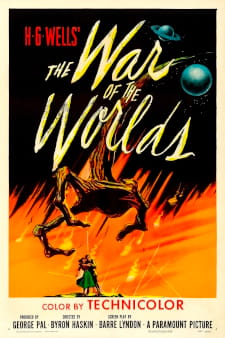
The War of the Worlds (1953) poster via Wikimedia. It is in the public domain.
“Plastic Bones” is a short film by comedian/actor Simon Gissler. He’s apparently one of the many talented artists struggling down in the Los Angeles area. I really don’t know much about him. He has a handful of credits on IMDb. And his bio on the Hollywood Fringe website says that he makes “high concept comedy shows with his sketch team Fish Licks.”
My sister introduced me to this short (6-minute) film that he wrote, produced, and co-directed. It’s shockingly effective, especially for something literally produced with pocket change.
About “Plastic Bones”
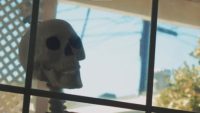
It tells the story of Human, who made the mistake of renting a place close to the cemetery. This has caused a local skeleton to begin stalking him. But it has anything but ill intentions. And thus begins a wild ride of comedy, romance, and murder. It also presents an object lesson in the importance of tipping. (See also: Michael Kallio‘s “The Texas Chainsaw Manicure.”)
The film is produced efficiently. It is shot entirely without a lighting kit. The coverage provides enough variety without getting cute. And it is combined with perfectly coordinated sound editing. It and Gissler’s goofy performance are what make it all work so well. But that shouldn’t take away from its solid script that takes the narrative in places that aren’t obvious. And Gregory Dean is excellent as all the other non-skeletons.
“Plastic Bones” is a good example of my belief that all major productions should be made with half as much money. The savings could then be given to poor filmmakers. And then we’d get a lot more films worth watching. First, I think big-budget producers would be more creative with less money. Second, no-budget producers would be more creative with some money.
But I can’t say that “Plastic Bones” would be better with more money. A lot of its charm comes from its lack of resources. And it shows just how powerful one unique idea is when it is well executed.
Watch “Plastic Bones”
Have a watch! It’s short and almost no one has seen it!
He was more what we consider a serious British actor. Had he lived longer, he certainly would have starred in Hot Fuzzand the Harry Potter films. Today, people remember him best for the Merchant-Ivory film A Room with a View. In it, he plays the sweet and liberal Mr Emerson. But I know him best for the brilliant comedy A Private Function. In it, he plays the vicious and snobby Dr Swaby.
But Denholm Elliott is widely known for many American films like Trading Places where he was the very proper and helpful butler Coleman. And, of course, he was the museum curator Marcus Brody in Raiders of the Lost Ark and Indiana Jones and the Last Crusade.
This would be enough to mention him today. But I’m most interested in him because of two Amicus films and another with Hammer. These were: The House That Dripped Blood, The Vault of Horror, and To the Devil a Daughter. The first two are anthology films. In the first, he plays a horror writer who thinks his psychopathic strangler character has come to life. In the second, he plays a dishonest art dealer who gets his due.
To the Devil a Daughter was the last Hammer horror film. It is along the lines of The Devil Rides Out. I’m not that fond of these films, but they’re fine. Elliott plays a father trying to save his daughter from a Satanic cult.
The House That Dripped Blood is by far my favorite of these three films. And I most like Denholm Elliott when he plays a nice guy — as good as he is at playing a terrible guy! So let’s watch it now to celebrate Elliott’s birthday!
Jim Hutton (1934-1979): Star of the Ellery Queen TV show.
Gregory Harrison (1950-): Star of the short-lived Logan’s Run TV series. He was also the star of Don Coscarelli’s first film, Jim, the World’s Greatest.
Jonathan Tucker (1982-): Actor known for The Texas Chainsaw Massacre, The Ruins, and more.
Colin Farrell (1976-): Actor known for Seven Psychopaths, some superhero films, and lots more.
Michael J Pollard was born on 30 May 1939 in beautiful Passaic, New Jersey. He died at the age of 80 in 2019 in equally beautiful Los Angeles, California.
Pollard is a great actor and he has been in a lot of great films. I will get to that shortly. But there is one role I most associate him with. He’s great in it. But it really is almost insulting. I always think of the Star Trek episode “Miri.” Despite being 27 years old, he plays a (barely) prepubescent boy. And he steals the whole episode. But nothing new there! He tends to steal every scene he’s in everywhere!
Right around this same time, he guest-starred as another boy on an episode of Lost in Space, “The Magic Mirror.” If you get a chance, check it out. It is poignant in a way the show was rarely.
Pollard had an excellent career in TV up to that point. But he had a breakthrough the following year in the 1967 feature film Bonnie and Clyde. It was a pretty typical role for him. He tended to be typecast as a likeable idiot.
He next starred in the motorcycle film Little Fauss and Big Halsy. But he mostly provided spice as odd characters for films he was in. He did this in a number of notable films: Melvin and Howard, Roxanne, Scrooged, and many more — including House of 1000 Corpses.
But my favorite Pollard film is Four of the Apocalypse. It is also probably my favorite Western. He plays a weak drunk who can’t be counted on. But he’s ultimately a good guy. You can watch the whole thing at the link. If you haven’t seen it, I hope you do!
I know of only one film that Michael J Pollard starred in. But it’s a good one! Dirty Little Billy. It tells the story of the early days of Billy the Kid. Leslie Halliwell hated it (of course), but rightly noted that “it presents its hero as the mentally retarded delinquent which history says he was.”
So let’s celebrate Michael J Pollard’s birthday by watching Dirty Little Billy.
Other 30 May Anniversaries
Filmmakers
Howard Hawks (1896-1977): Director of tons of notable films. He directed one of my favorite non-psychotronic films, His Girl Friday. And, of course, he directed the classic The Thing From Another World.
Mel Blanc (1908-1989): Voice actor known for voicing most of the iconic Warner Bros characters like Bugs Bunny.
Clint Walker (1927-2018): Actor who worked a lot and played the title character in the long-running TV western Cheyenne.
Keir Dullea (1936-): Actor known most as Dave in 2001: A Space Odyssey. He also starred in Black Christmas.
Mark Sheppard (1964-): Actor best known to me as Badger, the ruthless but insecure crime boss with a Cockney accent on Firefly.
Films
Undersea Kingdom (1936): Atlantis-based serial.
Fright (1972): A babysitter is attacked by the child’s insane father.
Embrace of the Vampire (1995): Vampire romance.
Wrong Turn (2003): College students get stranded in the woods and attacked.
El Chupacabra (2003): Animal control officers find a gored dog and figure it is the title monster.
Cemetery Gates (2006): A genetically modified Tasmanian Devil is on the loose.
The Strangers (2008): Home invasion film.
The Italian Job (2003): Heist film with none of the charm of the original.
Michael J Pollard via Wikimedia. It is in the public domain.
Empire Pictures released Dolls throughout the United States on 29 May 1987.
It was the third of the Brian Yuzna and Stuart Gordon films. The first, of course, was Re-Animator. Then they made From Beyond. Both of those films were loosely based on HP Lovecraft short stories, although the latter at least maintains the tone.
Dolls is a departure. I wouldn’t say that it was better than Re-Animator. But I watch it a lot more. Because I enjoy it more.
As I recall based on the writer-director commentary on the Shout Factory Blu-ray (now ridiculously expensive), Charles Band had the poster made first. This was incredibly common in those days. He then asked Ed Naha to write a script for it. And he wrote a perfect script!
But the film is more than the script. Everything works in this production. The casting is great. The production design and art direction create the perfect old dark house. David W Allen’s stop-motion animation is as good as anything he ever did. And the filming and editing are energetic enough to keep things interesting. It is, after all, a single-location story.
Of course, the film could be rendered much worse and I’d still like it. Over the years I’ve come to see the world as utterly devoid of justice. Evel Knievel died at 69 from breathing problems and not one of his many stupid (some would say calculated) stunts. Children commonly drown because of tsunamis. People can increase their chances but that’s all: increase their chances.
So I love Dolls because everyone gets what they deserve. The horrible people become dolls (and that doesn’t seem like such a bad life). And the good people live happily ever after. And the “gods” in this case (really a witch and a warlock) are simply beyond charming. What’s not to like?
This is, of course, why a lot of horror works!
If you haven’t seen it, you must. Right now! Here it is!
Other 29 May Anniversaries
Filmmakers
Bob Hope (1903-2003): The best part in all those road pictures.
Danny Elfman (1953-): Lead singer of Oingo Boingo and composer of all the films you already know.
Tony Randel (1956-): Director of a number of horror films including the second and third Hellraiser films.
Ted Levine (1957-): Actor best known for Monk but also the films The Silence of the Lambs, The Fast and the Furious, and The Hills Have Eyes.
Rupert Everett (1959-): Actor who starred in Cemetery Man.
John D LeMay (1962-): Star of Friday the 13th: The Series.
Ashley Laurence (1966-): Actor known mostly for the Hellraiser films.
Films
Dial M For Murder (1954): Hitchcock film about a man trying to murder his unfaithful wife.
King Kung Fu (1976): Hilarious combination of King Kong and the Kung Fu TV show.
Witchcraft IX: Bitter Flesh (1997): The sequel to Witchcraft VII. Really! Witchcraft VIII was a one-off. Here, the ghost of William Spanner (played a second and final time by David Bynres) must protect his girlfriend.Witchcraft X will again not feature the series’ main character.
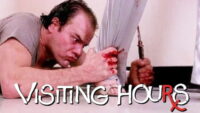
20th Century Fox released Visiting Hours in the United States on 28 May 1982. Astral Films released it in Canada the week before. Normally, I would have picked the earlier date, given that it was a Canadian production. But today is such a terrible day for anniversaries! So I’m putting it here.
The year 1981 brought us two notable hospital-based slasher films: Hospital Massacre and Halloween II. So Visiting Hours came late in this trend. But I think it’s the best of the lot. It at least offers a more interesting plot. Critics did right by Hospital Massacre. They ignored it. Had they bothered to watch it, they would have hated it. And that is the problem with “critic as ombudsman.” Too many of these professional trolls watch films that aren’t made for them.
Critics had to review Halloween II given how much they praised the original (which is just okay). And, of course, they found it wanting. It was too violent. Too bloody. Too mean. I know many people will disagree, but I think it was also less boring. I’m not a big slasher fan. And there is much to admire in the original film. But it’s mostly a bunch of waiting around.
But the critics had their knives out going in to see Visiting Hours. It had a fairly big budget. And it featured two bona fide stars and psychotronic favorite Michael Ironside — just off his success in Scanners. And what were its problems? Leslie Halliwell, always the open-minded viewer, wrote, “Tedious shocker wasting a reliable idea.” Leonard Maltin called it an “extremely unpleasant and distasteful shocker,” which was “needlessly sadistic.”
More recent (almost exclusively negative) reviews highlight Michael Ironside’s performance. This wasn’t true of contemporary reviews since Ironside wasn’t the icon he later became. But this is unfair. All the actors in Visiting Hours are terrific. But this is an old critic’s trick: highlight one performance over the rest so that readers think you are knowledgeable and were paying attention.
Not that I don’t have my own criticisms. I think the plot is needlessly complicated. And (as usual) I think the film could be cut down by at least 15 minutes. I do, however, think it is one of the better slasher films. But who cares what I think? As I said, I’m not that into them. But I think Visiting Hours is worth checking out — for slasher and non-slasher fans!
Other 28 May Anniversaries
Filmmakers
Ian Fleming (1908-1964): The creator of James Bond.
Edith Massey (1918-1984): Actor known for her work with John Waters.
Zelda Rubinstein (1933-2010): Actor known especially for playing the medium in Poltergeist.
Sondra Locke (1944-2018): Actor in Willardand many of her husband’s films.
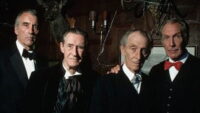
Today, 27 May, is the birthday of Vincent Price (1911) and Christopher Lee (1922). What’s more, Peter Cushing was born on 26 May 1913.
Three titans of horror. Three excellent actors. Three tall men. All born around the same date.
I guess they were also all friends, although it’s very hard to tell when it comes to actors who are always playing a part when a camera is rolling.
Collaborations
Everyone knows that Christopher Lee and Peter Cushing starred in a lot of films together. Watching a collection of Hammer films is a lot like watching “The Cushing and Lee Show. “
I know of only two films that featured Price and Cushing. The first was Dr Phibes Rises Againalthough Cushing is barely in it and probably wasn’t even on set at the same time as Price. Much better is Madhousewhere they work together closely and brilliantly. It’s a great part for Cushing!
And there’s only one film I know of with just Price and Lee: The Oblong Box. It’s a great film but the two men don’t work that much with each other.
All Three Men
There are two films that feature all three men. The first was 1970’s Scream and Scream Again. It’s a good film that has you confused until the very end. The problem with it is that Peter Cushing is hardly in it.
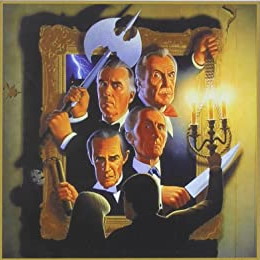
If you want to celebrate this occasion, you should watch House of the Long Shadows. It’s an ensemble film but the three men are all primary. And as a special extra it also features John Carradine!
So here’s to Peter Cushing, Vincent Price, and Christopher Lee! Let’s watch House of the Long Shadows.
Other 27 May Anniversaries
Filmmakers
Harlan Ellison (1934-2018): Science fiction writer who has been much used in the film industry for films like A Boy and His Dogand the Star Trek episode “The City on the Edge of Forever.”
Paul Bettany (1971-): Actor known for the action-horror films Legion and Priest.
Ben Feldman (1980-): Actor known mainly for the TV show Superstore but also had small parts in Cloverfield and Friday the 13th.
Films
Africa Screams (1949): Abbott and Costello vs the Cannibals.
Crypt of the Vampire (1964): A rich girl has nightmares that may indicate she is possessed by an ancestor.
Desperate Living (1977): Society woman murderer is on the run in this John Waters comedy.
Smokey and the Bandit (1977): Two drivers try to win a race delivering unlicensed beer in record time.
The Monster Club(1981): Much-hated horror anthology with musical segments. I like it!
Possession (1981): A woman gets divorced and gives birth to a tentacled creature that becomes her lover. Other stuff happens but that will give you an idea of what you are getting yourself into.
Killer Klowns from Outer Space(1988): Circus clowns from outer space kill small town humans for later consumption. Essential viewing.
Blood Ties(1991): Basically a family dispute among vampires.
The Flintstones (1994): Live-action film of the cartoon.
Peter Cushing was born on 26 May 1913. For most people, he is Grand Moff Tarkin in Star Wars. He brings gravitas to a thankless role. Who else to end Darth Vader’s choking trick? A lesser actor couldn’t pull it off — especially at his age and gauntness.
Although English, Cushing started his film career in Hollywood. He got small roles, like his first in the James Whale film, The Man in the Iron Mask. But he seemed to do more theater work there. When World War II started, he returned to England. But he did not fight in the war due to an injury. I find this curious since I know him to do minor stunts in various Hammer films.
Peter Cushing at Hammer
After the war, he was relatively successful in TV. And he probably would have continued like that and ultimately appeared as one of the critics in Theatre of Blood. But it was not to be. Hammer decided to make a go at horror and cast Cushing in the title role of The Curse of Frankenstein. That led directly to a two-decade relationship and 19 films. Note that not all are horror films.
In addition to Hammer, Peter Cushing made 15 films with Amicus. Of course, he wasn’t as big a part of them. That’s partly due to his age. But it’s more due to six of them being anthology films (marked with †). Here they are:
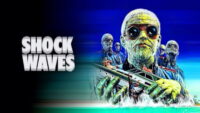
These two production companies explain why everyone knows Peter Cushing. I doubt seriously that he would have been cast in Star Wars without them. But the film I most associate with him (despite his importance in the Hammer Frankenstein series) is Shock Waves. And since I don’t think nearly enough people have seen it, let’s watch it to celebrate Cushing’s birthday!
Casper (1995): Sweet children’s horror-comedy where none of the ghosts are scary.
Johnny Mnemonic (1995): Data courier needs to get data out of his brain implant before it kills him.
Doppelganger (1993): The new girlfriend seems to have an evil doppelganger, but then it turns out to be a conspiracy. But then she really does have one!
Curse of the Puppet Master (1998): More fun with the puppets at a doll museum. A middling effort from David DeCoteau.
Shanghai Noon (2000): Comedy western starring Jackie Chan.
Beneath Still Waters (2005): A town is drowned to kill an evil force, but 40 years later, it comes back. Brian Yuzna directed this Spanish production.
Beneath the Flesh (2009): Anthology horror from Randall Kaplan.
The Devil’s Tomb (2009): A military unit goes to an underground structure to rescue a scientist, but unwittingly enters a war between God and the Nephilim. You’d think God wouldn’t need help…
The Offerings (2009): A new housekeeper is harassed by angry ghosts.
Peter Cushing via Wikimedia. It is in the public domain.
20th Century Fox released Star Wars on 25 May 1977.
I first saw the film on 4 July 1977. I was in no rush to see it because the commercial for it sucked. It seemed to depend upon the fact that there was already a lot of buzz about the film. And that was true. The nerd class in middle school was indeed abuzz! This made me less inclined to see it. Yes, I was a nerd. But I considered myself a higher level of nerd. I was a little prick!
I liked the film. But I didn’t go crazy for it. And I still find it hard to believe just why it was such a big deal. I guess it was the special effects. The plot was standard — pretty much the same as dozens of genre films. The characters were primative stereotypes. I’m not complaining. The film works. I just don’t understand why so many people lost their minds over it!
Since its release, of course, the film has been renamed Star Wars: Episode IV — A New Hope. Because it was the first film of the second trilogy of a trilogy of trilogies. I think the renaming is stupid and annoying as hell. But I will forgive George Lucas for the rest. Before The Empire Strikes Back, he was already pushing the trilogy of trilogies. So it was not, as many have told me, a later cash grab.
But what most annoys me is that Lucas has gone back and changed the special effects. All works of art are products of their time. Star Wars is now the product of the late 1970s — and the late 1990s. And there is no way that the film would have had such primative characters and stories in the late 1990s. So the film is, as it stands, a kind of Frankenstein’s Monster of a film.
What’s more, it wasn’t enough for Lucas to get his ultimate vision produced. He has also done everything he can to limit anyone from seeing the original film. That’s the kind of narcissism that comes from having far too much money, fame, and power.
I’d embed the film if that were possible. But it’s hard to find even a restored copy online. After all, George Lucas is only a billionaire. And Disney is just scraping by! (Much of Lucas’ billions are in Disney stock.)
But you know who the real villains are? People who don’t read this site. These are the people who make rich men richer because they just want to watch what everyone else is watching. Star Wars is psychotronic. There’s no doubt about that, though.
Instead of watching it, check out this clever Chris & Jack skit about who really wrote Star Wars.
Other 25 May Anniversaries
Filmmakers:
Charles Barton (1902-1981): Director known for Abbott and Costello Meet Frankenstein and Abbott and Costello Meet the Killer, Boris Karloff.
Claude Akins (1926-1994): Character actor I mostly know from The Night Stalker.
Ann Robinson (1929-2025): Star of the 1953 The War of the Worlds.
Ian McKellen (1939-): Actor known for the major films based on X-Men and Lord of the Rings.
Frank Oz (1944-): Best known as the man behind Miss Piggy, he is a solid film director of such hits as The Dark Crystal and Death at a Funeral.
Neil Marshall (1970-): Writer-director of many psychotronic films including Dog Soldiers and The Descent.
Cillian Murphy (1976-): Actor known for 28 Days Later.
Films:
Behind the Mask (1946): The second of The Shadow films.
The Stranger (1946): Orson Welles’ most banal film about a Nazi hunter who suspect a school teacher.
The Cabinet of Calagari (1962): Premiere of the classic story.
Dead Planet (1972): An overpopulated dystopian society bans pregnancy.
Return of the Jedi (1983): That’s right, it was released exactly six years after Star Wars. For the record, The Empire Strikes Back was close to being exactly in the middle. The premiere was 17 May. It went into limited release on the 21st. But didn’t see wide release until 18 June.
Dead Calm (1989): A married couple pick up a shipwreck survivor who turns out to be insane.
Possessed By the Night (1994): A mutant embryo controls people.
Witchcraft X: Mistress of the Craft (1999): British vampires go to California to get a Satanist needed for a ritual.
Bug (2007): Two weird people fight bugs in a motel room.












.jpg)
.jpg)
.jpg)

_-_Peter_Cushing_(cropped).png)
