
Amicus is an iconic horror producer that is best known today for its horror anthologies. (You can also call them “portmanteau films,” if you don’t think you come off enough as a pretentious twat.) The company produced 26 feature films from 1962 to 1977. Of course, seven were horror anthologies — more than a quarter. They produced a total of 14 horror films so it’s no wonder that the anthologies stand out.
Amicus Background
You can think of Amicus as Hammer’s kid brother. They produced less than half as many films and they had notably lower budgets. Just the same, they tended to hire the same people (eg, Roy Ward Baker, Peter Cushing). The films tended to look the same (budget constraints considered). And they were both going after the same audience.
Amicus Productions started in the early 1960s by Milton Subotsky and Max Rosenberg. Subotsky was the creative one — writing many of the company’s scripts. And Rosenberg was the business guy. Don’t discount the business side of filmmaking. Everyone is lost without it. And those who do it well are skilled and creative. That certainly was the case with Rosenberg.
Like many such companies, it produced films for the kids. It’s first two were silly musicals: It’s Trad, Dad! and Just for Fun. But it was probably inevitable that the company went toward horror. According to acclaimed director Freddie Francis, “Hammer was a business set-up. Had it dealt in garbage disposal, it would have been just as successful. Milton Subotsky from Amicus, on the other hand, was a real horror buff.”
Indeed, before they created Amicus, Rosenberg and Subotsky worked together on the horror film The City of the Dead (often inaccurately listed as an Amicus production). And Subotsky wrote the screenplays for three of the anthologies — the first one and the two based on EC Comics.
It is telling that Hammer never made any horror anthology films. They did do some TV but only after Amicus was out of business. The truth is that I may nitpick these films, but every one of them is a good watch. Rather than read me, I recommend watching any of them. But you can see my rankings below.
Dr Terror’s House of Horrors (1965)
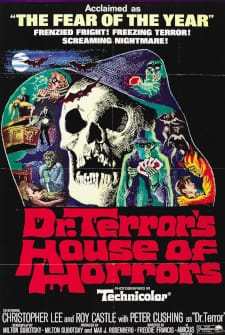
The first Amicus horror anthology starts with five men filling a cramped train compartment. They are joined by Dr Schreck (German for “fright” or “terror”), played by Peter Cushing. He tells each man’s fortune using Tarot cards. In each of these stories, the men die. Dr Schreck turns out to be Death, which surprises no one. The stories are:
- Werewolf: An architect (Neil McCallum) returns to his family home that he recently sold to make changes. He becomes convinced there is a werewolf and tries to protect the new owner (Ursula Howells).
- Creeping Vine: A man (Alan Freeman) returns from a vacation with his wife and young daughter to their home to find an unknown vine growing. It kills the dog and soon takes over the entire house.
- Voodoo: A jazz musician (Roy Castle) spies on a Voodoo ceremony and writes down the music played. He takes it back home and performs it. The creator god Dambala (Thomas Baptiste) is not pleased that he stole the song and kills him.
- Disembodied Hand: An art critic (Christopher Lee) is dismissive of an established artist (Michael Gough). But the artist gets the better of him and humiliates the critic. So the critic runs the artist down resulting in his losing his right hand. The hand then terrorizes the critic.
- Vampire: An American doctor (Donald Sutherland) returns home with a French bride (Jennifer Jayne), but she turns out to be a vampire.
The frame story here is very strong and well integrated. “Voodoo” and “Disembodied Hand” are also very good. “Werewolf” is far stronger than most werewolf stories. “Vampire” works well but it’s a tad clever and jokey to end the film. But “Creeping Vine” lacks tension and doesn’t even make sense to me.
I do continue to have questions about the film, though. How is it that only the men in one compartment on a train die? Did they die on the train? It seems more reasonable that the train is simply a mode of transfer to the other world and the men in this state have simply forgotten what happened to them. If that’s the case, why is the “Creeping Vine” man alone? His wife and daughter died with him. None of this matters, of course. I only started wondering the third time I watch the film
Regardless, the film is quite enjoyable to watch. The acting is great. The production is less claustrophobic than you’d expect. And even its weakest moments are enitrely watchable.
Torture Garden (1968)
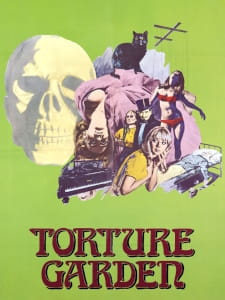
Torture Garden takes place at an amusement park. Dr Diabolo (Burgess Meredith) takes five brave customers of his sideshow into a special exhibit. Before he goes in, he burns all the money they gave him, so we know he really is The Devil.
The first four customers see their futures by staring at the shears of the goddess Atropos — in the form of a mannequin.
- Enoch: A man (Michael Bryant) lets his uncle (Maurice Denham) die so he can get to treasure he’s learned about. In looking for the treasure, he releases a telepathic cat named Balthazar, which provides gold in exchange for being fed. It feeds on the heads of humans.
- Terror Over Hollywood: A young actress (Beverly Adams) gets her big break when she falls in love with a star (Robert Hutton) who turns out to be a cyborg whose brain has been put into a robot. She ends up the same.
- Mr Steinway: A young woman (Barbara Ewing) falls in love with a famous pianist (John Standing). But his piano is alive and is jealous, so it kills her.
- The Man Who Collected Poe: Ronald (Jack Palance) is obsessed with Edgar Allan Poe (Hedger Wallace). He visits a big collector (Peter Cushing) only to discover that the man’s grandfather used the occult to bring Poe back from the dead.
The resolution of the frame story is complicated and I doubt many people really understand it. The fifth customer (Michael Ripper) refuses to look at the shears and instead stabs Dr Diabolo. Everyone except for Ronald run away and we find that this was just a fake and that the fifth customer works with Diabolo.
Diabolo and Ronald speak. Ronald lights his cigarette with the lighter he borrowed from Lancelot in the vision. At the end, Diabolo explains to the audience, “Of course, I lose one or two along the line this way, but it’s great for the sport.” The other three have a chance. Ronald does not; he’s already lost his soul, which he realized right after his vision when he said, “It can’t be… I can’t believe it… You! It really is!”
Or maybe not. It could just be a jumbled mess. Torture Garden features a great frame story and great shorts. But they don’t work together unless you create this complicated narrative. The first three people are pretty minor villains. Only Ronald in the fourth story deserves hell. But given the more complicated narrative, this film is great!
The House That Dripped Blood (1971)
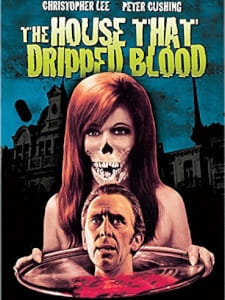
I believe the first Amicus horror anthology film I saw was The House That Dripped Blood. As a result, I have a special fondness for it even though it isn’t close to the best. It is interesting in being the first anthology where the frame story is also part of the last of the shorts.
A Scotland Yard inspector (John Bennett) comes to a small town looking for a missing horror movie star. He first goes to the local police (John Malcolm) and then later to the estate agent (John Bryans) who rented the house to the star. They both tell him something is wrong with the house. We get the following four stories:
- Method for Murder: A horror writer (Denholm Elliott) rents the house to finish his latest novel. But the murderer in the novel seems to have come to life. His wife (Joanna Dunham) claims he attacked her as the character so he goes to a therapist. The thing is: the character (Tom Adams) is real — and it is his wife’s lover.
- Waxworks: A man (Peter Cushing) sees the head of an old flame in the local waxworks. A friend (Joss Ackland) comes by and it appears that the three of them were in lovers’ triangle. The friend becomes obsessed with the figure. And they both die at the hand of the waxworks owner (Wolfe Morris), who was her husband.
- Sweets to the Sweet: A man (Christopher Lee) and his young daughter (Chloe Franks) stay at the house. He hires a tutor (Nyree Dawn Porter). The man is afraid of his daughter because she reminds him of his dead wife, who was a witch. So is his daughter, it turns out.
- The Cloak: A horror legend (Jon Pertwee) gets a cloak for his part as a vampire and it turns him into a vampire. It turns out that real vampires (specifically, Ingrid Pitt) so loved his films that they decided to make him one.
The first three of the stories are very strong. The last is kind of jokey. That’s a particular problem because it is the one that interacts with the frame story. But the quality of this one never dips low and is consistently enjoyable. And you could not ask for a better cast — especially the leads in each story.
Tales From the Crypt (1972)

Tales From the Crypt is the first of two Amicus anthology films based on EC Comics stories. And since the folks at EC also lifted liberally from other writers, we see here a version of Jacobs’ short story “The Monkey’s Paw.”
I must admit that I’m kind of biased about this film because I grew up reading EC. But not the originals. I read the reprints that came out in the early 1970s. I do, however, own one original EC, The Haunt of Fear #12. The first story in it is the basis of the third story in this film.
The film starts with five people caught in the catacombs by a man who is Satan (rather than the Devil in Torture Garden). He claims that he is going to tell their future, but it is clear from the middle of the first short (at the latest) that what we see has already happened.
- …And All Through the House: A wife (Joan Collins) murders he husband (Martin Boddey) at Christmas but a madman dressed as Santa (Oliver MacGreevy) comes to her house and her daughter (Chloe Franks) lets him in.
- Reflection of Death: A man (Ian Hendry) leaves his wife (Susan Denny) and children (Paul Clere, Sharon Clere) and runs off with his lover (Angela Grant). Their car crashes and he seems to have escaped but he eventually learns that he is a hideous creature. It turns out it is only a dream but then it happens for real.
- Poetic Justice: An old trash collector (Peter Cushing) is beloved by the local children because he gives them toys he has repaired. But a rich neighbor (Robin Phillips) turns the town against him and sends him a bunch of hateful valentines. So the old man kills himself. But the following Valentine’s Day, he gets revenge.
- Wish You Were Here: A horrible businessman (Richard Greene) has made a bad investment and is now poor. His wife (Barbara Murray) notices that a statue they have grants three wishes. Everything goes wrong and the man ends up alive but in intense pain because he was embalmed.
- Blind Alleys: A selfish man takes over the running of a home for elderly blind men. He starves and freezes them while treating himself and his dog extremely well. After one of the men dies, the rest capture the man and feed him to the dog.
The film wraps up with Satan sending everyone to Hell. But you can probably already see a problem. The man in the fourth story didn’t die. And it is such a trivial story to fix. This was done in the 1933 film The Monkey’s Paw as well as “The Monkey’s Paw — A Retelling” episode of The Alfred Hitchcock Hour.
The bigger issue for me is that the film is distinctly Christian. Only the first, third, and fifth of the shorts feature someone we really think deserves eternal torment. And even the guy in the third one seems to feel a little bad. But given the Christian context and how rigid it is about sin, it works well. Just try not to think about a guy who dies while checking out a sexy lady. You know: Hitler or a randy fellow, it’s all the same to God!
Asylum (1972)

Asylum features a clever frame story. A new doctor, Martin (Robert Powell), comes to a mental hospital to work. The head doctor, Rutherford (Patrick Magee), tells him about another doctor who recently went insane. As a test, he has the new doctor interview four patients to determine which of them is the doctor. An orderly (Geoffrey Bayldon) shows him each of the patients.
- Frozen Fear: A man (Richard Todd) kills his wife (Sylvia Syms), chops her up, and puts her in the basement freezer. But the pieces come alive and attack him. When his lover (Barbara Parkins), the patient telling the story, comes, she is attacked by the body parts and finds the husband in the freezer.
- The Weird Tailor: A tailor (Barry Morse) is struggling financially when a man (Peter Cushing) offers him a large sum of money to make a suit made out of a special material. It turns out the suit will be used to reanimate the man’s son but he admits that he has no money. Ultimately, the tailor returns home with the suit. The tailor’s wife (Ann Firbank) puts it on their mannequin, which comes to life and attacks the tailor.
- Lucy Comes To Stay: A woman (Charlotte Rampling) comes home from a mental hospital. She has a split personality (Britt Ekland) who kills her brother (James Villiers) and nurse (Megs Jenkins). Although this is a very tired plot, it’s one of the best renderings that I’ve seen.
- Mannequins of Horror: This one is hardly a story at all. We are introduced to Dr Byron (Herbert Lom) who makes little dolls that he says he can transport his soul into and thus control. The young doctor goes back to the head and tells him he thinks Dr Byron is the doctor who went insane. He’s wrong but before we can get to it, one of Dr Byron’s dolls stabs the head doctor in the neck killing him.
The film is resolved with the new doctor rushing upstairs where he finds out that the orderly is the actual crazy doctor who killed the real orderly. He then kills the new doctor and takes over the hospital.
This is a hard one. Most of the film is nearly perfect. And then we get into these silly dolls and the overly complicated ending and it all kind of falls apart. But I will admit the problem is much more the dolls than the ending chaos. I think with today’s technology (or even Puppet Master technology), it could work. But as it stands, it’s pretty silly in an otherwise serious film.
The Vault of Horror (1973)
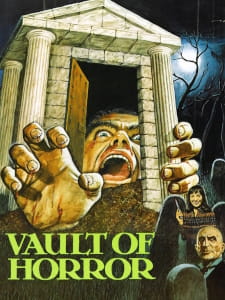
And so we come to the second of the two Amicus horror anthologies that is based on EC Comics, The Vault of Horror. It’s notable in that it is pretty much a comedy.
Five men are taking the elevator down a high-rise. But it doesn’t stop at the ground floor but proceeds to the sub-basement. It opens into a pleasant room with five chairs. The men get off, the doors close, and only then do the men realize that they are trapped because there is no button. So they sit down and start telling stories about strange dreams they’ve had.
- Midnight Mess: A man (Daniel Massey) hires an investor (Michael Pratt) to find his sister, Donna (Anna Massey). He then kills the investigator. Later, he goes to see Donna and kills her. But he does not listen to all the people who tell him not to be out at night. And it turns out his sister and much of town are vampires. There turn him into a human blood bag.
- The Neat Job: A fastidious man (Terry-Thomas) marries a woman, Eleanor (Glynis Johns). He drives her crazy with his demands. Literally. She kills him and organizes his body parts exactly as he would have liked.
- This Trick’ll Kill You: A magician (Curt Jurgens) and his wife (Dawn Addams) are in India looking for a new trick for their act. They find a young woman (Jasmina Hilton) who performs the Indian Rope Trick. The problem is, she refuses to sell it — or even admit it is a trick. So they kill her. When the wife climbs the rope, she screams and vanishes. Then the rope attacks and hangs the man. The rope effect as it goes after him is really well done.
- Bargain in Death: A man (Michael Craig) fakes his death with a friend (Edward Judd) to get insurance money. The plan is to take a drug that makes him look dead. After he’s buried, his friend will dig him up. But both men plan to betray each other. Meanwhile, two medical students (Robin Nedwell, Geoffrey Davies) decide to dig up the body so they can have more anatomy experience. They save the man, but the gravedigger (Arthur Mullard) kills him to finish the deal.
- Drawn and Quartered: An artist (Tom Baker) working in Haiti finds out that three people back in England (Denholm Elliott, John Witty, Terence Alexander) have conspired to make a bunch of money off his work after telling him it is worthless. So he pays a Voodoo priest to get revenge. Anything he paints happens. So he blinds one, cuts off the hands of the second, and kills the last. Unfortunately for him, he had already painted a self-portrait, which gets crushed as does he.
The frame story wraps up with the elevator doors opening and the men walking through into a graveyard. It turns out that the men are cursed each night to relive their stories with the realization that they are true.
This film captures all the fun of reading the comics. Each has an ironic ending. Only the last of them even tries a little to be serious. And the frame story is simple and compelling. There really isn’t much more to say. The film just doesn’t have any weak spots. It’s a joy from beginning to end.
From Beyond the Grave (1975)
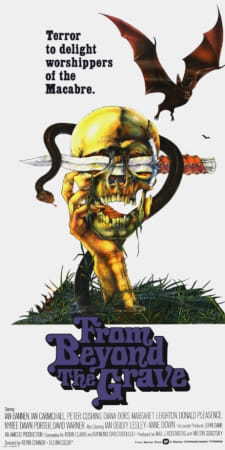
So after the comedy of The Vault of Horror, we get a very serious finale to the series, From Beyond the Grave. It features a simple frame story that works well.
A man (Peter Cushing) runs an antiques store. You don’t want to mess with him! If you steal from him — or otherwise cheat him — he will make you suffer. For example…
- The Gatecrasher: A man (David Warner) buys an antique mirror — but gets a great deal by claiming it isn’t really an antique. He and his friends hold a seance. It connects him with a ghost (Marcel Steiner) who then haunts him — demanding human sacrifices until he enters our world and kills the man who helped him.
- An Act of Kindness: A man (Ian Bannen) is in a terrible marriage with a wife (Diana Dors) and son (John O’Farrell). He becomes close to a street vendor (Donald Pleasence) and his daughter (Angela Pleasence). In order to impress the street vendor, he steals a medal from the antiques shop. Ultimately, the daughter kills his wife and him — all to answer the prayers of his son.
- The Elemental: A man (Ian Carmichael) switches prices on a snuff box and gets a great deal. On his way home, a psychic (Margaret Leighton) tells him that he has an “elemental” (sort of a demon) on his shoulder. It becomes clear that she’s right so he hires her. She seems to have gotten rid of the thing but it actually takes over his wife (Nyree Dawn Porter) and kills him.
- The Door: A nice younger man (Ian Ogilvy) buys an old door. He installs it and it opens into the room of an ancient occultist (Jack Watson) who tries to take the soul of the man’s wife (Lesley-Anne Down). After much effort, they destroy the man and the room. We then see the antiques dealer counting the money and find that he did pay what he promised, which explains the happy ending.
The film ends with a man trying to rob the store. He ends up dead and the dealer sadly quotes the Bible, “The love of money is the root of all evil.”
This film works really well. The only problem is “An Act of Kindness,” which doesn’t really make sense in the context of the frame story. But it’s hard to complain when that is such a strong short. Additionally, much of “The Elemental” is played for laughs. But it really doesn’t take away from the overall dark tone of the film.
Ranking the Amicus Horror Anthologies
Before I get to the rankings, I want to be very clear about this series. Every one of these films is worth watching. They are all quite enjoyable — perhaps especially today, fifty years after they were created. Amicus made a lot of other films. But watching all of these again, one after another, has shown that there is a reason the company is most remembered for its horror anthology films. They were good and consistent. No wonder Hammer never even tried to compete.
Ranking the Amicus Anthology Films
Here are my rankings for the seven films. As always, I reserve the right to change my mind at any time. But in this case, it is especially true because every film is good.
- The Vault of Horror (1973)
- From Beyond the Grave (1975)
- Tales From the Crypt (1972)
- Torture Garden (1968)
- Dr Terror’s House of Horrors (1965)
- Asylum (1972)
- The House That Dripped Blood (1971)
Ranking the Amicus Anthology Shorts
Anthology films are often criticized because they are inconsistent in quality. So I thought it would be interesting to rank each of the shorts on their own — outside their context within each film. The usual caveat applies. But it’s interesting that each of the seven films has at least one short in the top ten. I think that gets at the problem
There’s really only one in this list of 31 shorts that I don’t like, “Creeping Vine.” And even it isn’t bad.
- An Act of Kindness (From Beyond the Grave)
- …And All Through the House (Tales From the Crypt)
- The Neat Job (The Vault of Horror)
- The Door (From Beyond the Grave)
- Disembodied Hand (Dr Terror’s House of Horrors)
- Poetic Justice (Tales From the Crypt)
- Bargain in Death (The Vault of Horror)
- Frozen Fear (Asylum)
- Terror Over Hollywood (Torture Garden)
- Method for Murder (The House That Dripped Blood)
- Sweets to the Sweet (The House That Dripped Blood)
- The Weird Tailor (Asylum)
- Midnight Mess (The Vault of Horror):
- The Man Who Collected Poe (Torture Garden)
- Lucy Comes To Stay (Asylum)
- Enoch (Torture Garden)
- Drawn and Quartered (The Vault of Horror)
- Blind Alleys (Tales From the Crypt)
- The Gatecrasher (From Beyond the Grave)
- Voodoo (Dr Terror’s House of Horrors)
- This Trick’ll Kill You (The Vault of Horror)
- Mr Steinway (Torture Garden)
- Waxworks (The House That Dripped Blood)
- The Elemental (From Beyond the Grave)
- Reflection of Death (Tales From the Crypt)
- Werewolf (Dr Terror’s House of Horrors)
- Wish You Were Here (Tales From the Crypt)
- The Cloak (The House That Dripped Blood)
- Vampire (Dr Terror’s House of Horrors)
- Mannequins of Horror (Asylum)
- Creeping Vine (Dr Terror’s House of Horrors)
Watch These Films
I knew that the Amicus horror anthologies were good before I started writing this. But I didn’t know just how good. Any horror or psychotronic fan should watch them all.
As I write this, they are all available to stream for free from different services. And I don’t see any reason that will change. So if you find yourself at a loss for what to watch, just grab one of these. They don’t disappoint!
Dr Terror’s House of Horrors (1965) poster via IMDb under Fair Use. Torture Garden (1968) poster via Rotten Tomatoes under Fair Use. The House That Dripped Blood (1971) via IMDb under Fair Use. Tales From the Crypt (1972) poster via Wikipedia under Fair Use. Asylum (1972) poster via Archive.org. It is in the public domain. Vault of Horror (1973) poster via Rotten Tomatoes under Fair Use. From Beyond the Grave (1975) poster via IMDb under Fair Use. Amicus Productions via IMDb under Fair Use.

Wait… there’s one with Joan Collins and a madman Santa? Ok, it’s on my December watch list.
But do your non-horror side a favor and watch the Satyajit Ray anthology short! 42 minutes, and sir, we in this house were both blown away: https://librarydvdlove.substack.com/p/sunday-post-satyajit-rays-short-the
The short’s embedded in the post.
But don’t watch it before bedtime! Watch a nice gruesome horror movie before bedtime! Don’t go to sleep sad!