
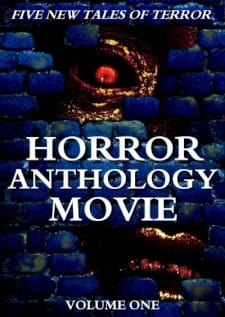
It is hard to find a horror anthology film that people really like. It’s not surprising. I can’t think of any anthology film that people love. Well, Love Actually. But that is a sign of social psychosis. I’m not sure why people like it. It suffers from all the usual problems of anthology films. In particular, I literally only care about the stand-ins for the sex scene. And that is not enough to put up with the rest of the film, which makes me want to retch.
And this is, I think, the fundamental problem with anthology films. We like some of the stories and we hate other ones. But it’s weird. Because this is also the problem with TV shows like Deadwood: we care about some storylines and we don’t about others. And I think, as with Love Always, we put up with the bad to get to the good. I guess I hate Love Always because there is just way too much bad to wade through to get to the good.
But the anthology film does not have this advantage. It’s one whole story followed by another whole story. There is no clever editing to get through the stories we don’t like. So you get to the end of Dr Terror’s House of Horrors and you can’t deny that there were 10 straight minutes of “Creeping Vine.” It doesn’t matter that there were 15 awesome minutes of “Disembodied Hand”!
And for a long time, I thought this was why people don’t give anthology films the respect they deserve. But I’ve come to see that this is only part of the problem. I’m recently published an article about the Amicus horror anthology films. And I’m noticed another problem: the frame story.
Horror Anthology Frame Stories
There are two approaches to horror anthologies: those with a frame story and those without. People generally prefer those without. For example, Trilogy of Terror. Most people don’t just forget that they didn’t especially care for “Julie” and “Millicent and Therese.” They forget they watched them at all. They only remember “Amelia” — the one with a terror doll with a spear. (For the record, I love “Julie”!) But without a frame story to focus attention, Trilogy of Terror becomes simply “Amelia.”
But there’s a bigger issue here. A lot of horror anthology stories are wedged into their frame stories. For example, only two of the four stories in The House that Dripped Blood really takes place at the house. The stories themselves are pretty strong. But what’s all that nonsense about the house reflecting the person who lives there? It’s just post hoc nonsense!
Highs and Lows
So horror anthologies suffer from our desire to have continity. It doesn’t matter how high the highs are, the lows spoil it. And even a great story like “Terror Over Hollywood” disappoints us in the context of Torture Garden, where it doesn’t belong because the main character’s sin is so minor that we don’t think it deserves Hell.
But one of the big points of this site is that we shouldn’t allow cinematic lows to diminish the cinematic highs. And that’s more true now than ever. There was a time when you had to go to movie theater to see a film. And more recently, you’d have to watch on live TV. But now, you can just skip right to the part you want to watch.
And as I went through the Amicus horror anthologies, I found that the individual stories were, overall, excellent. Only a couple were disappointing outside their contexts. Most were excellent and it was only in the context of the frame story that they were weak. And some were “Creeping Vine.” You can’t win them all!
Horror Anthology Movie Volume 1 via IMDb under Fair Use.
Well, Love Actually sucked because Richard Curtis is a shallow writer who titled his shallow movie as if it were the REAL TRUTH about love. In 2009, writer Tim Adams described the world of his movies as “Curtisland”: “an apolitical place, full of can-do possibility, obsessed with the educated middle class, perfectly relaxed about the filthy rich, much more in love with sentiment than ideas, and insatiable in its optimism; it was also in thrall to the idea of happy endings.” Perfect for people who were enthusiastic about Tony Blair.
In any anthology, I just want the movie as a whole to be more good than bad. if you’ve got two slightly-dull segments and one GREAT one, that’s more good than bad. If you’ve got one good, one bad, and one DOGS**T, that’s more bad than good. You want to come in just on the better side of par.
I think people were always disappointed by anthology films because, after all, they paid for a ticket, and if one of the entries stunk, they felt ripped off? (Nobody feels that way when there’s two lousy Twilight Zone episodes for every good one, we remember all the good ones.) But what about when you went to a regular movie that had some compelling story, and there was an AWFUL subplot of ingenues in Luuv, and that took up 15 minutes of your time you never got back? (Although, maybe people did what they do now, and used the crappy side plots as breaks to go to the bathroom or get popcorn).
In any case, I’ve always liked the format myself.
But Love Actually is perfect for Curtis! It’s just supposed to be a mindless Christmas film. But it doesn’t even manage that! I might give it a pass if I had liked every one of the other stories! That’s really not asking for much!
I like anthology films too. In my experience, short films are more dependably good than features. They get to be exactly as long as they need to be. Features are usually padded because you can get an 80-minute film distributed but not a 60-minute film. My recent article showed that this is still largely true. With the 7 Amicus films, the shorts are better than the films themselves. My advice to filmmakers would be to create a really simple frame story. The one I liked best was just 5 guys trapped in a room telling the others about their dreams, which turned out to be how they spend the afterlife: recounting the terrible ways they died. It’s kind of amazing how good all those films were. Amicus did not have much money. But it shows that if you have to put your money somewhere, put it in the actors!
I just realized… one of my favorite-ever movies is an anthology film. La Ronde, by Ophuls! It’s girl A meets boy B, then boy B meets girl C, girl C meets boy D, and so on… until finally the tenth story (or so) has someone meet girl A, so the circle (the round, la ronde) is complete.
I never thought of it as an anthology film, because you don’t have an entirely new set of characters/actors for each story. But it IS an anthology film, all the same.
Naturally the Nazis banned it, since the author of the original play was Jewish, and it had “sexual immorality.” I understand the play’s also been done with gay and/or bi characters, which totally fits the framing method.
I think the framing method is SO good, that also doesn’t make it feel like an anthology film. Because in most anthology films, even the terrific ones like Dead of Night, you’re aware the framing method is kind of a gimmick. In La Ronde, it feels inherent to the story.