Author Archives: Frank Moraes

Frank Moraes is a freelance writer and editor online and in print. He is educated as a scientist with a PhD in Atmospheric Physics. He has worked in climate science, remote sensing, throughout the computer industry, and as a college physics instructor. Find out more at About Frank Moraes.
House on Haunted Hill - Elisha Cook Jr

Elisha Cook Jr Is a Psychotronic Icon

Elisha Cook Jr

Elisha Cook Jr was born on 26 December 1903.

He is an iconic psychotronic actor. He was short and slender. As a result, he was initially typecast as a nice and smart fellow. One of his first roles was as “member of the glee club.” You get the idea!

He played the gunsel Wilmer in The Maltese Falcon. That changed everything. It was supposedly his favorite film. I don’t especially like him in it. I want to like him. But it shows that he’s a good actor. I hate him in the film.

I much prefer him in The Big Sleep where he plays Harry Jones — pretty much the same character as Wilmer but with a good heart. He ends up dead. But that was generally true of his characters during this period.

Elisha Cook Jr was in far too many notable films and TV shows to do justice in this short post. So let me mention just a few. He plays another meek guy abused by his lover in The Killing. He plays similar roles in Phantom Lady and Born to Kill.

In Shane, he plays an angry homesteader who is killed by Jack Palance. But like many actors, he then turned mostly to television. And you see him everywhere! There aren’t many major shows that he didn’t appear on. Most notable to me is The Night Stalker.

But he still worked a lot in feature films. Of note to horror fans, he starred in Rosemary’s Baby, Blacula, and (the reason we are all here today) House on Haunted Hill. So let’s watch it now. I never get tired of it!


Elisha Cook Jr via Wikimedia. It is in the public domain.

Psychotronic Christmas

Psychotronic Christmas Films to Watch Now

Psychotronic Christmas

There are some interesting psychotronic icons born on Christmas. Two big ones are Rod Serling (1924-1975) and Dick Miller (1928-2019). Other notable birthdays: Humphrey Bogart (1899-1957), Irish McCalle (1928-2002), Mabel King (1932-1999), Rick Berman (1945-), and Sissy Spacek (1949-).

Christmas-day releases are common. As a result, there are a lot of psychotronic films released as well. I found these: Cat People (1942), The Comedy of Terrors (1963), Abby (1974), Altered States (1980), An American Werewolf in Paris (1997), Mighty Joe Young (1998), The Faculty (1998), Galaxy Quest (1999), Catch Me If You Can (2002), Darkness (2004), The Life Aquatic with Steve Zissou (2004), Wolf Creek (2005), Black Christmas (2006), The Spirit (2008), and The Darkest Hour (2011).

For today, I present some psychotronic Christmas films that you can watch now for free. I had to skip some (eg, Krampus) because I couldn’t find copies. These are in no particular order.

Family-Friendly Films

I consider all of the following psychotronic. But they are also family-friendly and much beloved. You will note that I do not include Frosty the Snowman. I didn’t care for it even as a child.

  • Rudolph the Red-Nosed Reindeer: My favorite Christmas TV show. It is especially subversive in modern America where strict adherence to outdated norms is what much of the country demands. I grew up with Hermey and Yukon Cornelius as role models and it made me the shockingly odd guy I am today!
  • How the Grinch Stole Christmas!: The narration by Karloff is such a brilliant choice. Also of note is June Foray voicing Cindy Lou Who.
  • The Muppet Christmas Carol: Very possibly the best filmed version of this story!
  • A Charlie Brown Christmas: The use of actual children for the voices is pretty rough. But overall, this is still pretty good. (Note: Apple TV+ has this pretty well locked down. I’ve provided a playlist that mostly cuts perfectly.)
  • Santa Claus Is Comin’ to Town: This was my favorite Christmas show when I was a kid. It holds up pretty well. And I love Keenan Wynn as the Winter Warlock.
  • Klaus: This is the only recent Christmas film that I’ve connected with. It’s probably because it doesn’t stick too much to the modern conception of Santa. Also: JK Simmons has one of the best voices in all of film.
  • Night of the Meek“: The Christmas episode of The Twilight Zone starring Art Carney and John Fiedler. Sure to make you cry in a good way.
  • Night of the Meek“: Remake of the original in the 1985 reboot of the original series starring Richard Mulligan and William Atherton. It too is a real tear-jerker. Rockne S O’Bannon’s script works but it struggles with time constraints. It really deserves to be twice as long.

General Psychotronic Christmas Films

It would be so much easier to do Christmas horror films. I’m trying to mix things up. There are a lot more recent things but I just don’t keep up on that. These should keep you entertained!

  • Christmas Evil: This is a wonderful film about a guy who really likes Christmas. He rewards the good ones and kills the rest. Lots of good gore — especially outside the church!
  • The Long Kiss Goodnight: If I have to pick an action film, this will be the one. Another Renny Harlin film, Die Hard 2, would work almost as well. But I’d much rather spend two hours with Geena Davis than Bruce Willis.
  • Black Christmas: The ultimate slasher film almost completely devoid of the typical tropes that developed following this film. It’s also an all around great horror film.
  • Trading Places: This is a solid John Landis film. And it’s mostly pretty funny and ultimately incredibly sweet. It’s a rare role for Dan Aykroyd where I don’t want to die of cringe.
  • The Nightmare Before Christmas: People debate whether this is a Halloween film. It isn’t. Watch it. It’s tons of fun. Doesn’t matter how much you watch it.
  • Santa Jaws: This is the film for you if you absolutely must have a little Hallmark Christmas magic. It’s a good one to watch with your anti-horror family.
  • Anna and the Apocalypse: This is an odd one for me. It’s unusual, and it works. I could do without the song and dance, but that is core to it. The gore is excellent, however. So if the normies in your life like Santa Jaws, you can show them this.
  • The Curse of the Cat People: A classic Christmas horror film that I think is suitable for the whole family.
  • Jack Frost: This comedy slasher is a whole lot of fun. I normally understand why people hate particular films, even if I disagree. In this case, I don’t know why people dislike this one.
  • In Bruges: Not exactly Christmas but definitely Christmasy. It’s a great film that pushes the important moral principle that you shouldn’t necessarily kill all your enemies all the time.
  • Santa Claus Conquers the Martians: This is delightful. And way better-made than its reputation would indicate. It has a strong story with wonderfully goofy production design.

Merry Christmas, everyone!


Christmas Postcard via Missouri History Museum. It is in the public domain.

From Dusk Till Dawn 2 - Scott Spiegel

Scott Spiegel: Journeyman of Independent Filmmaker

Scott Spiegel

Scott Spiegel was born on 24 December 1957.

I’m a fan of Spiegel. But he just died (1 September 2025). Otherwise, I probably would have highlighted Michael Curtiz (1886-1962) or David F. Friedman (1923-2011).

Spiegel was part of that whole greater-Sam Raimi film ecosystem. He acted in the ur-Evil Dead film, Within the Woods.

He also appeared in JR Bookwalter’s first two films. Notably, he was the centerpiece of the best scene in all of The Dead Next Door.

Spiegel co-wrote Evil Dead II. Sadly, we remember him for it. I’m on record as more a fan of The Evil Dead. Fans overrate this “sequel.” But it’s also a great film. And Spiegel was the one pushing for it to be a comedy — the reason most people love the film.

Spiegel is like Trent Haaga (director of the criminally under-watched Chop). He was very talented but he did a lot of different things. So people don’t tend to know who he is. but toward the end, he directed a number of reasonable-budget films. These include action (My Name Is Modesty), sex comedy (Spring Break), and horror (Hostel: Part III).

But I want to highlight From Dusk Till Dawn 2: Texas Blood Money. Critics hated this film. It is the same old thing. It wasn’t a clone of the first film, so obviously it was bad. I think it is better than the original. Regardless, you can generally depend upon critics hating a film as a good sign that it’s worth watching.

I don’t know what happened to Scott Spiegel. He was only 67. And there was no cause of death mentioned in the one obituary I found. It looks like he retired a couple of years ago, which makes me think he may have had a long illness. It’s sad that he is gone, regardless.


Scott Spiegel via Wikipedia under Fair Use.

Dirty Harry (1971)

“Dirty Harry” and Reactionary Films

Dirty Harry (1971) poster

Warner Bros released Dirty Harry on 23 December 1971.

Director-producer Don Siegel saw himself as a liberal. And he spent rather too much time justifying this film. Dirty Harry is a reactionary film. It very clearly exists because of backlash to the Civil Rights movement of the 1960s. It is the cinematic expression of the Mulford Act of 1967. Ronald Reagan passed this gun regulation as California governor. He was afraid of the Black Panthers.

I’m not saying it’s a bad film. I like it a whole lot. It’s a fun ride. But it’s best to avoid thinking about too much.

Revenge works well in films because we know who the bad guy is. We delight in Harry blowing away Scorpio because we know Scorpio is a violent psychopath. In real life, we don’t know who the bad guys are. We have a justice system for this reason!

The Dirty Harry follow-up, Magnum Force, tells all. It seems like a big caveat for the first film. “We didn’t mean that cops should just go around blowing away people!” But that’s just what Harry does in the first film. He never makes a mistake. His justice is perfect.

But the film screams, “Forget managing the police! Just let them mete out justice!” And that’s fine! As long as it stays in the theater.

Unfortunately, the film was successful and iconic because far too many people did think we need our cities swarming with Harry Callahans. But that ain’t true at all!

The most iconic image from the film is when Harry is threatening a wounded and prone bank robber. Harry’s already killed a number of people in ways that certainly would have resulted in many innocent deaths. In the real world, Harry is a loose cannon who would get far more people killed than he could ever save.

But as a film character, he is as fun and unrealistic as Luke Skywalker. And with that in mind, have fun watching Dirty Harry!


Dirty Harry (1971) poster via Wikipedia under Fair Use.

The Mummy (1932)

The Mummy (1932) and the Sympathetic Villain

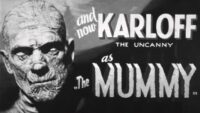
The Mummy (1932) poster by Karoly Grosz

Universal Pictures released The Mummy on 22 December 1932.

It is one of my all-time favorite films. Like the best of the Universal horror films, it has a lot of heart. Imhotep is the villain but he’s also very sympathetic. And Boris Karloff shows the same depth of character that he did in Frankenstein and that he would in Bride of Frankenstein.

The first time I saw The Mummy, I loved that it wasn’t like most modern horror films. Sir Whemple (Arthur Byron) and Muller (Edward Van Sloan) argue whether the curse should be heeded. And inexperienced Ralph (Bramwell Fletcher) takes the opportunity to look in the box and remove the scroll, reanimating Imhotep, the mummy. But instead of killing Ralph, Imhotep just takes the scroll that he needs and walks on. Some might not like it for this reason. Even at the end, we are at least a bit ambivalent about Frank (David Manners) saving Helen (Zita Johann).

This doesn’t always work. I think it’s actually quite toxic in modern-day action films. Most superhero films, for example, only manage to develop their villains. Whiplash has motivation for his actions, whereas Iron Man is definitionally good despite just being a rich prick.

We do get some of this in The Mummy. But you do side with Helen. It’s not even clear in the film that she really is the reincarnation of the princess. And even if she were, Helen has a right to her own life. Imhotep rightly fails in his efforts. But it is due to Helen and Isis, not Helen’s friends. It is bittersweet — something you can’t say about many films today.

Another thing I love about it (typical of other Universal horror films of this era) is the lack of music. When Imhotep is first brought back to life, there is a very tense scene. But there is no music. Even the denouement lacks a strong score. The story, acting, and design are enough to engage us.

So on this, its 93rd birthday (just over a year before it goes into the public domain), let’s watch The Mummy!


The Mummy (1932) poster by Karoly Grosz via Los Angeles Public Library. It is in the public domain.

Eegah (1962) - Arch Hall Sr

Arch Hall Sr: Drive-In Producer

Arch Hall Sr in Eegah (1962)

Arch Hall Sr was born on 21 December 1908.

He lived an interesting life. Jack Webb immortalized him in the film The Last Time I Saw Archie. Hall was apparently writer William Bowers’s friend during World War II and effectively stole the idea. (Or not. It’s hard to tell.)

Before the war, Hall worked in radio and as a stuntman and bit player in the movies. But we aren’t discussing him for any of this.

In the early 1960s, Hall formed what was originally a distribution company and eventually a production company, Fairway International Pictures. It released roughly a dozen films through the early 1970s. This included a notable film that Hall had no direct association with, The Incredibly Strange Creatures Who Stopped Living and Became Mixed-Up Zombies.

Arch Hall Sr wrote and produced most of the Fairway films. Like exploitation filmmakers everywhere, he was just trying to make a buck. He produced films specifically for the drive-in market. And they seem to have done well because he kept making them. He made them on a shoestring, of course. They are a lot better than their budgets would indicate.

His son, Arch Hall Jr, starred in most of his films. He’s not bad! But Jr didn’t have the face of a star. But he grew into his face and could certainly have been a good character actor.

I haven’t seen most of Arch Hall Sr’s films. It might make for a good article to watch them all. At this point, I only remember watching his first two: Choppers and Eegah. Most people only know the latter because of Mystery Science Theater 3000. It’s a clever film. It seems so much bigger than it is. Plus, it is shot in color — not something common in early 1960s low-budget features. And it has a great surfer soundtrack, a cool jalopy, and a helicopter.

It also stars Richard Kiel — 15 years before he became a star as Jaws in The Spy Who Loved Me. Arch Hall Sr directed the film — his only. He does a fine job of it. I’m not sure why he didn’t direct again.

Let’s celebrate his birthday by watching the film!


Arch Hall Sr in Eegah (1962) via Wikimedia. It is in the public domain.

Slaughterhouse Five (1972) - George Roy Hill

George Roy Hill and “Old” Films

George Roy Hill

George Roy Hill was born in Minneapolis on 20 December 1921.

Most people don’t know who he was. But he was an icon of my youth. For the decade starting in 1967, he directed nothing but hits. Two of them were huge hits: Butch Cassidy and the Sundance Kid (1969) and The Sting (1973). He isn’t really a psychotronic filmmaker, although one of them qualifies (see below).

But Hill makes me think of my older sister. Whenever I tell her about a great film, she always says, “Is it new?” And I usually say something like, “Yes! It came out in 1973!” That, of course, is not what she means.

The weird thing is that when my sister was a teenager, she loved old films. She was always watching old musicals on TV. Now she mostly watches new comedies — usually ones I hate like Grown Ups (2010). Not that I’m judging. Whatever someone likes is fine by me. But I like idiosyncratic people and I wish she were binging Busby Berkeley.

But I’m an annoying guy. When everyone had iPods, I noted that I’d long had my own MP3 player. What’s more, I had atransistor radio as a child, and it just ain’t that different.

And today, we could ban filmmaking for the next century, and it wouldn’t much matter. There’s a ton of great films that no one watches because there aren’t multi-million-dollar ad campaigns selling them.

My point is: George Roy Hill made a lot of great films that are just as fun today as they were then.

So let’s celebrate the birth of George Roy Hill by watching his only film that clearly qualifies as psychotronic: Slaughterhouse-Five. Of course, it also won the Jury Prize at the 1972 Cannes. I’m not big on awards. But David Cronenberg got it for his exceptional Crash in 1996, so I’ll allow it.


George Roy Hill by Steelehill12 under CC BY-SA 4.0.

Mouse Hunt (1997)

Mouse Hunt and Anti-Fun Film Critics

Mouse Hunt (1997) poster

DreamWorks Pictures released Mouse Hunt (or MouseHunt) on 19 December 1997.

I loved this film when it first came out. Years later, I read the reviews, which surprised me. The critics didn’t much like it. How do you not like this film?!

But at least Roger Ebert had a good reason for disliking it. I’m kidding, of course. His review was one of the classics: “I didn’t like this film for no particular reason so I reverse engineered my review!”

He gave us all a lesson about how comedy works!

A comedy that hasn’t assigned sympathy to some characters and made others hateful cannot expect to get many laughs, because the audience doesn’t know who to laugh at, or with.

Silly me! All these years, I thought Annie Hall was a comedy! And The Producers! Animal Crackers too! How could I have been so foolish?! Or could it be that Ebert was a useless hack? It still amazes me that people considered him a serious critic. I can’t think of any film that he provided a keen insight for.

Anyway, in Mouse Hunt, we know where our sympathies lie. We don’t want the mouse hurt. We are sympathetic toward the brothers but that is secondary. And we hope for an ending that is good for all three. Shockingly, we get it! And it is one that pleases their dead father. Truly, what’s not to like?!

Critics struggle most with comedy. I have never heard a critic engage this problem. You can find a film hysterical at one time and boring at another. Critics need to address this problem rather than speculating about how a film is not funny in some Platonic sense.

Mouse Hunt is extremely silly. And much of it is over-the-top. This isn’t surprising. It is written by Adam Rifkin, who is a total nutball. And it is directed by Gore Verbinski, who also directed the first three Pirates of the Caribbean films. With that in mind, I don’t see how you can miss with this film.

Unfortunately, all the streaming copies of the film on my main source are dubbed into other languages. Right now (and for only about a week), you can watch it for free on Hoopla. Right now, I’ll embed the trailer.


Mouse Hunt (1997) poster via Wikipedia under Fair Use.

He Never Died (2015)

“He Never Died” Is 10 Years Old

He Never Died (2015) poster

Vertical Entertainment released He Never Died on 18 December 2015. It premiered in March at SXSW, which is a big deal.

I love this film. I put it on a lot when I feel that the justice is absent in the world. So I put it on a lot these days!

Writer-director Jason Krawczyk has a sly and dark sense of humor. And Henry Rollins in the lead plays it perfectly. But if you don’t pay attention, you can miss this. I recommended the film to a friend and she told me she shut it off after 10 minutes. I said, “You didn’t pay attention, did you?” She admitted she didn’t and had totally missed the humor. She put it on again and loved it.

It got good reviews — especially from people in the psychotronic community. But Matt Donato at We Got This Covered did not disappoint:

Herein lies the problem – can you really get excited about a character who can’t seem to die? No matter how many times Jack is shot, tortured, or thrown in a river, he always comes back meaner and badder than before.

I think video games have melted the minds of many people. True, Jack can’t die. That is his biggest problem! And despite not being able to die, he feels pain. That is his second biggest problem! That is the point of my favorite line in the film, “I have pliers in my head. It hurts.”

If you haven’t seen He Never Died, you owe it to yourself. There just isn’t much to say about it. It’s pure joy. Unfortunately, I can only embed a copy from DailyMotion. You can also watch it for free (with a library card) on Hoopla. Or, you can get the DVD (as I have). Sadly, the producers have never released it properly. Not that they need to. It isn’t a film you need to learn about. Just watch and enjoy.

Here is a free copy:


Jason Krawczyk also directed The Briefcase, which is a very fun film. And I now see that he released another film last year (which I haven’t seen), Don’t Mess With Grandma.


He Never Died (2015) poster via Wikipedia under Fair Use.

King Kong (1976)

“King Kong” (The “Bad” One) Released

King Kong (1976) poster

Paramount Pictures released King Kong on 17 December 1976.

You can’t really remake a classic and expect critics to applaud you. Critics didn’t universally hate the 1976 King Kong. They mostly just dismissed it. I am one of those who dismissed it. I saw it at the time. And I thought it was stupid. In particular, Kong looked like a smiling idiot.

But I watched the film again recently. This time, I watched it with a positive attitude. And it really is rather good.

I am not fond of the presentation of the natives of Skull Island, but they aren’t any worse than in the Peter Jackson King Kong. The worst thing in that regard is the female lead. Dwan (the Ann Darrow character) is annoying because she acts more like a 13-year-old than a 26-year-old.

The film has a ton of 1970s-era cynicism. And it squashes Fred S Wilson (the Carl Denham character). So we lose the line, “It was beauty killed the beast.” But given the nature of the film, that’s probably for the best.

Overall, it’s a fun watch. And we are going to watch it! But if you ask me, A*P*E is better. In the days before The Asylum, different producers created cheap knock-offs of upcoming blockbusters.

But A*P*E isn’t just ripping off Dino DeLaurentis’s production. It is also mocking it. And despite having a tiny budget, the ape doesn’t look much worse than it does in King Kong. According to some, the production cost just $23,000. That’s $134,000 today. I find this extremely hard to believe. But it was definitely a low-budget production.

If you would like to watch A*P*E, I encourage you to do so. There is a good print you can watch for free. But I’m highlighting King Kong. It’s not great. And it doesn’t feature any fighting with a shark. But it is fun!


King Kong (1976) poster via Wikipedia under Fair Use.