Category Archives: Anniversaries

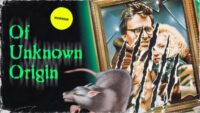
Of Unknown Origin (1983)

“Of Unknown Origin”

Of Unknown Origin (1983) poster

Warner Bros released Of Unknown Origin on or about 24 November 1983. It’s confusing. Different sources provide different dates.

Neither critics nor audiences took to the film. Of course, the producers didn’t give audiences much of a chance. They distributed the film in spurts. But I think I know what the problem was. The film is a comedy. Sure, it’s also horror. And it is pretty scary at times. But a lot of this film is laugh-out-loud funny.

Of Unknown Origin is like a lot of lower budget films. Critics like it much more now at its release. Because critics are idiots.

The film started with Chauncey G Parker’s novel, The Visitor. Executive producer Pierre David optioned it. He had veteran TV writer Brian Taggert write the screenplay. Director George P Cosmatos was also interested in making a film based on the book. So he hooked up with David.

Cosmatos is an interesting guy. He had some success in Europe early on. This film had a similar budget to the films he had been making, despite being his first North American production.

Cosmatos follwed up the film with a series of big budget films. These included two Sylvester Stallone films: Rambo: First Blood Part II and Cobra.

Let’s watch Of Unknown Origin on its (more or less) 42nd anniversary!


Of Unknown Origin (1983) poster via Wikipedia under Fair Use.

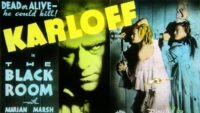
The Black Room (1935) - Boris Karloff

Boris Karloff and “The Black Room”

Boris Karloff (1913)

Boris Karloff was born on 23 November 1887 in London, England. In 1909, he moved to Canada. And until 1959, he worked there and (increasingly) in the United States. He spent the last decade of his life back in England.

What can I say about Karloff? I said a bit already in my article about Bela Lugosi. I’ve been clear that I’m much more of a fan of Karloff. Part of that is surely that I’m just not a big vampire fan. So I’m not that interested in Lugosi’s signature role. Compare that to Karloff’s signature roles: Frankenstein and the mummy. I love those! Bride of Frankenstein and The Mummy are two of my very favorite films.

But the two actors are very different in their skills. Lugosi was made for the stage. Karloff was a better screen actor. A lot of his work was very subtle. In his most iconic roles, he doesn’t have a lot to work with. He could also go broad and over-the-top — like he did in The Raven. Of course, I could say the same about Lugosi. He was also great. It’s just a question of degrees.

But mostly, Karloff was simply in better films. As a result, I’m tempted to highlight the 1940 film, The Ape. Michael Weldon wrote of it:

Karloff plays another kindly doctor, trying to cure a polio victim. He needs human spinal fluid for the miracle serum, so kills an escaped circus gorilla, skins it (off-screen), and disguised as the ape goes after more spines. What a brilliant idea! Nobody would notice a gorilla killing people. And you thought only Bela Lugosi made movies this dumb.

You really should watch it! Archive has a decent print of it. But I want to present The Black Room. It is far better. Plus, he plays a dual role as twin brothers. Happy birthday, Boris Karloff!


Boris Karloff (1913) via Wikimedia. It is in the public domain.

I Spit on Your Grave (1978)

“I Spit on Your Grave” and the Rape-Revenge Film

I Spit on Your Grave (1978) poster

Cinemagic released I Spit on Your Grave on 22 November 1978. The Jerry Gross Organization re-released the film two years later.

I Spit on Your Grave is probably the most disturbing film of the rape-revenge subgenre of horror. My preference in these films is a brief rape and a lot of revenge. This is why I’m so fond of Ms 45. But that ain’t reality. And Grave presents the rape and the incredibly violent act that it is.

The rape goes on for almost a half hour. Obviously, it isn’t sexy. In fact, it isn’t even sex. It is pure brutality. It is so bad that I haven’t watched it for a decade. And I never will again. However…

I watch the last half hour every year or two. And I will continue. Because these guys deserve to be killed over and over.

But this is the problem with the film. A one-to-one ratio of rape-to-revenge just isn’t enough. And the final guy gets a death that, while thematically great, is practically underwhelming.

Alexandra Heller-Nicholas in her excellent book, Rape-Revenge Films: A Critical Study, notes:

Even today, the blatant (and yes, sensationalized) depiction of human suffering in I Spit on Your Grave emphasizes how sensitized we are to glossy depictions of rape. However, somewhere in those grueling 25 minutes is a lightning flash of empathy where we realize we are trapped, too — even leaving the cinema or turning off the DVD can’t take back what we’ve already seen. Jennifer’s rape therefore leaves us powerless. [The film] moves the onus of trying to comprehend the brutal incomprehensibility of rape firmly onto the spectator.

She is right. Society gets a skewed perspective on rape with more “sensitive” depictions. I think men can easily understand the horror of being anally raped in prison. It shouldn’t be hard to expand this to understanding all sexual assault. If not, I Spit on Your Grave provides a very good example.

As far as I know, I Spit on Your Grave was the first rape-revenge film where the victim gets the revenge. This is an essential innovation. And a big reason I admire the film.

Here is the film. If you’d like to skip the rape, watch the first 20 minutes. Then you can skip to 47:00. It’s still hard to watch. If you would prefer just the revenge, skip to 64:00.


I Spit on Your Grave (1978) poster via Wikipedia under Fair Use.

Frankenstein (1931)

“Frankenstein” and Horror Iconography

Frankenstein (1931) poster

Universal Pictures released Frankenstein on 21 November 1931.

I think of the Universal Horror era as starting with Dracula. Most people include earlier films, but they are all silent — even though they are generally pretty good like The Phantom of the Opera and The Man Who Laughs. Frankenstein came second — unless you include the excellent Spanish-language Dracula that came out shortly after the Bela Lugosi film.

Bride of Frankenstein is one of my all-time favorite films. But Frankenstein is still really good. The reason Bride is better is that it has better characters. The good doctor doesn’t have much of a personality. And the creature doesn’t even get to talk! The second film largely fixed this.

But all the films have one major problem. Victor is sympathetic. Regardless what the creature says at the end of Bride, he too deserves to die.

Guillermo del Toro gives Victor a great narrative arc. He’s horrible but learns valuable lessons from Elizabeth and the creature. This isn’t even in the book. But it really focuses on the main theme of the book about the hubris of man.

I still think the 1931 version of Frankenstein is better than the 2025 version. With all due respect to a filmmaker I adore, it’s possible to make a film breezy. James Whales does as much in 70 minutes as Del Toro does with twice that. Not that I’m criticizing the recent film. I think it is outstanding!

But let’s be clear: the 1931 film defines the creature. It is what everyone thinks of. And as good as the 2025 film is, no one will remember the creature design. As it is, I spent much of the new film thinking, “That looks like an Engineer from Prometheus.” Flat Top Boris will not be replaced for as long as people still want to watch Frankenstein.

On 1 Janary 2027, this film will enter the public domain. But there is already a fine print on Archive:


Frankenstein (1931) poster via Wikimedia. It is in the public domain.

First Men on the Moon (1964)

“First Men in the Moon” and Realistic Sci-Fi

First Men on the Moon (1964) poster

Columbia Pictures released First Men in the Moon in the United States on 20 November 1964. They released it in the UK a few months before that.

This is an amazing film! It takes the HG Wells novel and places it in the frame of the race to the Moon. The astronauts land on the Moon and discover a British flag. So they find one of the men who did this decades before. And he tells the novel story. This works really well. It also allows the producers to tack on a War of the Worlds ending.

The film starts with the following acknowledgment in the middle of the credits, “The Producer acknowledges with thanks the co-operation of the National Aeronautics and Space Administration, Washingtin DC…” When I saw that, I laughed. But then the narrative started and it presented a landing on the Moon. And it presented the procedure that was actually used by NASA just five years later!

I figured the film would be what I think of as science-based science fiction. That includes films like Destination Moon and Phase IV. And it tries to be. It’s limited by the source material. And the first half of the film is a comedy. Lionel Jeffries lights up the screen in this regard.

But the realism does matter. I like films where humans land on the Moon and it’s a tropical paradise with women in bikinis. But those have to maintain that level of silliness throughout. If a film can manage to be reasonably correct, it helps my enjoyment.

I suspect that after the actual Moon landing, people weren’t interested in watching this film. It does, after all, feature a bunch of insect creatures living under the surface of the Moon. But it’s actually a whole lot of fun. After all, Americans lost interest in the Moon after it turned out to be just a big space rock. This film is a great corrective!

So on the 61st anniversary of its release, let’s watch First Men in the Moon!


First Men on the Moon (1964) poster via Wikipedia under Fair Use.

Sleepy Hollow (1999)

“Sleepy Hollow” and Not Staying True to the Souce Material

Sleepy Hollow (1999) poster

Paramount Pictures released Sleepy Hollow on 19 November 1999. It premiered at Mann’s Chinese Theatre two days before for all the Beautiful People.

I quite like the film. It features a very clever story and a well-constructed screenplay. And it looks good — with Tim Burton’s style but without dominating the way it usually does. Finally, it features an amazing cast.

At this point, not a lot of people have read “The Legend of Sleepy Hollow.” It is a clever story. But it features terrible characters. There really isn’t much in it to make for a good movie. Except, of course, the legend itself.

I think I like the film Sleepy Hollow because all it takes from the story is the legend. None of the characters are the same. Ichabod Crane is now a big city constable with very modern ideas about his job. Katrina is the same as she is in the book except that the screenwriters have given her a personality. Brom is barely in the film.

Unlike the story, the film is not just a single (but good) joke. Even better, it abandons the materialist bent of the story. In fact, the rationalist Ichabod slowly comes to accept the supernatural. That is the film’s main arc.

My mother was a big reader. She was reading all the time. And the whole family went to see any movie based on those books. Mom was rarely happy with the films. Most readers aren’t! But most readers are wrong. Few novels make good movies without a lot of changes. (Short stories have similar, if different, problems.)

Burton is good enough (or powerful enough) to avoid this. He did the same thing with his later Alice in Wonderland. It didn’t especially like it. But I don’t especially like any film based on that book. He came closer to cracking it as anyone else.

Let’s celebrate the 26th anniversary of its release by watching Sleepy Hollow now!


Sleepy Hollow (1999) poster via Wikipedia under Fair Use.

Jack Frost (1997)

“Jack Frost” and Hallmark Horror

Jack Frost (1997)

A-Pix Entertainment released Jack Frost to the world on 18 November 1997. It went direct-to-video. You can see why. The producers largely shot the film on a sound stage. But it actually looks pretty good. It’s a whole lot of fun. And I believe they released it in theaters in some locations.

The story is pretty standard. It’s pretty much the same as Child’s Play. A serial killer becomes a snowman for ridiculous reasons that don’t matter. This is a formula that has been used countless times. I think this is a lot like The Gingerdead Man, which I really don’t like but mostly just because of the monster design. Jack Frost looks great!

But what is the point of films like this? They really aren’t scary. And they aren’t especially funny. But they are fairly engaging. And they don’t require much from the viewer. They are the horror equivalent of Hallmark Christmas movies. The fact that Jack Frost is also a Christmas movie makes it perfect.

I will always prefer these horror films to Hallmark films for one objective reason: I believe murder exists but love — the kind you see in Hallmark films — does not. If you would prefer to watch A Christmas Melody, well, all I can say is that you aren’t reading this because no one who wants to watch it would be on this site.

So let’s celebrate the 28th birthday of Jack Frost by watching it!


Jack Frost (1997) via Wikipedia under Fair Use.

Asylum (1972)

“Asylum” and Anthology Horror Film Frame Stories

Asylum (1972) poster

Amicus released Asylum on 17 November 1972. The UK got it the previous July. And it premiered in the US on 11 October 1972 in Los Angeles.

By my count, Amicus produced 28 films between 1962 and 1977. But only four of them were not psychotronic. Sixteen were horror films. And of these, seven were anthology films. Today, the company is most known for these films:

Asylum is not my favorite of the anthology films. But it has the best frame story of the lot. Most anthology films feature perfunctory frame stories. And that’s fine. Actually, I’m fine with no frame story at all.

Film producers have long claimed that people don’t like short films so anthology films need something to sew them together. I don’t know if this is true. The excellent Southbound (2015) has no real frame. That’s also largely true of V/H/S (2012). The film industry is heavily dependent on conventional wisdom based on little but vibes. It is kind of like political consulting, but with more money.

In my experience, short films are, on average, far better than feature films. The argument against anthology films is that audiences won’t like all of the shorts. But do audiences like every part of most feature films? Or is it — like with sketch comedy — that audiences can better express their displeasure?

I think the shorts could be better if no time were wasted trying to tie them together. But if we must tie them together, it should be done as it is in Asylum. And on this 53rd anniversary, let’s watch it!


Asylum (1972) poster via Archive.org. It is in the public domain.

Torture Garden (1967) - Burgess Meredith

Burgess Meredith’s Psychotronic Delights

Burgess Meredith

Burgess Meredith was born on 16 November 1907.

Meredith isn’t what I would call a psychotronic actor. He had an extremely broad career in TV, film, and theater. But he worked so much that he managed to do more psychotronics than many actors who were more focused.

We know Burgess Meredith for a lot of mainstream successes late in his career: Rocky (I, II, and III), Foul Play, Magic, and Grumpy Old Men. But he is important to psychotronic fans primarily because of his work in TV.

Most people probably know him best for playing The Penguin in 21 episodes of the 1960s Batman TV series. He really chews the screen in that show. He delivers lines like, “I am an aristocrat of crookery, my dear man!”

Psychotronic fans most remember his work on The Twilight Zone. He was in four episodes:

  1. “Time Enough at Last”: One of the most iconic episodes where a bookworm survives a nuclear bomb and is happy to have the rest of his life to read, only to break his glasses.
  2. “Mr Dingle, the Strong”: Space aliens give Luther Dingle super strength. I’ve always hated this episode because the aliens criticize him for not doing anything good with his strength. But they’ve hardly given him any time. Isn’t it natural that the first thing anyone would do is play around with the power?
  3. “The Obsolete Man”: A totalitarian state finds a librarian to be obsolete. He uses his execution to make a point. It’s pretty good but I could do without all the religion.
  4. “Printer’s Devil”: A newspaper publisher hires a new printer. He alters the press so that anything that he prints happens. I think this is my favorite of these.

Burgess Meredith also appeared in two episodes of Night Gallery:

  1. “The Little Black Bag”: A former doctor and current drunk finds a medical bag accidentally transported from the future.
  2. “Finnegan’s Flight”: A lifer is hypnotized by his cellmate. He’s so susceptible that what he’s told to believe actually happens to him — with tragic consequences. Cameron Mitchell is wonderful in the lead here.

So, let’s celebrate Burgess Meredith’s birthday by watching his one Amicus film, Torture Garden. In it, he plays Mr Diablo, a carnival showman who holds the horror shorts together. You will be shocked to learn that he’s actually The Devil!


Burgess Meredith via Wikimedia. It is in the public domain.

Manos: The Hands of Fate

Manos: The Hands of Fate — Better Than You Think

Manos: The Hands of Fate poster

Emerson Film Enterprises released Manos: The Hands of Fate throughout the southwest. But the film premiered on 15 November 1966.

People have written so much about this film. But I don’t want to repeat any of its history because it is all questionable. For example, people still claim that writer-director-producer Harold P Warren was a fertilizer salesman. But Brian Albright in Regional Horror Films, 1958–1990 disproved this claim.

Mystery Science Theater 3000 features Manos on the last episode of its fourth season. Most people have only seen it in this form. That was me for many years. I used to think it was the worst film I had ever seen. Of course, that was before seeing Black Frankenstein and Bad Teacher.

But there’s something more. A few years ago, I found a good print of Manos: The Hands of Fate. The print that MST3K used was terrible. There is no film good enough to counter that. So I watched this print. And I found a lot to like.

For one thing, John Reynolds as Torgo is iconic. People may laugh but the character is a lot like Ro-Man in Robot Monster. If he weren’t so weird, no one would remember him. And the character is deeply disturbing for the first half of the film when there isn’t much else of interest.

And Reynolds isn’t alone. The acting is way better than it should be — generally as good as the acting in most Herschell Gordon Lewis films.

The film also looks pretty good — especially considering they clearly had limited lighting and most of it takes place at night. This is very clear in a good print. The bad print makes the main set appear disgustingly dirty, which was the biggest issue for me during early viewings.

But okay. The script isn’t great. But it works reasonably well. The idea of a sex cult that kidnaps a family and turns the father into a Renfield and his wife and young daughter (!) into sex slaves is creepy in the extreme.

So let’s watch Manos: The Hands of Fate the way it should be presented. I’m not saying it’s great. But it’s a lot better than people give it credit for. And it’s a fast and even fun watch!


Manos: The Hands of Fate poster via Wikimedia. It is in the public domain.