Frank Moraes is a freelance writer and editor online and in print. He is educated as a scientist with a PhD in Atmospheric Physics. He has worked in climate science, remote sensing, throughout the computer industry, and as a college physics instructor. Find out more at About Frank Moraes.
We have another mixed bag this week. Some are just fantastic. But as usual, I try to mix things up and intentionally watch films that I don’t think I’m going to like all that much.
But in many cases, films are on this list simply because I got them on disc. (Full reviews are coming!)
I continue to marvel at just how much good work is around. I don’t think we appreciate how good we have it. At the same time, it makes watching films hard because we have so many choices.
The whole point of this site is not to help people sift through everything. That’s supposedly what film reviewers are for (they fail spectacularly). Rather, we want to help people appreciate films (or at least give them a try). And that’s hard because it isn’t always clear to us why someone would like a particular film. But we try.
This is one of my all-time favorite films. I don’t have a lot to say here. You should just read my analysis.
Bite
I’ve been spending more time over at SHOUT! Factory TV these days. One of the little delights I found over there was this wonderfully gooy film about a young woman who is bitten by something and then transforms. These filmmakers know their Cronenberg and do him one better.
Bloodsucking Bastards
Horror-comedy is not one of my favorite genres but only because they are so rarely funny. When they are funny, I really enjoy them. This one is from a comedy group. It also has some nice horror moments and tons of blood.
Class of 1984
The worst thing about this film is that it seems to think it’s socially relevant. The second worst thing about it is that it takes forever to get to the good stuff. But if you can get through more than an hour of Blackboard Jungle, the last 15 minutes is pretty fun!
More Christopher R Mihm
As of this month, I have only one more Mihm film to add to my article. So it should come out sometime this month. Last month I added, Demon with the Atomic Brain, Guns of the Apocalypse (probably my favorite), It Came From Another World!, and Queen of Snakes.
Djinn
This widely hated film is actually very good. I take special exception to the way that critics treat Tobe Hooper. Although he stuck with the horror genre (probably his greatest sin for the critics) he was constantly trying new things. This is a straight-up ghost story and it’s quite effective.
Eaten Alive
This is a Tobe Hooper classic. I really don’t have any idea why critics don’t like it. In its way, it’s every bit as good as The Texas Chain Saw Massacre.
The Exotic Ones
This is a wonderful exploitation film in the tradition of Herschell Gordon Lewis. But it’s a lot better made than his films. It’s also known as The Monster and the Stripper, which is more fitting since it’s about a Bigfoot captured to use in a strip club.
Five Guns West
This film is most notable for being Roger Corman’s first as director. And as usual, it works pretty well. I have my problem with valorization of the Confederacy. But Corman can sure tell an interesting story on a budget!
Grosse Pointe Blank
Although I think the sorta-sequel of this, War, Inc, is a masterpiece, Grosse Pointe Blank is more enjoyable for most people. It’s very funny. “You can never go home again, Oatman… But I guess you can shop there.”
Isle of the Snake People
This is a pretty typical jungle voodoo drama but with good acting, dialog, and some very sexy scenes.
Lady Terminator
This is more or less a parody of The Terminator. There are a lot of negative reviews of this film by totally clueless people who just don’t grok it. It’s wonderful with lots of action and sex. I must investigate Indonesian films of this era.
Ms .45
I love this film. The protagonist is amazing: a young mute woman who is raped twice and seeks revenge. It’s also pretty arty.
Night of Bloody Horror
Another arty one, this thriller works pretty well with very cliched effects from the 1960s. A pretty creepy outing from the man who would go on to be Major Dad.
Prom Night
This is one of the better slashers from this period. The opening section with the little kids is particularly good. And the ending is interesting. The best part is the head rolling onto the dance floor.
Re-Animator
I just got the Arrow Blu-ray on this and it’s great. Time only makes the accomplishment of this film more impressive. The effects are fantastic but then so is everything else here!
The Taking of Deborah Logan
There are supposedly a bunch of bad found-footage films. I haven’t come across them. I’m generally impressed with the genre. This one is wonderful. And it tells a pretty complicated story. Well worth watching!
The Texas Chainsaw Massacre 2
Tobe Hooper was unhappy that it took people so long to realize how funny the first film was so he made this. This is very dark comedy. But it does have some amazing comedic images like Leatherface fighting with a chainsaw impaling him. This film is a great chaser after watching the original.
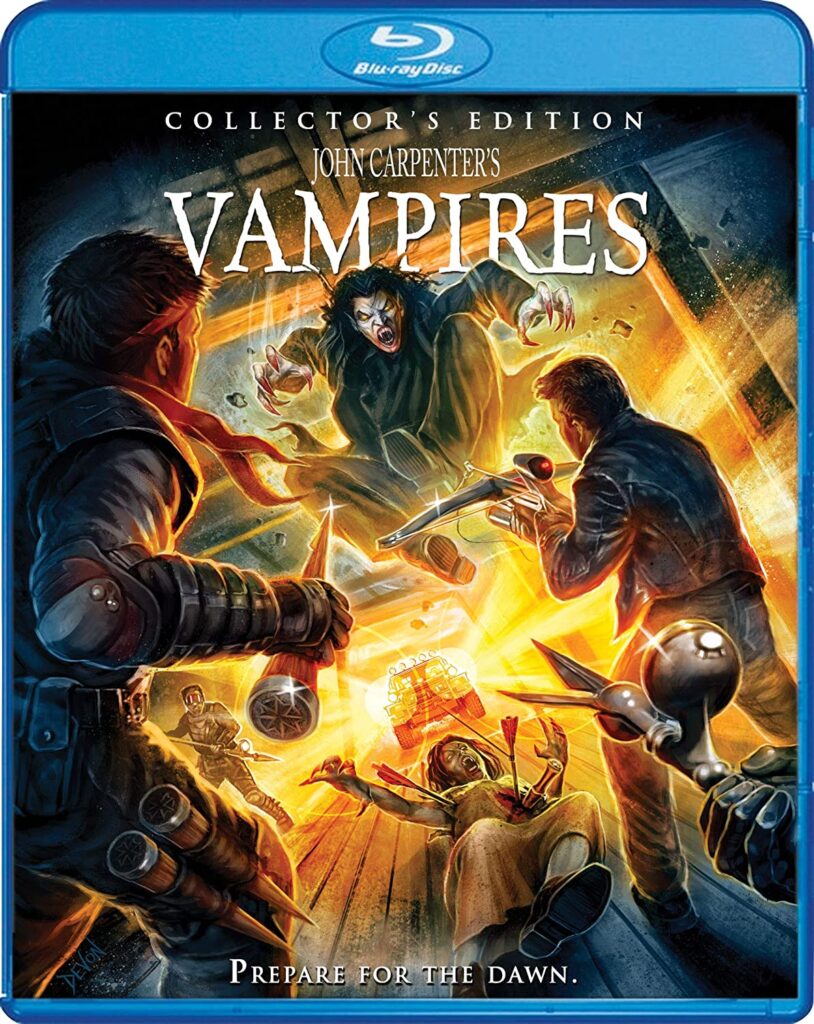
Vampires
John Carpenter does a typically exceptional job on this film. I have my problems with its content. But there’s no doubt that it works really well. Check out my review of the Blu-ray.
When I saw Vampires in the theater, I quite liked it. So I finally broke down and bought it on Blu-ray.
It’s a pretty standard SHOUT Factory release for a John Carpenter film. You get the standard commentary, some interviews, and an old making-of featurette. I’ll discuss those in more detail below. I’d say it’s a bit less than Prince of Darknessand In the Mouth of Madness.
The film itself is highly polarizing. Some people love it and others hate it. I’m the same way: I love it and hate it. But there is no doubt that it’s an incredibly good film — as well made as anything Carpenter has ever done.
Synopsis
A team of vampire hunters led by Jack Crow (James Woods) clears out a nest of vampires in an abandoned house in the Southwest. They do this in a very cool way: shooting an arrow attached to a line into each vampire and then dragging them into the sunlight where they burst into flame.
Team Is Destroyed
That night they have a drunken party with a group of prostitutes at a motel. A “master” vampire, Valek (Thomas Ian Griffith), shows up and kills everyone except for Crow, his second in command, Tony (Daniel Baldwin), and a prostitute, Katrina (Sheryl Lee), who was bitten and thus “infected.”
In their escape from Valek, they crash their truck. They steal a car from a guy (writer/director Frank Darabont) whose only crime is being in a film with asshole übermenschen. Then they drive back to the motel where they spit up. Crow will stay and dispose of the bodies and Tony will guard Katrina elsewhere.
Crow goes to meet Cardinal Alba (Maximilian Schell) who bankrolls him. He sends Crow off with Father Guiteau. Crow treats him as bad as he treated Katrina. But we’re still supposed to like him because he is Saving the World.
Meanwhile, at the hotel, it’s clear that Tony likes Katrina. She tries to kill herself but he saves her. He cuts his arm in the process and she, attracted by the blood, bites (and thus infects) him.
New Team Hunts Valek
The four all together now, they search for Valek. Because she was bitten by him, Katrina has a psychic connection with Valek. She can see what he sees. Eventually, they learn that Velek has acquired the Bérziers Cross, which he can use to allow himself to live in the daylight. It only took abusing a prostitute and threatening the life of a priest.
They learn where Valek and his group of “master” vampires are hanging out. So, despite having nowhere near the physical and human resources they did before, they go hunting with Katrina rapidly turning into a vampire.
They kill one vampire but not before a lame joke about soccer players not being real men. (Get it?! It’s funny because it isn’t a popular game in the US!) This is the first scene of Father Guiteau turning into a badass (which is the best part of the film).
They kill another vampire but night comes suddenly and the remaining vampires attack. Tony and Katrina race away in a jeep. She’s now a full vampire and bites him. They crash the car. Katrina joins the other vampires. Tony observes from afar.
Crow Is Captured
Father Guiteau hides in a local shop and Crow is captured by the vampires. They learn that Cardinal Alba is working with Valek because he’s getting old and is afraid to die. They need Crow for a ceremony with the cross. So they bind him to it.
Guiteau climbs on to the roof of the van and shoots and kills Alba. It’s almost sunrise and Crow tells Valek that he can’t do the procedure without Alba. Valek counters, saying Guiteau will do it. And if the priest doesn’t, Valek will burn Crow alive.
Before Valek can torch Crow, Tony drives through, shoots an arrow with a line into the cross, and drags Crow away. Father Guiteau unbinds him and the vampires flea from the sun.
Crow and Valek fight. Eventually Crow destroys some of the roof causing Valek to burst into flames and then explodes. (He’s no ordinary vampire!)
Tony saves Katrina and puts her in the van away from the sun. Crow lets them go because Tony saved him — giving them two days head start. They drive off and Crow and Guiteau go back in to kill vampires as the badasses they are. Who needs sleep after you’ve been awake for two days straight?
Analysis
Carpenter says that he made this film as a western — specifically Red River. It’s almost impossible to miss the similarities. But I think it explains the things that I don’t like in the film.
In Red River, there is a father-son dynamic and a shared history of the father’s lost love and the son’s potentially happier future. Additionally, the woman in the story has agency.
Jack Crow
In Vampires, the main thing we get is that the main character is thoroughly unlikeable. I generally appreciate dark and difficult characters. But Crow is abusive to his comrades. And that just doesn’t work for me.
It isn’t a problem with the film itself. But it’s a choice. And it keeps me from liking the film more. Jack Crow is no Snake Plissken. He’s more like an advertisement for toxic masculinity. And I know I’m supposed to like it.
But I could argue that it’s brilliant. It isn’t a problem that Jack Crow is horrible and doesn’t grow in any way during the course of the film. That’s because he is the opposite of Valek who is also unchanging in his horribleness. But I can’t do those kinds of intellectual gymnastics while watching the film.
Character Arcs
The other characters are much better. Tony, who is arguably worse than Jack at the beginning, has an arc that ends with him developing human empathy even as he becomes a vampire.
Katrina spends the whole film turning into a vampire. The part is more like an animal than a human. But it’s fascinating to watch her and Tony struggle together is distinct ways. She also has an incredibly sexy scene with Valek early on.
Father Guiteau changes in ways that I don’t love. But he experiences a solid movie arc. He stops being a book-worm (because that’s bad) and becomes an action hero badass. Okay. Since I naturally identify with bookish characters, I prefer when they clearly hold on to those values even as they transform. But it works just fine.
Weird Third Act Transition
In the film, after Crow escapes from the vampires, there is a dissolve to a slightly later time and we see the vampires rushing back to their hideout. It’s almost as though the film ends at this point and the rest is just a coda.
This is curious. It happens with about 7 and a half minutes of story left. I’d like to see more of this. I would even go for two or three codas. At least in these cases, the filmmakers would need to come up with something interesting to do rather than arbitrarily expanding their second acts.
Other Delights
The rest of the film is outstanding. It has a great look both inside and outside with its John Ford like vistas. The fire effects are cool. So is the gore — especially when Mark Boone Junior is cut in half. And it’s edited swiftly so that the film seems over almost before it’s begun — a notable trick for a film that runs over an hour and a half.
The acting is also excellent. The stand-out is Sheryl Lee. She isn’t given much to do other than slowly change yet she becomes more sympathetic with each scene — even after she becomes a vampire.
Blu-ray Details
The print looks great. The only downside is that much of the film is at night. And it seems that there just isn’t as much contrast on video as there is on film. So it’s one you definitely want to watch with the lights out.
The audio is available as 5.1 DTS-HD and 2.0 DTS-HD. They both sound fine. There is also an isolated score, which is more listenable than most.
The film is only in English and it comes with subtitles only in English. It is subdivided into 12 chapters.
Interface
The interface is typical of newer releases with a static base menu with pop-up menus for the selection. Personally, I don’t like this system. I find it annoying to navigate. I wish everyone would go back to having different screens.
But if we are to have this system, it’s best to paginate the extras so that you don’t have to press down 9-times to undo a accidental button press on Extras. It also seems a little slower than on other SHOUT Factory releases.
It’s still better than what Arrow has been doing recently.
Extras
The extras are fairly good on this disc although certainly not up to what we often see from SHOUT Factory.
Commentary
The best extra is the 1999 commentary with John Carpenter. He generally provides solid commentaries and this one is no different. It includes a lot of information about the production.
It may just be me but it seems like he’s a little bored doing it. At times, he sounds like he’s reading off a list. But it’s still interesting and valuable.
Featurette
There is an odd 24 minute video from the time of the film’s release. It’s rendered at 4:3 aspect ratio. And it’s really just a set of shorter featurettes, with a lot of duplication:
Making of (6 minutes)
John Carpenter interview (2 minutes)
James Woods interview (2 minutes)
Daniel Baldwin interview (2 minutes)
Sheryl Lee interview (2 minutes)
B-roll footage (9 minutes).
New Interviews
The new interviews are better because there is less of the typical promotion-tour happy talk. Everyone does seem aware of not trying to offend anyone, however.
Time to Kill Some Vampires: Interviews with Carpenter, producer Sandy King, and cinematographer Gary B Kibbe. It runs 12 and a half minutes. My main takeaway from it was that everyone found James Woods difficult to work with but didn’t want to say it.
Jack the Vampire Slayer: Interview with James Woods — Jack Crow (22 minutes). He talks a lot of nonsense and seemed to think that Carpenter wrote the script. I’ve always figured he was very smart and he certainly comes off that way in the 1998 interviews. One interesting thing he says is that Jack Crow is one of his favorite roles and that he had wished for a sequel (other than the direct-to-DVD releases). He also spoke nicely about their efforts to keep Sheryl Lee from getting hurt during the scenes when she was abused.
The First Vampire: Interview with Thomas Ian Griffith — Jan Valek (10 minutes). He is very excited and friendly in this interview. He discusses how Carpenter kept him from the other actors and how much fun he had making the film.
Raising the Stakes: Greg Nicotero — special effects make-up (10 minutes). He talks about working with special effect coordinator Darrell Pritchett to create burning victims moving while on fire (inspired by The Thing). There are many other details about how they created particular effects. This interview could have been a lot longer!
Padre: Tim Guinee — Father Adam Guiteau (13 minutes). He’s very friendly and positive and offers a few good stories. One is about farting when James Woods was on top of him. He seems to have a sincere admiration and fondness for Carpenter.
Other Extras
The rest of the extras are the standard things that you might watch once:
Theatrical trailer (just over 2 minutes)
Five TV spots including a longer one for Japan, I think (3 minutes)
Photo gallery of 81 images including a fair amount of dreck (6 minutes). But the stuff from the press kit is great. So are the alternative and foreign posters.
Other Versions
There are lots of other ways to get Vampires, but the SHOUT Factory Blu-ray is the best way.
2000 VHS: If this is your thing, you can probably find this at garage sales and thrift stores for nothing. I assume it is cropped to 4:3, which is criminal with this film.
1999 DVD: Original DVD release of 2.35:1 print with the Carpenter commentary and an image gallery. It features the same two English tracks and a French dub. There are matching subtitles.
2002 DVD: Region 2 (Europe) release of 2.35:1 print with the Carpenter commentary, image gallery, and the first section of the featurette on the Blu-ray. It comes with English and Spanish language tracks and subtitles for English, Spanish, Czech, Danish, Dutch, Finnish, Icelandic, Norwegian, and Swedish.
2002 DVD: Region 2 (Europe) release of 2.35:1 print with unknown extras. Although it claims to be uncut, it is 5-minutes shorter than the US release so less sex and gore. It includes 5.1 tracks in English and German. The same version seems to have been released on Blu-ray.
2003 DVD: Superbit release of 2.35:1 print with only the trailer on the disc and an insert with some making-of information. It does, however, come with English, French, Portuguese, and Spanish subtitles.
2005 DVD Vampires Collection: Region 1 release along with the direct-to-disc follow-up films Vampires: Los Muertos(2002) and Vampires: The Turning(2005). The first and second films are presented as 4:3. The last is widescreen. It’s all on one disc so it’s unlikely to have any extras.
Streaming: Amazon Prime offers HD and SD versions of the film to rent or buy. Generally, these come with cast and informational text screens.
There are other version besides these. In particular, there is a Region 2 French release (unavailable) that includes the hour-long episode of The Directors called “The Films of John Carpenter” from 1999. You can generally find it online.
Bottom Line
This is a solid release of a really well-made film that is chock-full of psychotronic delights. Regardless of how annoying I find the main character, this is not a film to miss. I like all of the Apocalypse Trilogy vastly more than Vampires, yet it is in many ways just as good.
Obviously, if you’re crazy for Carpenter, you should get this version. And if you like the film at all (and you should), it’s worth picking up. I’m certainly glad to have it.
Blu-ray cover images via Amazon, the banner image from the Blu-ray, and the film stills from the trailer. All taken under Fair Use.
Most people know of the 2012 feature film The Woman in Blackstarring Daniel Radcliffe. It was based on Susan Hill’s 1983 novel of the same name. But the novel first found its way on to film through an ITV production that first aired on Christmas Eve 1989.
This widely loved film has not been well distributed. It was releases as a PAL VHS and later on a Region 1 DVD. Both these versions are long out of print although you can still find them. Thankfully, ITV has released the film as it should be on a Region B/2 Blu-ray. I was lucky enough to get a copy from the first printing. They have already run out and are doing a second run.
Story
The Woman in Black is a Gothic ghost story. The central character is Arthur Kidd (Adrian Rawlins) — a young lawyer in 1920s London. He has a wife and two small children. His boss sends him out of town to settle the affairs of a recently deceased woman.
Once he arrives, he gets odd reactions from the locals. But no one tells him anything specific. Few people have even met her, since she was a recluse. One woman does show up at the funeral, but he is never able to talk to her.
At the house, he sees the same woman. But this time, he’s terrified. And when she approaches him, he runs into the house and locks the door. Then he turns on every light in the house and has a look around. Except for one room that is locked that will later be a major part of the plot.
He finds an old audio recording device and learns from the former owner that she is visited often by some unnamed woman. “Last night, she did not come until four in the morning. Then it was bad — a bad night.”
Eventually, he learns that owner adopted her younger sister’s bastard son. One day, the younger sister came back and kidnapped the boy. But they were both killed will traveling through the marsh away from the house. Now, whenever the ghost of the sister is seen in town, a child dies due to accident or illness.
The Ending — Briefly
Kidd has many terrifying experiences before a total breakdown. Eventually back in London, his assistant tells him that a woman who dressed as though she were in mourning was hanging around outside the office. This sets Kidd off again and he destroys much of his office in an effort to burn the last of the deceased woman’s things.
Later, Kidd takes his family on holiday. They are in a boat on a lake. The woman in black appears and a large tree falls on the family’s boat — killing them all.
Analysis
The ending doesn’t make a lot of sense, given that the ghost was known for causing the deaths of children. In the book, the protagonist doesn’t die — just his wife and child.
But I don’t think this much matters. It does finish out the plot in a fulfilling way. And all things considered, I’d rather be dead than haunted by this woman.
Otherwise, this film exemplifies what is best about horror. Even as I write this — having watched the film 5 times recently — I have chills. It doesn’t have many jump scares. It’s just the whole feel of the film. It’s overwhelming.
A big part of its success is due to the character of Arthur Kidd and how he is played by Adrian Rawlins. He’s likable and believable. He’s even a bit goofy at times like when he discovers the recording device. So everything he goes through really matters to me.
A Beautiful Film
It’s also a thoroughly well-made film. The sets are great. The exteriors are shot so as to edit well with the indoor shots. It’s also cleverly shot. A couple of stand-out moments are when the woman in black shows up at the house, she appears from nowhere during a single shot. Then, at the end, after she appears and the tree starts to fall, Kidd’s wife rises up in the boat to obscure the woman’s body.
It’s nice to see such care taken in a film. But it’s wonderful when it results in such effective storytelling.
Blu-ray Quality
The first time I saw this film was with a terrible YouTube print — probably not even as good as the original VHS release. But the film was shot on 16 mm negative with well-lighted sets. So I knew better video was possible.
There are two versions offered on this disc. There is the original 4:3 televised version and a 1.78:1 widescreen version. Both show some grain on the scenes with less light. And it can be a bit more pronounced on the widescreen version. But overall, the film looks great. And that’s especially true for the scenes that are most important.
The 4:3 version includes title cards between the acts, as the film appeared on television. These are removed for the 1.78:1 version so that it plays as it would in a movie theater.
The sound is presented in mono, but it is well mixed. The music and voices are distinct. It also includes clear and accurate subtitles.
Special Features
There aren’t that many extras with this disc. But I often think releases provide a lot of useless extras just to impress people. Seven short interviews are better than one long feature that puts them together in some cohesive way? Not really.
Apart from the widescreen version of the film, which is an extra I suppose, there are three extras.
Image Gallery
This is a minor feature. It consists of 34 images displayed over the course of one minute and 35 seconds. Some are rather good but this is nothing special.
Commentary Track
Commentary tracks range from excellent to useless to abusive. The track for The Woman in Black is good. It is hosted by writer Kim Newman. With him is Mark Gatiss of Sherlockfame. Both of them love the film and much of the commentary is simply them commenting on things they appreciate in the film.
For example, they note that what makes the big jump scare work so well is that slightly before we see her, we see her shadow cast on Kidd’s body. It’s the sort of thing you feel but don’t usually notice consciously.
They also discuss various aspects of the novel and how the film got made.
Andy Nyman is also included. He played Jack, the shorter law office assistant with curly brown hair. He adds some colorful stories to the mix.
Viewing Notes
For me, the high-point of the extras was a little 20-page booklet, The Woman in Black: Viewing Notes by Andrew Pixley. It goes through the original book, the play, this film, and the later one. It also goes into depth about Nigel Kneale and his approach to rendering it for the screen.
I highly recommend reading this book. You will learn some of it with the commentary. But if you want to know about how this film got to screen, you should really start here.
The Other Booklet
Along with the Blu-ray came a 24-page booklet The Woman in Black. It appears to have been some kind of promotional material for the film when it was released in 1989 — a press book for the media. There are even corrections on it. The first page says it will show at 9:35, but this is crossed out in red pen and “9:30” is written under it.
It provides basic information about the plot, characters, cast, and crew. But mostly, it contains short interviews with cast members Adrian Rawlins, Bernard Hepton, David Daker, and Pauline Moran. These are the sort of interviews that would today be extras on the disc.
But I don’t think it is officially part of the Blu-ray release. The booklet is too large to fit inside the case and it isn’t mentioned on the case. So you might get it or you might not.
Final Thoughts
I’m pleased to have this. The film is great and it rewards multiple views. It’s also a film you can show to older friends and family members since it is classic horror. It is, however, scary. I just showed it to my Stephen King-loving father and he was impressed — and frightened.
Sadly, it is only available on a Region B/2 disc. But if this gets you to buy an all-region Blu-ray player, great! I purchased it directly from Network on Air for just $21.23. The total shipping charge was less than what Amazon charges and it got here in a week! So they are a company you can trust (and I have absolutely no business relationship with them).
This is a fitting release for an excellent film.
Blu-ray image taken from Network on Air under Fair Use.
I added a lot of films this month — some that I didn’t watch. I have a backlog of these things. But I’ve also been watching more films.
Normally, I go on vacation in June. I didn’t this year. And it’s been weighing on me. I just don’t feel like working on high-paying projects most of the time.
So I use the permission to watch films instead. Although really: watching films is work. And the better I get, the most work it is. I can’t just watch films anymore. I have to analyze them and compare them to other films and put them in context.
This Tigon production offers us witches terrorizing a village in 1700s England. It’s really nice to see a very straightforward story told so well. On the other hand, it’s hardly the kind of film I want to watch over and over. Much of the violence is highly effective. And there is a scene where a young witch tries to seduce a priest that is very sexy.
Book of Shadows: Blair Witch 2 (2000)
I had to watch this just because everyone hates it so much. And: surprise! It’s actually really good. I don’t see how a sequel to The Blair Witch Projectcould have been better. I’m glad to own it. It is worth rewatching.
Brannigan (1975)
The truth is that I will never understand the appeal of John Wayne. From his earliest films to this, one of his last, he’s awkward and annoying. You can’t be a great actor if you spend all your time trying to prove to the world that you are a “real” man.
But the picture itself is good. And it makes up having John Wayne in it. But it would have been better with literally any other actor.
Cannibal Holocaust (1980)
I put off seeing Cannibal Holocaustfor a long time because of the animal cruelty. What’s aggravating is that none of it adds to the film. I could easily edit it all out without hurting the film at all.
And this is a great film. And one that has something to say. I don’t really see why the animal cruelty isn’t edited out. Of course, it would still be stained by that. But I do think that we just have to understand that this is how films were once made and they generally aren’t today. Let’s more on.
Let’s not forget that people continue to commit great acts of animal cruelty. People roast crabs and boil lobsters alive. Just because something is done on screen doesn’t make it worse.
Chris Seaver Films
I have tried really hard to like Chris Seaver’s films. Pretty much all of them have moments that are interesting. But they are filled with far too much puerile sexual humor that only immature 13-year-old virgin boys would find funny.
Here we have two films separated by 15 years. The first is Quest for the Egg Salad, which is distinctly better than his earlier films. And then Paranormal Investigation Agency, which is distinctly better still. But the annoyance factor is still so high that I think Seaver is a couple of decades from making a film that comes out in the black.
Christopher R Mihm Films
Christopher R Mihm is a guy who makes parodies of the 1950s science fiction and horror films. He’s put one out per year since 2006. I first saw House of Ghosts, and I didn’t think that much of it. But his films grow on you. And over time, I’ve become a big fan of his work.
I have an article about his films coming out soon.
The Crazies (1973)
The Craziesis generally said to be a lesser George Romero film. And I’d love to disagree, but I think that’s accurate. There’s nothing particularly wrong with the film. But the story is too scattered and just doesn’t have the impact of one of the Deadfilms or Martin.
Death Bed: The Bed That Eats (1977)
I’ve been talking about this one for years. If you want more information, read my discussion.
This is one of the mythic films — something people dreamed of seeing in decades past and is now just a Google search away. The film is hardly great, but it features amazing special effects by three masters of the art form.
Frogs (1972)
This is an odd one starring Ray Milland and a very young Sam Elliott. Basically: the swamp turns on a rich family. It’s very well-made but just odd. Better to watch Tobe Hooper’s Eaten Alive.
House Hunting (2012)
House Huntingis one of those made-for-TV delights I run into all the time. It’s a very effective haunted house film. It’s amazing what great work people do on a small budget. And what dreck they manage with huge budgets!
Lady Frankenstein (1971)
This is very Gothic but at the same time extremely disturbing with a lot of weird sexual quirks. Read my analysis.
Lucio Fulci Films
We featured two Fulci films this month: The Black Cat (1981) and The New York Ripper (1982). The Black Catis an excellent film but much more subdued than what most of us Fulci fans have come to expect. But with Patrick Magee, it’s hard not to love. I think any Fulci fan should own it.
I was surprised to learn that even today, The New York Ripperis not well-liked by critics. I figured this was a film that critics had come to recognize as a classic, but no. And it is really great. Admittedly, it’s a bit misogynistic. But it also portrays men as horrible. And it’s really effective. I think it’s one of Fulci’s best.
The Milpitas Monster (1976)
The horror film made by a high school photography class! Read my discussion.
The Mountain of the Cannibal God (1978)
Although not as known for it as Cannibal Holocaust, this film features animal cruelty. And it isn’t nearly as good. Still: it is worth watching. But if you didn’t have a problem with this film, I don’t see why you should have one for the other.
Night Gallery (1970-1973)
This was another of my favorites when I was a kid but I think I only saw it in syndication. This series does not get enough credit. I enjoy it more than The Twilight Zone. Read more of my thoughts.
The Night Stalker Films and TV Series
I loved the original The Night Stalkerand the follow-up The Night Strangler. And then Kolchak: The Night Stalkerwas my favorite show. I was destroyed when it was cancelled. Watching them now, the show wasn’t as good as the movies but they are all a lot of fun.
Omega Doom (1996)
Yet another remake of Yojimboin another environment. It’s a pretty good film overall.
Space: 1999 (1975-1977)
I’ve long loved this silly science fiction TV series. Just read my discussion.
I quite like this film. It’s a lot like Jawsbut with trucks. None of it is especially surprising but the acting is good and it holds your interest throughout.
Valley of the Zombies (1946)
This is a fun little romp. Just grab a copy from Archive. It’s short.
White Slave (1985)
This film has its moments but is kind of slow. It was released under a lot of different titles. I watched it under the title Cannibal Holocaust 2. And I can see why they did that. But it really isn’t that kind of film. It takes place in the jungle but it’s mostly a romance — although a weird one.
The Woman in Black (1989)
This is a great ghost story. Skip the more recent one and see this if you can. I just got it on Blu-ray direct from the UK, but it’s Region B/2. It hasn’t been released in the US. Time has been kind to this film and I think it will be more so in the coming decade.
Each month I seem to focus on a certain kind of film or a particular filmmaker. This month I watched way too many films by one particular director. Even though I like him, I got to hate his work by the end. Or at least it felt like that.
There are a few films here that I think are classics of the genre. I’ll mention them when I come to them.
Fully half of all the films were directed or co-directed by Mark Polonia. Along with his late twin brother John, the Polonia Brothers are legends of the micro-budget industry.
That really started with Splatter Farm (co-directed with Todd Michael Smith). This was not their first feature and yet they were still only teens. The film is extremely crude in terms of technique. But it’s also amazing. Effortlessly, the boys create some of the most disturbing film that I’ve ever seen.
Most of the films I watched were made after John died. Polonia’s technique has certainly developed but his budgets haven’t. But he uses digital effects to great effects. Many of them are the sort of thing you see in Birdemic, but used really well to make the films look a lot more expensive than they are.
Polonia also uses digital effects to render creatures. These work less well and many of his films come across as proofs-of-concept more than finished films. But there is no question that the films work. And at times, like in Sharkenstein, they are works of comic genius.
I plan to write a more thorough discussion of Polonia, so you will have to wait for that. But if you have Amazon Prime, check out some of his films.
The Beastmaster
I’m a big Don Coscarelli fan but I’d missed this one because I’m just not that into these kinds of films. But this one works well. Having now seen all of his films, I can see what ties them all together. He makes films about young people surviving. If you remove all the horror from most of his films, you end up with My Side of the Mountain.
Black Sabbath
A very Gothic horror anthology by our friend Mario Bava. It’s not one of my favorites of his, but it’s still a classic.
Dawn of the Dead
Is it okay to not especially like this film? I know why I loved it when it first came out. It’s such a survival fantasy: you fight off the zombie and then you get to play in a shopping mall all by yourself. And the only way to die is by being a total idiot.
I still enjoy it. But it’s much too long. And there are so many other Romero films that don’t get enough attention. But I’ll admit: if people didn’t like this film, I’d be a loud defender. Because there is no question that it’s a hell of a lot of fun!
Les Diaboliques
This is a really good thriller with a clever plot. It’s a lot like a Hitchcock film but with much greater care. Bad things happen to good people and good things happen to bad. At least until the very end. This one is definitely worth watching.
Don’t Torture a Duckling
I’m still obsessing about Lucio Fulci and this is one of his best films. More than in his horror films, this one is rich with themes — especially about sex and morality. And it shows the way that people act like monsters — well on display in many of Fulci’s other films.
Killer Nerd
This film ought to be used to recruit Incels. It’s brilliant — particularly in its use of Toby Radloff. But its misogyny is so extreme, it’s hard not to be troubled by it.
Little Evil
This parody of The Omen is hilarious. And it has an exceptional supporting cast. Sadly, it only seems to be available via Netflix streaming, which is odd given how good this one is.
Mega Scorpions
This is the last film directed by JR Bookwalter. I just revisited it and it’s actually really good. The further I get into the trenches of low-budget filmmakers, the more I’m impressed with his talent.
Messiah of Evil
Directed by noted screenwriting couple Willard Huyck and Gloria Katz, this is a very smart and creative zombie film. According to some scholars, this film had an impact on later Italian horror films like Zombie.
Parts: The Clonus Horror
This is a low-budget gem. Forgotten at the time of its release because of similar big-budget films, this one beats them all. It’s a great 1970s-style paranoid mystery. Who can you trust? No one!
Saving Private Perez
This Mexican comedy features a lot of great actors and some genuinely funny moments. But I was mostly kind of bored. Maybe I’d like it better if I spoke Spanish.
Space Captain: Captain of Space!
This Rocky Jones, Space Ranger parody is brilliant. I don’t know why these people haven’t done more. If you get a chance, see it!
The Toxic Avenger
Roughly speaking, there are two kinds of Troma films: trashy micro-budget quickies and more substantial and inspired stuff. This is in the latter group. It’s no Poultrygeist, but it’s damned good.
Vampyres
This is the find of the month: a sexy vampire filmed with equal parts sex and violence. In fact, it verges on softcore porn at times. But it is beautifully rendered. A must-see!
Zombie
Lucio Fulci’s seminal zombie film. It drives me crazy that people dismiss it as a rip-off of Dawn of the Dead, when it is so different and, frankly, so much better. If nothing else, go check YouTube for “splinter eye scene.”
On this day, 28 July, in 1974, Gone in 60 Secondswas put into wide release in the US. Most people know the remake starring Nicolas Cage and Angelina Jolie. But this is the one to watch.
As a point of comparison, the remake cost roughly 200 times as much to make in real dollars. It highlights something that has been much on my mind these last few years: psychotronic film has gone mainstream.
Or has it? Because when films like Gone in 60 Seconds or Parts: The Clonus Horrorare remade, they lose their individuality. They become just another blockbuster. That doesn’t make them bad. But it does mean that there is a certain sameness to them that is the result of getting the full blockbuster treatment.
Gone in 60 Seconds
Gone in 60 Seconds was created by HB Halicki. He was the son of a towing company family who started his own in southern California. He did some work in and around the independent film scene before he decided to make the film.
With the exception of editor Warner E Leighton, Halicki relied primarily on an inexperienced crew. And yet, the results are exceptional. People mostly talk about the 40-minute car chase that ends the film. But I’m more impressed with the first hour.
One exceptional aspect of the film is all the inside information that it provides — from car theft to police work to the insurance industry. It all comes off like a really exciting documentary.
It’s also beautifully shot. When I first saw it, I figured that Halicki must have hired an experienced camera operator and cinematographer. But no.
Another aspect of it is the dense sound editing. You can’t possibly catch it all on one viewing. It’s as exciting as the action on the screen.
Overall, it’s just a wonderful story that has you hooked from the start. I imagine that Halicki was a great raconteur. There isn’t a lot to the story of Gone in 60 Seconds, but the telling is great.
The film was a big hit at the time. But since then, it’s been neglected and dismissed as just a car-chase film. There is so much more here and if you haven’t seen it, you owe it to yourself.
Later HB Halicki
Halicki went on to create a few more films that were similar in nature and usually in plot. But during a stunt for Gone in 60 Seconds 2, he was killed at the age of 48.
You can get Gone in 60 Seconds on DVD but the Blu-ray and combo DVD/Blu-ray are both cheaper. The single Blu-ray comes with some interviews. The combo comes with more including a commentary with cinematographer Jack Vacek and editor Leighton. The film is also on Amazon Prime.
Over the last few years, Tempe Digital has slowly been releasing their greatest hits on “ultimate” edition Blu-ray releases. In 2017, they released The Dead Next Door. In 2018, it was a beautifully restored (and fixed) Robot Ninja.
This year, Ozone gets the treatment with two different versions. The Standard Edition comes with the Blu-ray. The slightly more expensive Signature Edition also comes with a DVD and (while supplies last) an Ozone refrigerator magnet. Is upgrading to the Blu-ray worth the cost? Read on to find out.
2003 DVD Release
Each time that Tempe comes out with one of these releases, they face a bit of a problem: they’ve already produced excellent DVD releases. Ozonewas released in 2003 and it was great. I’ve had it for years and I never thought, “I really wish Tempe would put out a good edition of this film” — as I have for far too many of my favorite films.
More than that, every time there’s a sale, I pick up a few copies of the DVD, which I give out like the micro-budget horror Johnny Appleseed. (I do the same thing with Kingdom of the Vampire.) If you are interested in my thoughts on the film itself, check out Every JR Bookwalter Film Ranked. I think Ozone is Bookwalter’s best film.
My one major complaint about the 2003 DVD release is it is slow. All my players really struggle with moving from selection to selection. Maybe this is due to my playing it on Blu-ray players. Regardless, this isn’t a problem with the new discs.
Audio and Video
I’ve gotten used to the look of Ozone over the years. It was shot on S-VHS-C, which might have been passable for broadcast at the time but certainly isn’t today. And the film is overwhelmingly shot in dark locations. So I figured what I was getting on the original DVD was about all that I could expect.
I was wrong. This Blu-ray version looks distinctly better. And the colors, which are really important in the film, are richer — fuller. I don’t know how to put it other than to say that it looks a whole lot better.
The sound is also better. The dialog is clearer and the music has more depth. It makes the DVD version sound mushy now.
Setup
There are a number of significant additions to the setup on the Blu-ray. First up is that Ozone gets subtitles for the first time — in English and Spanish.
This goes along with the standard English audio track in DTS-HD 5.1 and a Castilian Spanish dubbed in Dolby Digital. I seem to be in the minority of people who have no problem with dubbing — as long as it’s done right. And the Spanish dubbing is pretty good — up their with Italian films like Suspiria.
Of course, what’s most interesting about the Spanish audio track is that it allows interested parties to compare the sound designs for the film. For example, when Eddie and Mike are talking in their car, the crickets sound like they are all over in the English track. In the Spanish track, you only hear a solitary cricket now and then.
Commentary Tracks
There are also three commentary tracks included on this disc. First there is the 2003 commentary from the DVD with Bookwalter and James Black. It’s mostly interesting because of the enthusiasm that Black shows for the work. That’s also seen on the commentary track for Galaxy of the Dinosaurs. There are also some interesting story like Black’s concern that the bar extras (who had been drinking) were actually going to do him harm.
There is another track with Bookwalter alone from the 2003 release of the film as Street Zombies. This is a surprisingly good commentary. Not only does Bookwalter cram a lot of information into it, he does it in an amusing way. At times it seems like he is doing a stand-up routine. This commentary was not on the DVD release.
And finally, there is a new commentary with Bookwalter and Ross Snyder of Saturn’s Core Audio & Video. It’s generally the kind of commentary I like best — more or less an interview. If you don’t know much about the making of Ozone, it’s probably the best one to listen to first.
Sadly, the Blu-ray does not include a widescreen version of the film. But I won’t complain — at least as long as Tempe doesn’t release a widescreen version only on iTunes for another ten bucks! (They did that with Robot Ninja.) [See below]
Scenes
The original DVD release subdivided the film into 29 chapters. The Blu-ray subdivides it into 20. The first 5 chapters are the same. After that, the ones on the Blu-ray are kind of arbitrary.
Not that it matters too much but it would be nice to have shorter chapters since Ozone has so many notable scenes you might want to share with friends.
Extras and Special Features
Now things get kind of complicated. Or at least detailed.
Recycled Material
First, we have the stuff that is recycled from the 2003 DVD, although in many cases, it has been updated in some way:
Production Gallery: 5-minute video using all the production and artwork images.
Promotional Gallery: 6-minute video using all the promotional images (mostly shorts of magazine and newspaper articles).
Paying for Your Past Sins: 30-minute documentary about the making of Ozone.
Into the Black: 8-minute documentary about James Black. It’s odd though. There’s very little interviewing of Black in it.
2003 Location Tour: 5-minute documentary with James L Edwards. Edwards is charming and it’s interesting to see the locations as they actually exist in context with each other.
Behind the Scenes: 7-minute behind-the-scenes documentary. In this version, you can choose to listen to Bookwalter’s discussion or just music.
Early Test Footage: 13-minutes of the footage that David Wagner shot before Bookwalter came onboard.
New Material
The following stuff was not on the original DVD:
Bloopers: This is 30 minutes of material. Normally, I hate this kind of thing. But it works as a kind of behind-the-scenes documentary.
1993 TV News: 3-minute segment from local news on Tempe Video and Riot Pictures. (They misspell Mark Basko’s name.)
1993 NewTalk Interview: 19-minute local talk show featuring Bookwalter and the Riot Picture guys, Bosko and Wayne Harold. It focuses on Riot more than Tempe.
Trailers
The Blu-ray comes with fewer trailers than the original DVD (there are more on the DVD that comes with the Signature Edition). It presents trailers that are currently available from Makeflix: Ozone, Robot Ninja, The Dead Next Door, Platoon of the Dead, and Poison Sweethearts.
Signature Edition DVD
The DVD features the original VHS version of Ozone. I don’t actually see any difference between it and the original DVD version. But to be honest, I haven’t looked in detail.
It too comes with English and Spanish subtitles. There is a Dolby Digital 2.0, production, and isolated music tracks. The production track seems to be the basis for the Spanish language dub on the Blu-ray. That is: it doesn’t sound as good.
The highlight of the disc is a commentary track with Doug Tilley and Moe Porne of No-Budget Nightmares — one of the few listenable film podcasts. They manage to be funny and informative. They are also highly opinionated in a way that doesn’t make me want to turn them off.
The film is divided into the same 20 chapters as on the Blu-ray.
Extras
The extras are all on the original DVD:
Ozone: Droga Mortal: 12 minutes of the film with Spanish dubbing. With the whole film now available in Spanish, this is just included for completeness.
1992 B’s Nest Video Magazine Intro: Tempe used to put a little video magazine at the end of their tapes. Basically, they’re just commercials. This one is interesting in that it is produced by Bookwalter and Lance Randas (who is also Bookwalter). What’s up with that?!
The Blu-ray also comes with an eight-page booklet with an article by Ross Snyder that puts Ozone into historical context relative to the films that went before and after. It’s excellent and well worth a read.
Additionally, Tempe has had some Ozone magnets produced and one comes with the Signature Edition. The magnet is much more substantial than the old (still cool) magnets that they used to sell. It’s more than worth the extra $5 the Signature Edition will cost you.
Summary
I see that all the cheap 2003 Ozone DVDs at Makeflix are sold out. You can purchase it on Amazon, but at $12.99, you are better off springing for the Blu-ray.
The Blu-ray is available on Amazon, but currently, you get a better deal at Makeflix — even with shipping (which is free if you order more than $30). The basic version is $19.99. If you want the Signature Edition ($24.99), it seems to only be available from Makeflix. If you’re any kind of fan of the film, it’s the one to get.
Note
It turns out that the source material just doesn’t have the resolution to do a widescreen print. It was possible with Robot Ninja(which looks great in widescreen) because it was shot on 16mm film.
Thanks for the review! One clarification: Native 4:3 SD resolution is 720×480, so cropping a movie originally shot this way to 16:9 would have serious image degradation. Same reason we did not upconvert the restoration to HD — better to let the Blu-ray player handle that task.
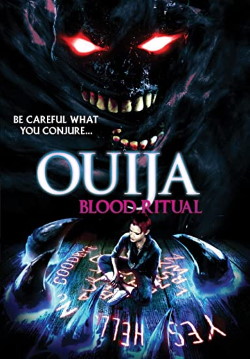
Ouija Blood Ritualwas released at the start of this month and it is a masterpiece.
I didn’t even want to buy it. It looked like just another micro-budget horror film. But Tempe just put out a Blu-ray of Ozoneand even though I have several copies, I had to get this version.
The problem is that Makeflix gives free shipping on orders over $30, and I’m really cheap about that. So I purchased Ouija Blood Ritual. And glad I am that I did!
The film is the brainchild of Dustin Mills. I haven’t seen any of his films before, even though he’s made a dozen and a half features since 2010. He is also a puppeteer, which raises him further in my estimation.
The Plot
Ouija Blood Ritual tells the story of three 20-somethings who are producing a YouTube video series that recreates rituals meant to summon ghosts and demons. Things like Bloody Mary.
Not surprisingly, their recreation of the summoning of Closet Man (the boogeyman who hides in your closet) actually works. Things go from uncomfortable to unnerving to terrifying from there
The plotting of it subtle and clever. There are a number of very tense points that aren’t necessarily directly related to the plot. Then there is an extra layer of psychological torture going on in the second half of the film that makes it almost unbearable.
Structure
It’s constructed as a found-footage narrative with two different groups. The second group’s video exists as a kind of film-within-a-film. But it’s also used effectively at the beginning to set the tone.
One element of the story that heightens its effectiveness is that Closet Man can grab your phone and use it to film what he sees. This is seen at the very start but it gets much more intense as the film unfolds.
Acting
What most struck me as I watched the first half-hour of Ouija Blood Ritual was how much I liked the three principal characters. And they all seemed very real. I was surprised to learn that they didn’t have a history of working together. In fact, they mostly hadn’t worked together at all.
The lead is played by Kayla Elizabeth (The Dead Will Rise 2). She’s the on-screen talent for the show who would like to leverage it to get a job in local news. The producer is played by Rob Grant who is understanding of the foibles of his colleagues even if he doesn’t hide his annoyance well. And the cameraman (who is also Kayla’s brother) is played by Dustin Mills himself.
The three come off very much like friends who are working on a project together. Then, when things start going wrong, they respond with the same concern and aggravation that you would expect. The acting was mostly ad-libbed, but I think it speaks well of the actors that they seem like they’ve known each other for years.
Technical Elements
Most of the effects in Ouija Blood Ritual are practical or editorial. Digital effects are also used, however. But only once in a major way and always in a way that added to the film.
The sound editing is exquisite — one of the main reasons the film works so well. It mostly consists of electronic noise. But it is how it is used that makes it effective. For example, there is one scene where Dustin is in his room sobbing and speaking into the camera. But all we hear is noise until the sound cuts to what he’s saying, “I can’t, Goddammit!”
I so often find myself annoyed at music in film making me feel things that the rest of the film would not. So it’s nice to not have any here. Even if we admit that noise is music, its use here only heightens what’s already happening. I think the film would still work with only the in situ sound.
As you can tell, I love this film. Now I’m going to have to dig into Dustin Mills’ old films.
Blu-Ray Details
The video and sound on the Blu-ray are excellent, but that’s not really my thing. Others may be less impressed.
When I looked carefully at some scenes, I saw a bit of aliasing, which is probably in the source material. And since the film is supposed to be found footage, it isn’t well lit. As with other films like V/H/S, not being able to see details is part of the appeal.
Commentary
The Blu-ray comes with a commentary by Dustin Mills. As solo-director commentaries goes, it’s pretty good. There is a lot of background information about the production. And I was pleased to hear him discuss the likability of the characters, which was a critical element of my enjoyment.
Interviews
There is a 7-minute interview with Kayla Elizabeth and 4.5-minute interview with Rob Grant. They don’t add much to what is in the commentary.
Misc Extras
The full footage (14:21) of the film-within-a-film adds a bit of context for the production.
I recently published a discussion about Lucio Fulci’s Gates of Hell trilogy. In it, I briefly discussed the ending of City of the Living Dead. I’ve given some thought to it, and I now think I understand it.
The Ending
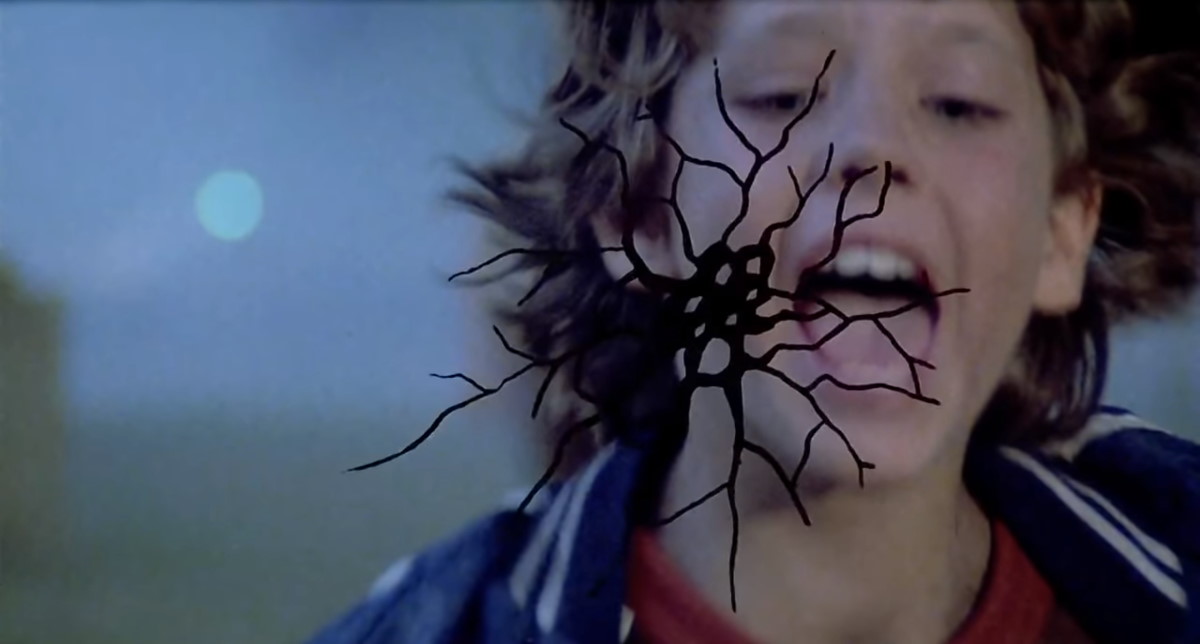
At the end of the film, Mary and Gerry have managed to kill Father Thomas and thus close the gate of hell. They come out of the tomb and see John-John, the young boy they had rescued after all his family was murdered. He runs toward them smiling.
Then they look concerned. We see John-John running toward the camera, still happy. But we overhear the survivors screaming. The shot freezes and then is cracked with black lines that expand to fill the screen. The end.
What Happened
It is widely claimed that the original footage shot was destroyed. That may be true. But it isn’t necessarily. What we do know is that Fulci decided, for whatever reason, that he couldn’t use the ending that was shot.
Clearly, whatever the original ending, it had to include something that Mary and Gerry saw and recast the happy ending it appeared we had reached was not a happy ending after all.
There isn’t a lot to work with here, though. They are in an isolated area. So:
Zombies could have appeared from out of the forest.
The police, who brought John-John to the tomb, could be zombies.
John-John could have been a zombie.
What most people say about the ending as it stands is that we are supposed to understand that John-John is a zombie. But so what?
Ending in Context With “Gates of Hell”
It doesn’t really matter who is a zombie or even how many zombies there are. When Mary and Gerry killed Father Thomas, all the zombies burst into flames. If there are zombies outside the tomb, well… Are they really back in the normal world?
Based on the ending of The Beyond, it would seem that the appearance of zombies means that they are rather in Hell itself. So they saved the world but imprisoned themselves in the process.
The other possibility is that they simply defeated Father Thomas and his minions but the gates of hell are still open. But in that case, what were the characters doing for the previous hour and a half?
Does the Ending Matter?
To be honest, I’d rather the film just end with the death of Father Thomas. As I mentioned before, City of the Living Dead is more of a cinematic nightmare than anything else. Sure, it has a plot and character. But the point is to horrify the viewer.
No one watching the film thinks, “I wonder what happened to John-John”! The scene outside the tomb seems tacked on. And it isn’t as though the world is now safe. There are seven gates of hell. What are the odds that a plucky psychic and harried psychologist will manage to show up to close the other six just in time?
The epilogue deprives the viewer of a satisfying ending. So instead of reflecting on the masterpiece that you just saw, you spend a bunch of time trying to figure out what you were supposed to take away from the ending.
City of the Living Deadis an exceptional film with a third act that kills (literally and figuratively). But I don’t think it’s deep. It isn’t the kind of film that is supposed to make you think. So don’t!
I’m going to pretend this epilogue doesn’t exist and that Mary and Gerry will always be standing in the tomb in front of the ash of Father Thomas.
The Cairnes brothers are a successful editor and director in the Australian TV industry. They know their craft and work with some great people.
Their first feature was the horror comedy 100 Bloody Acres, which everyone should see. It features a twisted sense of humor that should appeal to anyone who enjoys horror generally.
Scare Campaignis kind of odd. It’s really well made with a great performance by Josh Quong Tart. But I find the plot predictable. But I eagerly await their next film. These guys are great!
2 Young 2 Die
David Palmieri is a successful grip in Hollywood and on the side he makes micro-budget (mostly) horror films. Such people are really inspiring because they could just relax in their careers. But he continues to put out films.
I’ve only seen 2 Young 2 Die(AKA Axegrinder). It was one of his first films. It features some good gore and a plot that kind of makes sense. I’d definitely like to see more of Palmieri’s work.
City of the Living Dead (1980) and The Beyond (1981) and The House by the Cemetery (1981)
This is Lucio Fulci’s “Gates of Hell” trilogy and it is amazing. Every horror fan should own them. And of course that means that they haven’t been released together, as they ought to be.
Check out my article, The Gates of Hell Trilogy. It also includes a thorough round-up of the available versions. Sadly, City of the Living Deadhas been released really well only outside the US. If you only get one, I think The Beyondis the best. And most other people agree.
Housebound (2003) and The Seekers (2003) and Platoon of the Dead (2009)
I originally bought Platoon of the Deadwhen Tempe Video was closing down. It’s a good micro-budget zombie film. So I decided to look into the work of director John Bowker. There’s a double DVD with Housebound and The Seekers.
I hope to write an article looking at the progression of Bowker’s career. These two earlier films aren’t as good as Platoon. But they are still worthy and The Seekers was pretty fun.
The Birds (1963)
I grew up with The Birds. Because it was filmed locally, every time it came on TV, we had to watch it. I still enjoy it — especially Suzanne Pleshette and the bird-lover, Ethel Griffies.
BloodRayne: The Third Reich (2011) and Blubberella (2011)
These two Uwe Boll films were made at the same time. BloodRayneis a standard Nazi action film and Blubberellais a parody of it. They are both solid films, but the main reason to watch BloodRayne is that you will better enjoy Blubberella.
Death Ship (1980)
Death Shipfeels so much like it was made for TV but it wasn’t. It has its moments. I didn’t much like it but to be honest, I really don’t like George Kennedy.
The Funhouse (1981)
I love The Funhouse. It’s scary, has interesting characters, and looks fantastic. Wayne Doba as the “monster” is great. And I quite like Elizabeth Berridge. This is one of Tobe Hooper’s best.
The Ghost and Mr Chicken (1966) and The Incredible Mr Limpet (1964)
Don Knotts has not aged well for me. I find him kind of annoying. Yet these films work remarkably well. The Incredible Mr Limpetis the lesser of the two. It’s got a strange Cold War kind of plot that seems tacked on. Still, the animation is good and it’s sweet.
The Ghost and Mr Chickenis a surprisingly scary film. I don’t have any children, but if I did, I’d definitely use it to infect them with the Horror virus.
Hell of the Living Dead (1980)
Hell of the Living Deadis a Bruno Mattei “me to” film. It’s not great. But it features some awesome gore. Frankly, I’ve always found the conflict in Day of the Deadkind of annoying and it’s the same here.
Poison Sweetheartsis a series of short films — mostly about women who are pushed too far. It’s roughly horror but presented in a very artistic way. It’s worth a watch. I really liked one of the shorts.
The Unseen (1980)
This is one of those “Great horror films you’ve never seen” type of things. I’ve gotten tired over the years of having plots where I’m trying to figure out who the killer is. There’s none of that here. And the story is heartbreaking. I highly recommend The Unseen.
V/H/S (2012)
V/H/Sbrings together a number of fine filmmakers to create a bunch of connected shorts. What’s not to like? Even the poor lighting and limited resolution is used for great effect. I need to check out Siren, which was spawned by this film.