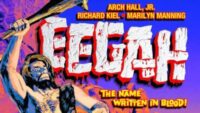
Eegah (1962) - Arch Hall Sr

Arch Hall Sr: Drive-In Producer

Arch Hall Sr in Eegah (1962)

Arch Hall Sr was born on 21 December 1908.

He lived an interesting life. Jack Webb immortalized him in the film The Last Time I Saw Archie. Hall was apparently writer William Bowers’s friend during World War II and effectively stole the idea. (Or not. It’s hard to tell.)

Before the war, Hall worked in radio and as a stuntman and bit player in the movies. But we aren’t discussing him for any of this.

In the early 1960s, Hall formed what was originally a distribution company and eventually a production company, Fairway International Pictures. It released roughly a dozen films through the early 1970s. This included a notable film that Hall had no direct association with, The Incredibly Strange Creatures Who Stopped Living and Became Mixed-Up Zombies.

Arch Hall Sr wrote and produced most of the Fairway films. Like exploitation filmmakers everywhere, he was just trying to make a buck. He produced films specifically for the drive-in market. And they seem to have done well because he kept making them. He made them on a shoestring, of course. They are a lot better than their budgets would indicate.

His son, Arch Hall Jr, starred in most of his films. He’s not bad! But Jr didn’t have the face of a star. But he grew into his face and could certainly have been a good character actor.

I haven’t seen most of Arch Hall Sr’s films. It might make for a good article to watch them all. At this point, I only remember watching his first two: Choppers and Eegah. Most people only know the latter because of Mystery Science Theater 3000. It’s a clever film. It seems so much bigger than it is. Plus, it is shot in color — not something common in early 1960s low-budget features. And it has a great surfer soundtrack, a cool jalopy, and a helicopter.

It also stars Richard Kiel — 15 years before he became a star as Jaws in The Spy Who Loved Me. Arch Hall Sr directed the film — his only. He does a fine job of it. I’m not sure why he didn’t direct again.

Let’s celebrate his birthday by watching the film!


Arch Hall Sr in Eegah (1962) via Wikimedia. It is in the public domain.

Slaughterhouse Five (1972) - George Roy Hill

George Roy Hill and “Old” Films

George Roy Hill

George Roy Hill was born in Minneapolis on 20 December 1921.

Most people don’t know who he was. But he was an icon of my youth. For the decade starting in 1967, he directed nothing but hits. Two of them were huge hits: Butch Cassidy and the Sundance Kid (1969) and The Sting (1973). He isn’t really a psychotronic filmmaker, although one of them qualifies (see below).

But Hill makes me think of my older sister. Whenever I tell her about a great film, she always says, “Is it new?” And I usually say something like, “Yes! It came out in 1973!” That, of course, is not what she means.

The weird thing is that when my sister was a teenager, she loved old films. She was always watching old musicals on TV. Now she mostly watches new comedies — usually ones I hate like Grown Ups (2010). Not that I’m judging. Whatever someone likes is fine by me. But I like idiosyncratic people and I wish she were binging Busby Berkeley.

But I’m an annoying guy. When everyone had iPods, I noted that I’d long had my own MP3 player. What’s more, I had atransistor radio as a child, and it just ain’t that different.

And today, we could ban filmmaking for the next century, and it wouldn’t much matter. There’s a ton of great films that no one watches because there aren’t multi-million-dollar ad campaigns selling them.

My point is: George Roy Hill made a lot of great films that are just as fun today as they were then.

So let’s celebrate the birth of George Roy Hill by watching his only film that clearly qualifies as psychotronic: Slaughterhouse-Five. Of course, it also won the Jury Prize at the 1972 Cannes. I’m not big on awards. But David Cronenberg got it for his exceptional Crash in 1996, so I’ll allow it.


George Roy Hill by Steelehill12 under CC BY-SA 4.0.

Mouse Hunt (1997)

Mouse Hunt and Anti-Fun Film Critics

Mouse Hunt (1997) poster

DreamWorks Pictures released Mouse Hunt (or MouseHunt) on 19 December 1997.

I loved this film when it first came out. Years later, I read the reviews, which surprised me. The critics didn’t much like it. How do you not like this film?!

But at least Roger Ebert had a good reason for disliking it. I’m kidding, of course. His review was one of the classics: “I didn’t like this film for no particular reason so I reverse engineered my review!”

He gave us all a lesson about how comedy works!

A comedy that hasn’t assigned sympathy to some characters and made others hateful cannot expect to get many laughs, because the audience doesn’t know who to laugh at, or with.

Silly me! All these years, I thought Annie Hall was a comedy! And The Producers! Animal Crackers too! How could I have been so foolish?! Or could it be that Ebert was a useless hack? It still amazes me that people considered him a serious critic. I can’t think of any film that he provided a keen insight for.

Anyway, in Mouse Hunt, we know where our sympathies lie. We don’t want the mouse hurt. We are sympathetic toward the brothers but that is secondary. And we hope for an ending that is good for all three. Shockingly, we get it! And it is one that pleases their dead father. Truly, what’s not to like?!

Critics struggle most with comedy. I have never heard a critic engage this problem. You can find a film hysterical at one time and boring at another. Critics need to address this problem rather than speculating about how a film is not funny in some Platonic sense.

Mouse Hunt is extremely silly. And much of it is over-the-top. This isn’t surprising. It is written by Adam Rifkin, who is a total nutball. And it is directed by Gore Verbinski, who also directed the first three Pirates of the Caribbean films. With that in mind, I don’t see how you can miss with this film.

Unfortunately, all the streaming copies of the film on my main source are dubbed into other languages. Right now (and for only about a week), you can watch it for free on Hoopla. Right now, I’ll embed the trailer.


Mouse Hunt (1997) poster via Wikipedia under Fair Use.

He Never Died (2015)

“He Never Died” Is 10 Years Old

He Never Died (2015) poster

Vertical Entertainment released He Never Died on 18 December 2015. It premiered in March at SXSW, which is a big deal.

I love this film. I put it on a lot when I feel that the justice is absent in the world. So I put it on a lot these days!

Writer-director Jason Krawczyk has a sly and dark sense of humor. And Henry Rollins in the lead plays it perfectly. But if you don’t pay attention, you can miss this. I recommended the film to a friend and she told me she shut it off after 10 minutes. I said, “You didn’t pay attention, did you?” She admitted she didn’t and had totally missed the humor. She put it on again and loved it.

It got good reviews — especially from people in the psychotronic community. But Matt Donato at We Got This Covered did not disappoint:

Herein lies the problem – can you really get excited about a character who can’t seem to die? No matter how many times Jack is shot, tortured, or thrown in a river, he always comes back meaner and badder than before.

I think video games have melted the minds of many people. True, Jack can’t die. That is his biggest problem! And despite not being able to die, he feels pain. That is his second biggest problem! That is the point of my favorite line in the film, “I have pliers in my head. It hurts.”

If you haven’t seen He Never Died, you owe it to yourself. There just isn’t much to say about it. It’s pure joy. Unfortunately, I can only embed a copy from DailyMotion. You can also watch it for free (with a library card) on Hoopla. Or, you can get the DVD (as I have). Sadly, the producers have never released it properly. Not that they need to. It isn’t a film you need to learn about. Just watch and enjoy.

Here is a free copy:


Jason Krawczyk also directed The Briefcase, which is a very fun film. And I now see that he released another film last year (which I haven’t seen), Don’t Mess With Grandma.


He Never Died (2015) poster via Wikipedia under Fair Use.

King Kong (1976)

“King Kong” (The “Bad” One) Released

King Kong (1976) poster

Paramount Pictures released King Kong on 17 December 1976.

You can’t really remake a classic and expect critics to applaud you. Critics didn’t universally hate the 1976 King Kong. They mostly just dismissed it. I am one of those who dismissed it. I saw it at the time. And I thought it was stupid. In particular, Kong looked like a smiling idiot.

But I watched the film again recently. This time, I watched it with a positive attitude. And it really is rather good.

I am not fond of the presentation of the natives of Skull Island, but they aren’t any worse than in the Peter Jackson King Kong. The worst thing in that regard is the female lead. Dwan (the Ann Darrow character) is annoying because she acts more like a 13-year-old than a 26-year-old.

The film has a ton of 1970s-era cynicism. And it squashes Fred S Wilson (the Carl Denham character). So we lose the line, “It was beauty killed the beast.” But given the nature of the film, that’s probably for the best.

Overall, it’s a fun watch. And we are going to watch it! But if you ask me, A*P*E is better. In the days before The Asylum, different producers created cheap knock-offs of upcoming blockbusters.

But A*P*E isn’t just ripping off Dino DeLaurentis’s production. It is also mocking it. And despite having a tiny budget, the ape doesn’t look much worse than it does in King Kong. According to some, the production cost just $23,000. That’s $134,000 today. I find this extremely hard to believe. But it was definitely a low-budget production.

If you would like to watch A*P*E, I encourage you to do so. There is a good print you can watch for free. But I’m highlighting King Kong. It’s not great. And it doesn’t feature any fighting with a shark. But it is fun!


King Kong (1976) poster via Wikipedia under Fair Use.

Minority Report - Philip K Dick

Philip K Dick in Hollywood

Philip K Dick

Philip K Dick was born on 16 December 1928.

Dick is one of the most important science fiction writers of the 20th century. I used to be a fan of his. I’m not so much anymore. Now, I’m more interested in his effect on film.

As a writer, he was no stylist. He had some interesting ideas. He wrote interesting and usually engaging stories and novels.

Politically, Dick was a leftist. But had he lived longer, I think he would have turned reactionary right. His work has a shockingly positive view of the police. “The Minority Report” is the most fascist-friendly work of Dick’s I’ve read. Ultimately, I believe his paranoia would have turned him into that special form of American libertarianism that is an easy mark for fascists.

But he didn’t turn because he died at the age of 53. And his later life was tragic as his long-time mental health problems became worse. So I don’t mean to dump on the guy. He was a mess. And that’s sad.

Overall, the films based on his work are better. But they also often flip exactly what he was saying on its head. Let’s look at three biggest films:

  • Blade Runner (1982): Based on the novel Do Androids Dream of Electric Sheep? (1968). Everything is upside down in this. Dick’s novel is more realistic where real animals are expensive and the mechanical ones are what the poor get. Also, Deckard is not a replicant. Making him so is a big problem with the film.
  • Total Recall (1990): Based on the short story “We Can Remember It for You Wholesale” (1966). Again, in the film, Quaid is delusional; in the story, Quail is really a secret agent.
  • Minority Report (2002): Based on the short story “The Minority Report” (1956). Anderton is set up in both. But in the story, he is set up by someone who wants to destroy Precrime. It ends with Anderton accepting punishment in order to save Precrime — the opposite of the film.

I love all these films! And they never would have been made without Philip K Dick. So to celebrate his birthday, let’s watch Minority Report, which I think does the most to improve upon the original. (Lois Smith is absolutely fabulous here!)


Philip K Dick via Wikimedia. It is in the public domain.

Young Frankenstein (1974)

“Young Frankenstein” and the Narcissism of Mel Brooks

Young Frankenstein (1974) poster

20th Century Fox released Young Frankenstein on 15 December 1974.

It is the only Mel Brooks film that works completely. His script for The Producers was fantastic. But his direction of it (despite many people trying to help him) was pathetic. It’s still funny. But it’s also hard to watch.

Blazing Saddles has its moments. I’m very fond of the parts that involve Cleavon Little. But so much of it is just embarrassing. And the ending is terrible. Then there were Silent Film and High Anxiety, the first signs that Brooks had given up trying to do anything good. Everything after that is unwatchable. (I will give him credit for at least trying in Life Stinks.)

But let’s talk about Young Frankenstein. The direction is fine. There are annoying parts — like the quick zooms. But Brooks had clearly learned a lot since the disaster that was The Producers. Better was the production. But it is the script and the cast that really make it work.

The idea was Gene Wilder’s. Toward the end of his life, he was going everywhere telling a story about the writing of it:

I would write all day. And he would come over after dinner. “Yeah, yeah, yeah. We need a villain. The Bürgermeister isn’t a good enough villain. We need a real villain.” And one night he comes over and looks at the pages and says, “You tap dance to Irving Berlin? In top hat and tails with the monster? Are you crazy? It’s frivolous.” And I started to argue and I argued for about 20 minutes til I was at least red in the face. I think it may have been blue. And all of a sudden, he says “Okay, it’s in!” And I said, “Why did you put me through this?” And he said, “Because I wasn’t sure if it was right or not. And if you didn’t argue for it, I knew it was wrong.”

When I first heard this, I thought Wilder was suffering from Stockholm syndrome. But over time, I realized what he was doing. He was laying claim to the best thing in the film. He knew if he left it, Brooks would eventually take credit for it. So he pretends that Brooks had some brilliant way of sniffing out comedy. Fine. Throw the man a bone. At least Wilder gets credit.

But note that Brooks was not doing that! Brooks was jealous. And he would rather harm the film than admit that. But given the level of Wilder’s pushback, Brooks relented.

Listen to Mel Brooks himself talk about the writing. Basically: nothing. Note that he talks about the “nights” of writing. But it’s clear from what Wilder said that Brooks wasn’t there during the days when the writing was actually done. In other words, Brooks was overseeing the writing. Most directors would not take screenplay credit. But Brooks did because he’s a narcissist. (Note that Brooks and Wilder never worked together again — remarkable after doing such a hugely successful film.)

Brooks did much the same thing to Andrew Bergman on Blazing Saddles. Check out this hilariously small text for story credit:

Blazing Saddles - Story Credit
Screenplay credit for Blazing Saddles used under Fair Use.

There are clearly things in the film that Brooks wrote. “Walk this way…” is a joke that has never aged in almost a century of him repeating it. “Call it a hunch!” is another Brooks winner that would have killed in the Catskills! I’m sure Brooks took the final script and punched it up with a lot of old jokes. But it still works.

I dread next June when Brooks will turn 100 and I will have to see the world gush about how great he is and how hilarious Spaceballs and Robin Hood: Men in Tights are. I’m not saying he’s terrible. But he’s the Alfred Hitchcock of comedy. He’s done some good work. But he ain’t the genius people assume he is.

But let’s watch his one unquestionably great film, Young Frankenstein.


Young Frankenstein (1974) poster via Wikipedia under Fair Use.

My Name Is Bruce - Ted Raimi

Ted Raimi Is a Great Actor

Ted Raimi

Ted Raimi was born on 14 December 1965. So he’s 60 years old today. Little brother is all grown up!

I have a soft spot for the man for a reason that has nothing to do with his work. His older brother Sam has bragged about mistreating him during the making of early films. And I know about this. It is typical of “man culture.” And it’s nonsense. I hope Sam eventually grew up. But even if he didn’t, I’m used to admiring films made by awful people.

But back to Ted.

Most of my friends love Ted Raimi. But they also think he is a bad actor. He’s not. He’s a fine actor. But he has no sense of shame. He’ll do anything. And if you are a psychotronic fan, you have to love that.

And don’t be surprised if over the next ten years or so, he gets a “serious” role that garners him an Academy Award nomination. Think Peter Fonda in Ulee’s Gold. If you watch Raimi in things like The Midnight Meat Train and the TV series SeaQuest DSV you see a bit of what he can do in serious roles. Even early in his career, he was great in Skinner.

So I don’t want to hear anymore about Ted Raiming being a weak actor!

Having said that, I most love him in his over-the-top comedic roles. One of my favorite films (With no caveats!) is Man with the Screaming Brain. And Ted is the best thing in it. Yes! Even better than Bruce Campbell’s milk scene!

But to celebrate Ted Raimi’s big six-oh, let’s watch My Name Is Bruce. In it, he plays three characters. First, he’s Mills Toddner, Bruce’s incompetent and unethical agent. He also plays Ted the Sign Painter, an offensive Italian stereotype. And finally, he plays Wing, an offensive Chinese stereotype. But somehow the offensive stereotypes aren’t because he brings a lot of humanity to them.


Ted Raimi by GabboT under CC BY-SA 2.0.

Chitty Chitty Bang Bang - Dick Van Dyke

Dick Van Dyke at 100

Dick Van Dyke

Dick Van Dyke is 100 years old today. And the midwestern actor seems to be doing well. He might well outlive Kirk Douglas, who died at 103. Or even Norman Lloyd, who died at 106.

People don’t associate him with psychotronic film. After all, he’s the friendly man who played Rob Petrie on that show that is ridiculously titled The Dick Van Dyke Show. (And yes, I think the same of The Mary Tyler Moore Show — even though Mary Richards at least shares a first name!)

But Van Dyke played a much broader set of roles than most people think. I remember this upset me as a child. I didn’t like seeing him play a murderer on Columbo (even though he was somewhat sympathetic).

Let us not forget: films like Mary Poppins are psychotronic. You see boys and girls, there was a time when films like that were thought to be made for children. It wasn’t the kind of stuff adults went to see alone. Admittedly, the big budget did make the critics swoon. But people did look down on adult viewers who took it seriously.

Van Dyke did perform in some edgier films. In The Comic (1969), he plays a narcissistic silent film comedian whose life slowly falls apart. In The Runner Stumbles (1979), he plays a Catholic priest who has an affair with a nun, who ends up murdered with him looking guilty.

He was also in a number of generally strange films. These include The Art of Love (1965), Lt Robin Crusoe, USN (1966), and Cold Turkey (1971).

But today, we celebrate Dick Van Dyke’s 100th birthday by watching Chitty Chitty Bang Bang. As a child, both The Last Man on Earth and Jaws gave me nightmares for years. But neither were as disturbing while watching as this supposed kids’ film. I hope it doesn’t disturb you too much!


Dick Van Dyke via Wikimedia. It is in the public domain.
The Golden Voyage of Sinbad - Gordon Hessler

Gordon Hessler After One Century

Gordon Hessler

Gordon Hessler was born on 12 December 1925 in Berlin, Germany. Lucky for him, he grew up in England. He lived there most of his life.

He was a notable director in both film and television. But we are most interested in his work for American International Pictures.

Hessler started his career as a story reader for Alfred Hitchcock Presents. He leveraged this to get his first directing job for the episode “Final Arrangements.” It starred Martin Balsam and Vivian Nathan. He was associate producer when the show morphed into The Alfred Hitchcock Hour. After this, he directed two feature films and produced some TV.

He got a big break with AIP in early 1969. Michael Reeves was in pre-production for The Oblong Box. But he died from an accidental overdose of barbiturates. So AIP hired Gordon Hessler to direct and produce the film.

Hessler went on to direct three more AIP films: Scream and Scream Again, Cry of the Banshee, and Murders in the Rue Morgue. He then bounced around a bit. This culminated in his biggest film, The Golden Voyage of Sinbad. It is a thankless job to direct a Ray Harryhausen film. But Hessler did a great job — showing off his usual distinct visual style.

He could have continued to direct theatrical releases. But he chose to go back into TV. He directed numerous TV movies as well as episodes of iconic TV series like Kolchak: The Night Stalker, Kung Fu, Hawaii Five-O, Wonder Woman, and CHiPs.

Let’s celebrate Gordon Hessler’s 100th birthday by watching his most psychotronic film, The Golden Voyage of Sinbad.


Gordon Hessler via Mémoires de Guerre via Fair Use.