Author Archives: Frank Moraes

Frank Moraes is a freelance writer and editor online and in print. He is educated as a scientist with a PhD in Atmospheric Physics. He has worked in climate science, remote sensing, throughout the computer industry, and as a college physics instructor. Find out more at About Frank Moraes.
THX 1138 (1971)

“THX 1138” Is a Little Gem

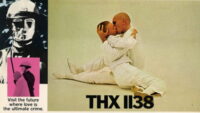
THX 1138 (1971) poster

Warner Bros first released THX 1138 in the United States on 11 March 1971.

The film is well-known. It was George Lucas’ first feature-length film. But American Zoetrope produced it with backing from Warner Bros. So it has a notably larger budget than you would think. The film cost about three-quarters of a million dollars. That’s roughly $6 million today.

THX 1138 is probably my favorite of Lucas’ films. Of course, I’m not a huge fan of his. He’s a good producer and director but I find his ideas pretty limited. That has worked out really well for his career. He never gets too far ahead of his audience.

But in this film, he shows off his excellent visual sense. Even if you aren’t that into the story, this film is enjoyable to look at.

The film tells a very typical dystopian story for its time. It reminds me of John Christopher’s young adult books The Tripods.

THX lives in an emotionless world. The society drugs everyone to keep them working. His roommate changes his medications so that his sex drive comes back. She gets pregnant and they go to prison. She is killed. And he escapes.

All psychotronic fans should see this film. It isn’t as good as Phase IV. But George Lucas could have been killed on his way to the premiere. And this film would still be a little gem that genre fans love.


THX 1138 (1971) poster via Wikipedia under Fair Use.
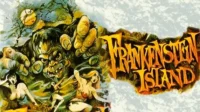
Frankenstein Island - Jerry Warren

Jerry Warren Put Together Films

Jerry Warren

Jerry Warren was born on 10 March 1925.

Warren is a unique filmmaker — even by psychotronic standards. He produced and directed a small number of films. But mostly, he purchased foreign-language films and edited them for American audiences.

La Momia Azteca — better known here as The Aztec Mummy — is a great example of this. He created Attack of the Mayan Mummy. As usual when he did this, he did not simply dub the film. He shot new scenes with American actors and added voice-over to explain the significantly different plot. The original Godzilla was the same. This is why you really need to see the Japanese- and English-language versions. I don’t think the same about The Aztec Mummy.

The Wild World of Batwoman got the Mystery Science Theater 3000 treatment. I’m sure I’ve seen it since it was during the Comedy Central days and I’ve seen all of those. It isn’t one of Warren’s better outings despite (or because of) his writing the screenplay.

Some other titles are worth a look. But they can be hard to get through. The Incredible Petrified World is pretty boring. But it does show that you can make a film in which almost nothing happens. Terror of the Bloodhunters is a more interesting specimen. It features two men and a woman escaping from an island prison. You’d think it would be exciting! It’s really not.

My directing is what is adequate for the type of films I wanted to put together.

–Jerry Warren

And then there is Teenage Zombies. I think it is one of Warren’s better films. There’s nothing in it that stands out. But it works. Warren’s wife that that time was Brianne Murphy. She had a small role in this film. But she would go on to be an important cinematographer. She was the first woman to join the American Society of Cinematographers (ASC) Guild. They divorced around the time that film was released.

But I am currently writing a book about Frankenstein on film. So we have to watch Jerry Warren’s last film, Frankenstein Island. Well… It is dorky in a charming way. And it has a surprisingly good cast. The sets are terrible. And for the husband of one of the most important cinematographers of the late 20th century, it is shot in a strikingly dull way. But it’s fun — especially if you know what you are getting into!


Jerry Warren image cropped from a larger picture in Return of the B Science Fiction and Horror Movie Makers under Fair Use.

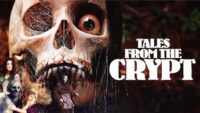
Tales From the Crypt (1972)

“Tales From the Crypt” and EC Comics Films

Tales From the Crypt (1972) poster

Cinerama Releasing Corporation put out Tales From the Crypt in the United States on 9 March 1972. Despite it being a British (Amicus) production, it was first release there. It didn’t appear in the UK until 28 September 1972.

When I was a kid, EC Comics were just about the only comic books that I liked. I was, for obvious reasons, focused mostly on the horror titles. But I liked the rest — even the war and crime titles. This is probably due to the moral clarity of all their stories and their heavy use of revenge for their denouements.

It may surprise some readers to learn that I have generally been unhappy with filmed versions of these titles. I mentioned this in my capsule review of Tales From the Crypt. The three main horror titles featured jokey narrators who presented the stories. It was not high-brow humor. But it worked really well. It took the edge off the horror.

But we’ve learned a lesson about this just as we learned it about Stephen King’s novels. Things that work well on the page don’t necessarily work well on the screen. And horror puppets spitting out puns to introduce horror shorts don’t work!

And that’s why Tales From the Crypt works well. It’s all done straight. The Crypt-Keeper is here but he’s serious. And Ralph Richardson! It was followed with The Vault of Horror, which was produced the same way. No jokey puppets!

Interestingly, this was the first film based on the EC horror titles. It was only later that producers tried to make the connective bits humorous. These two Amicus films were co-produced and written by Milton Subotsky. Like me, he was a fan of the comics. And I think he understood that the jokes wouldn’t work. Later producers and writers were not as wise!


Tales From the Crypt (1972) poster via Wikipedia under Fair Use.

The Lady in Red (1979) - Lewis Teague

Lewis Teague Can Tell a Story

Lewis Teague

Lewis Teague turns 88 today. He was born on 8 March 1938.

Teague is YACD — Yet Another Corrman Director. I don’t think Corman should get a lot of credit. He was just around at the right time to hand out small amounts of money to make films. It’s not like he was developing talent. He was just using the talent that was available.

This all shows that there is a lot of talent in the world. It just needs the opportunity to express it. I think this is why Canada produces so many great artists. But that’s a subject for another time.

Lew Teague has made a number of fun films. That’s what he’s known for. No one makes a big deal of his style. I love that! I’ve come to see directors known for their style as directors with tics. Like Stanley Kubrick and his overuse of symmetrical composition. You may consider it brilliant, but I consider it boring.

Teague is known for being an efficient director. But I think of he more like Clint Eastwood: someone who was focused on telling a compelling story. But in Teague’s case, those stories can be bizarre like sewer alligators!

He is perhaps most notable for making two films based on the work of Stephen King that were actually good! This has been a big problem over the years. King’s writing doesn’t lend itself to film. But Cujo and the anthology film Cat’s Eye are both great.

He also made two excellent films with John Sayles. First was the crime drama The Lady in Red. And then the monster movie Alligator. (They also worked together on the TV pilot Shannon’s Deal.)

So let’s watch The Lady in Red. It’s a remarkable film with a remarkable screenplay. And Quentin Tarantino called it a “miracle.” And given the budget, I think that’s accurate.


Image cropped from Lewis Teague by Rodleen Getsic under CC BY-SA 3.0.

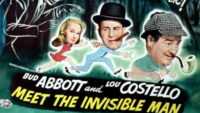
Abbott and Costello Meet the Invisible Man (1951)

“Abbott and Costello Meet the Invisible Man” Meets Psychotronic Review

Abbott and Costello Meet the Invisible Man (1951) poster

Universal-International released Abbott and Costello Meet the Invisible Man on 7 March 1951.

Abbott and Costello made a number of “horror” films for Universal. And these started in 1949 with Hold That Ghost. But they quickly followed it with Who Done It? Then came five “meet” films:

  • Abbott and Costello Meet Frankenstein (1948)
  • Abbott and Costello Meet the Killer, Boris Karloff (1949)
  • Abbott and Costello Meet the Invisible Man (1951)
  • Abbott and Costello Meet Dr Jekyll and Mr Hyde (1953)
  • Abbott and Costello Meet the Mummy (1955)

What are we to make of these films? Should we be grateful because they kept the Universal monsters alive in the public mind? Or should we hate them because they trivialized these horror icons?

I think this is a question that honest people can answer differently. If you love these films, that’s great! Films are meant to be enjoyed, not criticized. But obviously, I disagree. I’m not interested in them. I think they take away from the earlier great films.

There are two competing interests with regard to film. On the one side, there is what I will call art. This is the effort to make something that is good. On the other side, there is commerce. But I don’t place one above the other. I understand that films need to make money. And the fact is that in the 1940s and 1950s, Abbott and Costello made money! And they were also masters of their art.

I have a different problem. The Universal monsters were a cash grab. Bela Lugosi recieved a payday for Frankenstein. So that’s good! (He was also on The Abbott and Costello Show.) But otherwise, I wish they didn’t exist.

It doesn’t help that I am just not that fond of Abbott and Costello. Even as a kid, I didn’t find them very funny. So I’m clearly not the target audience. But these films are quite watchable. Here is Invisible Man.


Abbott and Costello Meet the Invisible Man (1951) poster via Wikipedia under Fair Use.
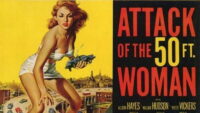
Attack of the 50 Foot Woman - Allison Hayes

Allison Hayes and Her Amazing 1957!

Allison Hayes

Allison Hayes was born on 6 March 1930.

I am talking about her today because she starred in one of my very favorite films, Attack of the 50 Foot Woman. In terms of 1950s science fiction, it is the best film — only Them! comes close. And no, The Thing from Another World, as good as it is, is nowhere near as good.

And what makes this film great is Allison Hayes because of the fragility of her performance. That’s what sells it. If you don’t love her, you don’t love this film. I think the rest of the cast is great too. In particular, Yvette Vickers is fantastic as the woman you love to hate. But that means nothing without Hayes.

In 1957, Hayes starred in a number of low-budget films:

  • The Undead: A Roger Corman film about a woman (Pamela Duncan) sent back to the Middle Ages via hypnosis, Hayes plays a witch in that time who can change into a cat.
  • Zombies of Mora Tau: Edward L Cahn directed this B-picture about divers looking for treasure. Unfortunatey, it is guarded by zombies. Hayes plays the “bad” woman who sides with the zombies.
  • The Unearthly: Boris Petroff directed and produced this film featuring John Carradine as a mad scientist and Tor Johnson as his assistant. Hayes plays the beautiful woman who must be saved.
  • The Disembodied: Walter Grauman (Lady in a Cage) directed this jungle voodoo film. Hayes plays a native woman (in dark make-up) who married a western doctor. It’s the kind of role that Yvette Vickers would have been great in!

And the following year, Allison Hayes made 50 Foot Woman. But she didn’t even work for another decade. She suffered from an undiagnosed illness. Doctors dismissed it, as was typical for the time — and still pretty common. She ultimately developed leukemia and died at the age of 46.

Let’s watch Attack of the 50 Foot Woman. I’m always up for it!


Allison Hayes via Wikimedia. It is in the public domain.

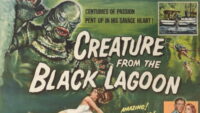
Creature From the Black Lagoon (1954) poster

“Creature From the Black Lagoon” and Modest-Budget Horror

Creature From the Black Lagoon (1954) poster

Universal-International released Creature From the Black Lagoon regionally on 5 March 1954.

When I was a little boy in the late 1960s and early 1970s, local TV stations played this film all the time! I didn’t understand this. I didn’t hate it. But I also wasn’t especially fond of it. Then I watched it as an adult and it blew me away!

Black Lagoon seems like a low-budget film. But it isn’t. For example, the Gill-Man suit was not cheap! Milicent Patrick, Bud Westmore, Jack Kevan, and Chris Mueller Jr designed and built it for $15,000, according to Jeff Rouin in The Fabulous Fantasy Films. Overall, the film cost somewhat more than half a million dollars. That’s about $6 million today.

This doesn’t mean they are swimming in cash. It just means this was a professional production. All the principal actors had notable careers outside this film. That’s even more true of the people working behind the camera.

Creature From the Black Lagoon tells a pretty standard psychotronic story. An ancient creature thought extinct is actually alive. And it wants our women!

Universal-International next produced the weak follow-up, Revenge of the Creature. It’s pretty much the same film. Then came the arguably best film of the set, The Creature Walks Among Us. The first two films were shot in 3D. Revenge became the first 3D film broadcast on TV.

Films like this make me despair for film viewers. If people just sat down and watched Black Lagoon, they would enjoy it. But in this modern world, people seem only willing to watch films that have been sold to them. The selling seems to be more important than the writing, acting, and filming.

But Creature From the Black Lagoon is a classic for a reason. And all psychotronic fans should see it!


Creature From the Black Lagoon (1954) poster via Wikimedia. It is in the public domain.

The New York Ripper (1982)

“The New York Ripper” and Rough Films

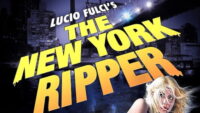
The New York Ripper (1982)

77 Cinematografica released The New York Ripper in Italy on 4 March 1982.

Have you ever wondered if you are a psychotronic fan? Do you have doubts that maybe you just like the occasional odd film but that you aren’t a true psychotronic fan? Well, I have a test for you! Watch The New York Ripper!

Here’s the thing. This film is rough! Okay. It is not rough the way I Spit on Your Grave is! But in some ways, it’s worse. We see events through the perspective of the murderer. And the murder turns out to be rather too much like the kind of people who enjoy psychotronic films!

I mean no offense! I am one of the biggest fans of these difficult films. But part of that is realizing that I too contain multitudes. I am non-violent. But films like this bring up disturbing ideas. And I like grappling with them.

This may sound horrible. But I think it is not. And that’s even more true today when films commonly present torturers in a positive light. I never see them this way. And in watching The New York Ripper, I never think of the killer as anything but a fiend. And we aren’t left with the killer roaming the streets because “there are still horrible people in the world.” The police kill him. Shot in the face, in fact. (Not before his girlfriend fatally stabs him in anything but a horror film!)

Most people find the sex in the film disturbing I don’t. Human sexuality continues to be odd to me. So I’m not judgmental. Whatever works for people in fine by me. And in this film, strange sexual habits have nothing to do with the violence on screen. In fact, you might say a healthy attitude toward sex pushes against violence.

Regardless, The New York Ripper is a great film. It’s not close to my favorite film from Lucio Fulci. But it is essential viewing!


The New York Ripper (1982) via Google Play Store under Fair Use.

Absentia (2011)

“Absentia” and Low-Budget Brilliance

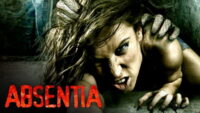
Absentia (2011) poster

The Fargo Film Festival presented Absentia for the first time on 3 March 2011. It continued to make the festival rounds before Phase 4 Films acquired the streaming and DVD rights on 1 July 2011.

Today, people know this film because Mike Flanagan has become a big deal. He is now a horror icon. He has written some of the best horror series ever produced. These include The Haunting of Hill House, The Haunting of Bly Manor, Midnight Mass, The Midnight Club, and The Fall of the House of Usher. Every one of them is great. Psychotronic fans should search them all out.

But Absentia shows that Flanagan doesn’t need a big budget to do great work. It blew me away when I first saw it. So many filmmakers only succeed with big budgets. This is why every movie star makes passable films when they direct. I think there should be a law. We should force them to make a feature with a hundred grand first. That would stop most of them from wasting our time!

And the film is heartbreaking at its very base. When the husband is barfed back it takes a sad situation and turns it into tragedy. I also find the terrible police response to be very believable. The sister has a drug problem? That certainly explains what’s going on. The husband comes back emaciated after seven years, and so he’s suspect. Even in a world of supernatural horrors, humans are horrifying.

If you haven’t seen it, I highly recommend spending 90 minutes with it. Absentia is great!


Absentia (2011) poster via Wikipedia under Fair Use.

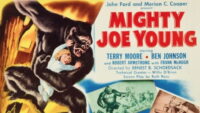
Mighty Joe Young - Willis H O'Brien

Willis H O’Brien and Stop-Motion Animation

Willis H O'Brien

Willis H O’Brien was born on 2 March 1886.

Before there was Ray Harryhausen, there was O’Brien. In fact, the two men worked together. And if you look at Harryhausen’s work, it isn’t any better. The main difference is that there is more of it.

He got his start on a silent short in 1915, The Dinosaur and the Missing Link: A Prehistoric Tragedy. It’s a silly comedy using stop-motion animation. He made several others, including The Ghost of Slumber Mountain in 1918. It was the first film to combine stop-motion animation and live action footage.

O’Brien became something of a star with the release of The Lost World in 1925. It is a silent film with animation that isn’t any better than his earlier work. But there is far more of it. It is way more detailed. And it is crystal clear. It is available at full length for free on Wikipedia.

And then, of course, came King Kong. And then the silly but fun Son of Kong. After these, he didn’t get the opportunity to do much similar work. For the next 15 years, he did other kinds of special effects — especially matte painting. And that’s cool! That stuff allowed people to present stories they simply could not afford to otherwise.

But 1949 was a big year. He was Technical Creator of Mighty Joe Young. O’Brien hired Ray Harryhausen as First Technician. ARKO Productions got the Academy Award for Best Special Effects for the film. O’Brien certainly would have won for King Kong but the catagory didn’t exist at that time.

So, let’s celebrate Willis H O’Brien’s birthday by watching Mighty Joe Young. It’s a good film and the special effects stand up really well today. Harryhausen used some of the same techniques almost two decades later in One Million Years BC.


Willis H O’Brien via Oakland Library under Fair Use.